Friday, April 19, 2019

What’s in a Name? The Difference Between Longswords and Bastard Swords in the Fechtbücher


 Many of those who study medieval swords can be somewhat cavalier (pun intended) regarding the precise lexicology of sword types.  It is to be hoped that any who consider themselves serious students of the subject will understand that the term “broadsword” refers not to large, heavy cruciform swords of the type hoi polloi mean when they use the term, but rather to basket-hilted, double-edged swords of the type developed in England.  Some terms, however, remain indistinct or confusing, even among the cognoscenti, especially the term “bastard sword.”

Many sources tend to lump bastard swords together under the broad heading of longswords (I do so myself in my unarmored longsword book, to my shame), and yet a careful study will show a distinction between the two terms, and, indeed, we see that distinction made manifest in the Fechtbücher, as this essay will demonstrate. In this essay, I will urge the sense of the term taught by the great Ewart Oakeshott, who referred to bastard swords as “hand-and-a-half” swords, meaning that they fell between arming swords and longswords, and could be used as easily with one hand on the hilt as with two [1].  Conversely, we will limit the term “longsword” to swords which are generally used only with two hands on the hilt (except in armor, of course) because using them one-handed, while possible, would be awkward.

That definition is not absolute in the literature.  For example, in 1801 Joseph Strutt referred to a bastard sword as “A sword without edges or point.” [2] However, as early as 1617, Joseph Swetnam referred to: “The Bastard Sword, the which sword is something shorter than a long sword, and yet longer than a short sword.” [3] The term “hand-and-a-half sword” only dates to the late nineteenth century [4], but it seems clear this is what Swetnam meant and we will hold that term to be synonymous with bastard sword.

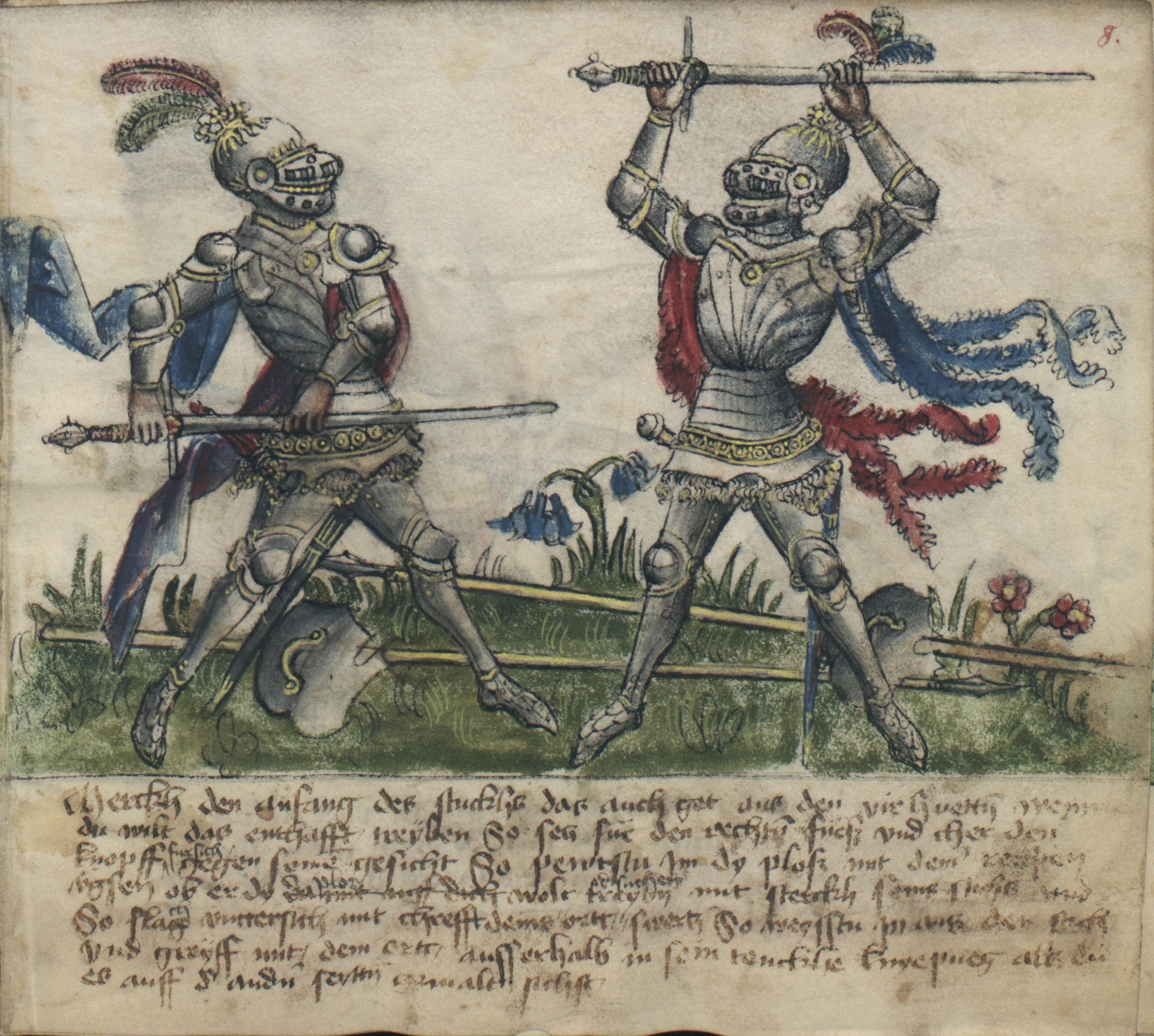
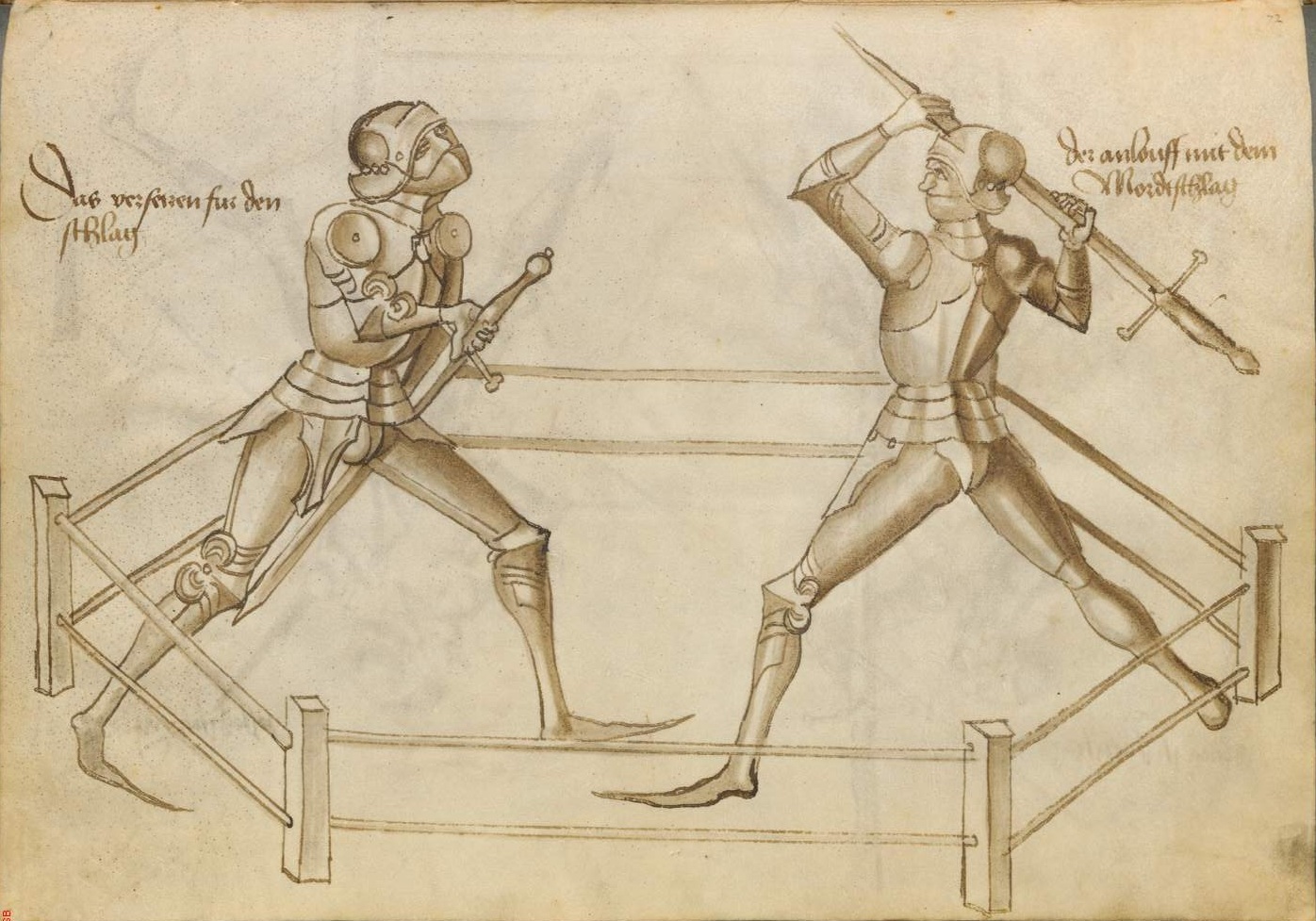
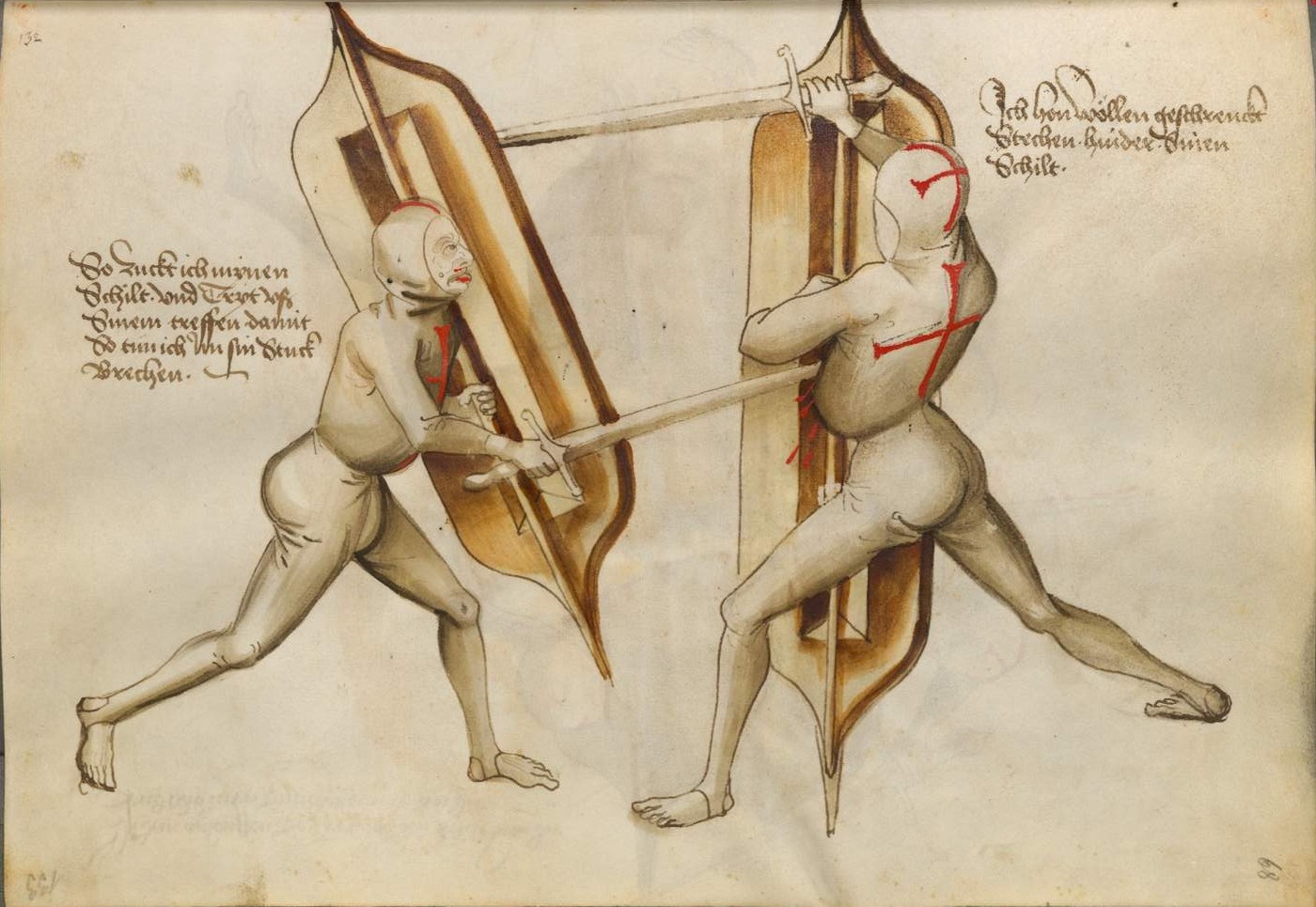
This distinction between bastard swords and longswords shows up in the Fechtbücher.  When we look at the Gladiatoria Fechtbuch from the first half of the fifteenth century, for example, we see similar swords used both in an out of armor.  All of the swords in that source, whether used in armored combat or out of armor with a Langenschilte or buckler seem to be bastard swords, with hilt and blade lengths appearing to be the same for all (note, however, that this source does not contain any unarmored longsword combat).
Longswords in Harnischfechten in Gladiatoria:  http://wiktenauer.com/images/7/74/MS_Germ.Quart.16_08r.jpg
Sword and Langenschilt in Gladiatoria: http://wiktenauer.com/images/1/18/MS_Germ.Quart.16_54v.jpg

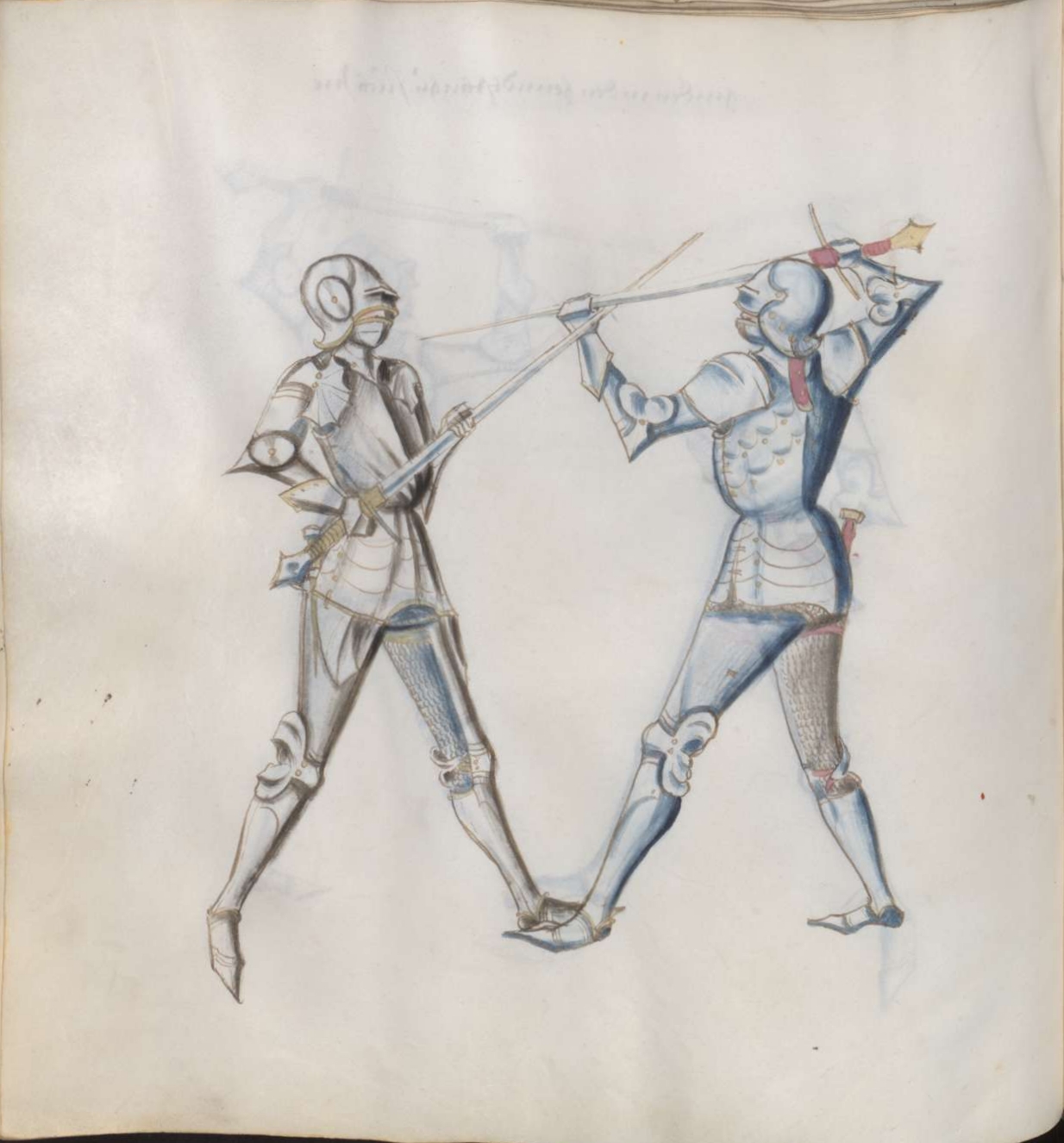
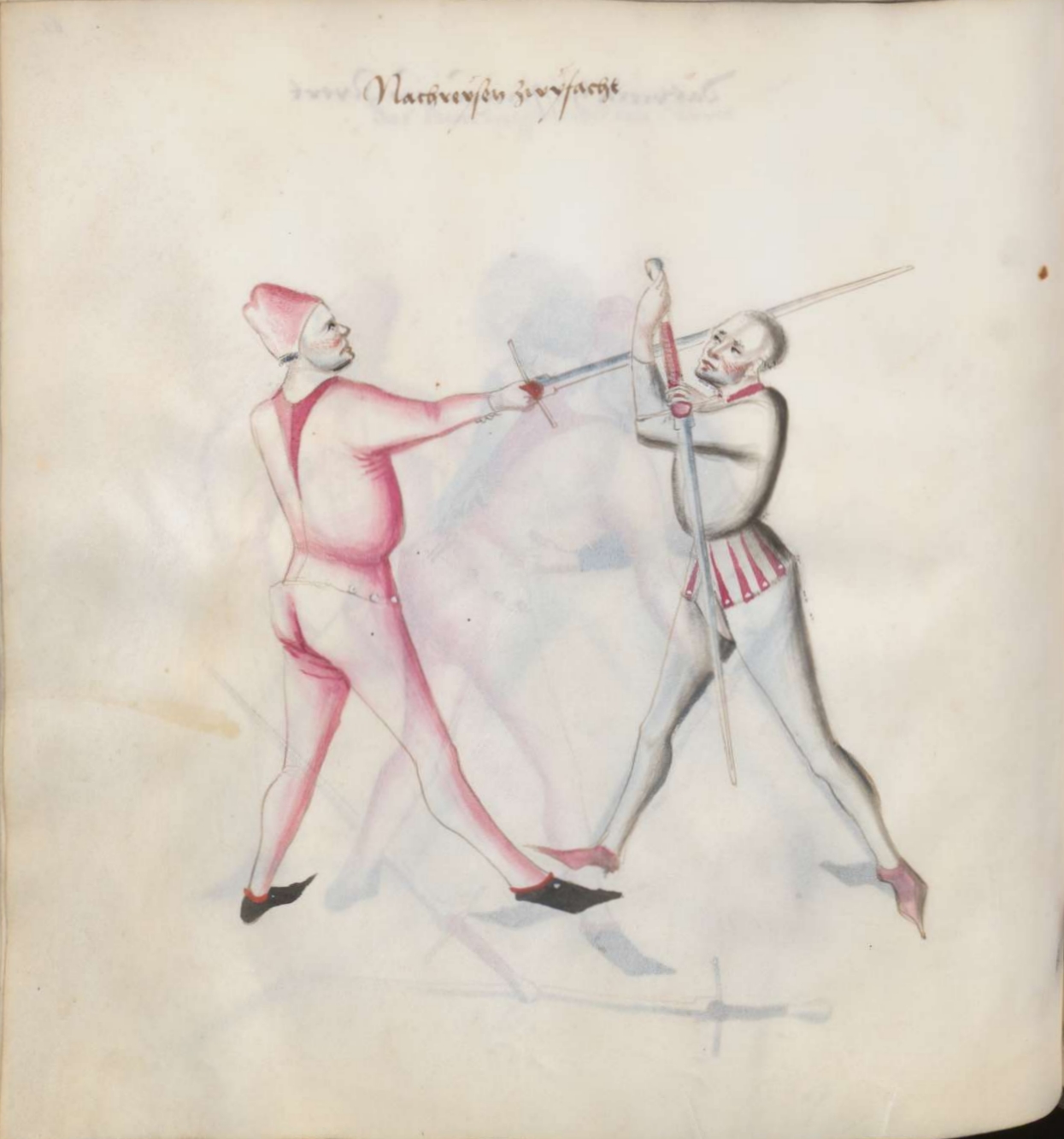
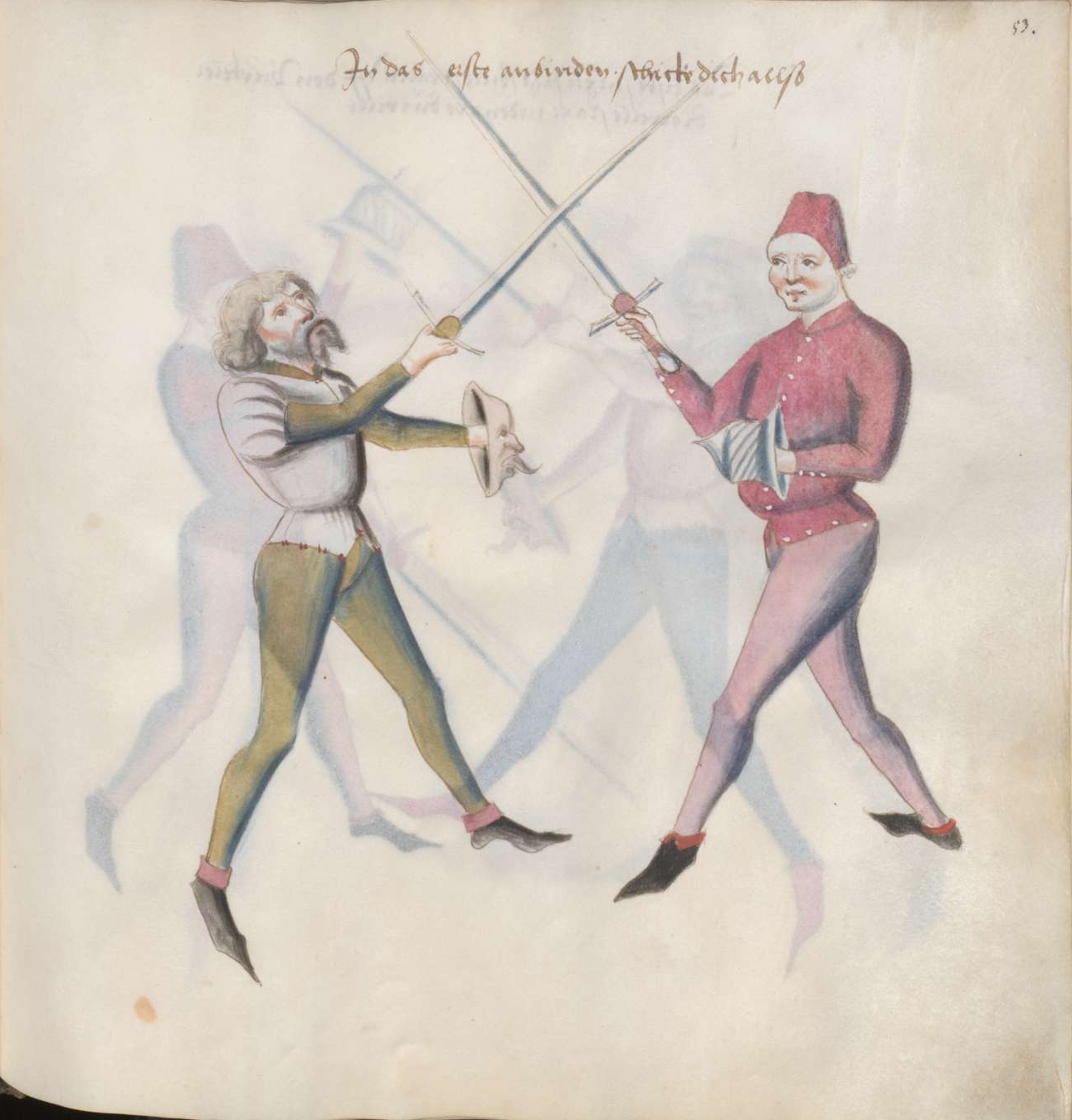
In Paulus Kal’s 1470 Fechtbuch we see a distinct difference between the longswords used for halfswording in armor or for unarmored longsword and the bastard swords used one handed for sword and buckler combat.
Longsword in Harnischfechten in Paulus Kal:
Longswords in Bloßfechten in Paulus Kal:
Sword and buckler in Paulus Kal:

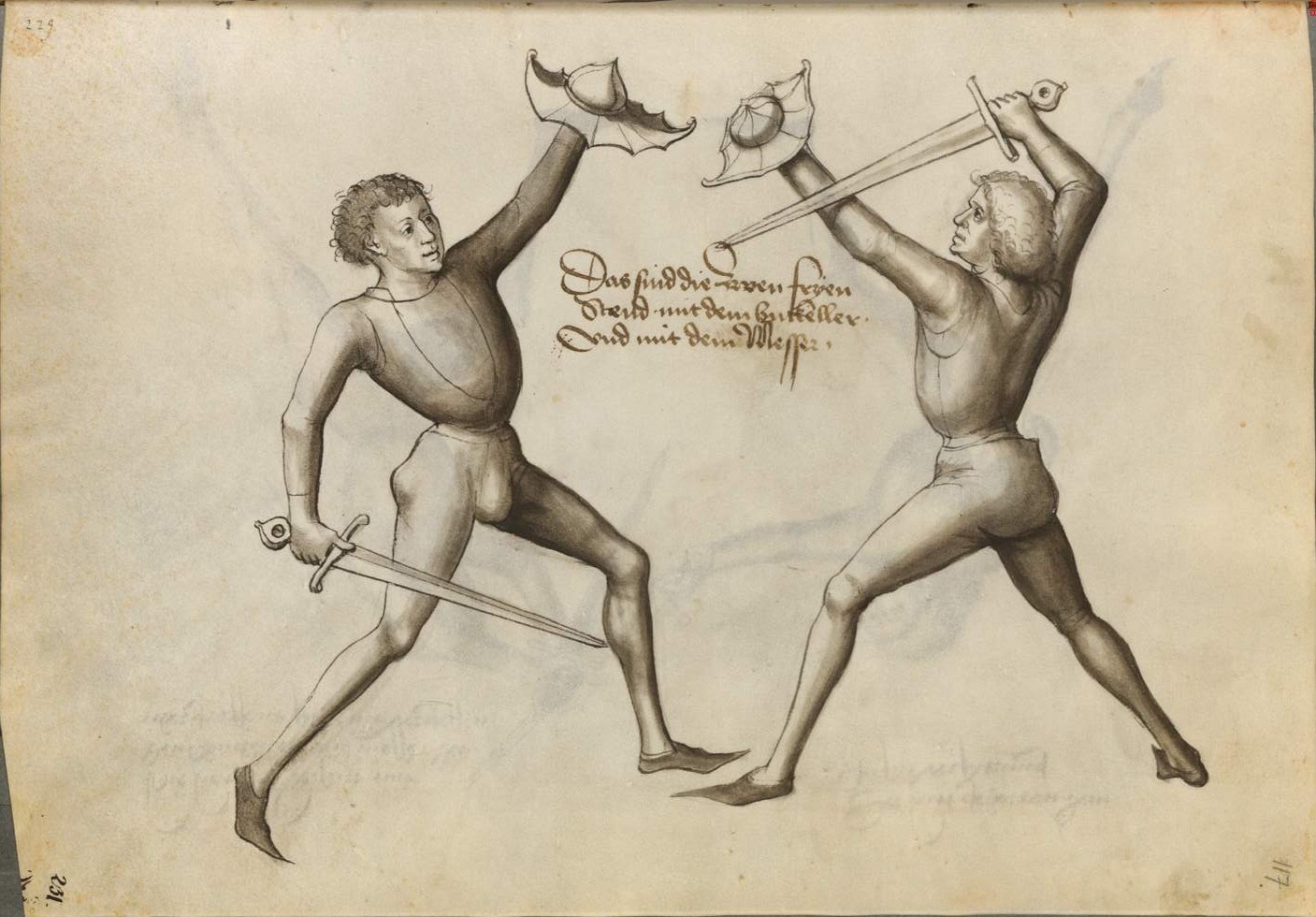
The distinction is even plainer in Hans Talhoffer’s 1467 Fechtbuch.  There we see distinctly different swords for unarmored longsword or armored halfsword combat (longswords), Langenschilt combat (bastard swords), and sword and buckler combat (arming swords).
Longswords in Bloßfechten in Talhoffer 1467:  http://wiktenauer.com/images/5/53/Cod.icon._394a_8r.jpg
Longsword in Harnischfechten in Talhoffer 1467:  http://wiktenauer.com/images/7/7f/Cod.icon._394a_37v.jpg
Sword and Langenschilt in Talhoffer 1467:  http://wiktenauer.com/images/c/c4/Cod.icon._394a_68r.jpg
Sword and Buckler in Talhoffer 1467:  http://wiktenauer.com/images/c/c7/Cod.icon._394a_117r.jpg

From this we can develop a rough grouping of sword categorizations:  Arming swords are intended for one-handed use; longswords for two-handed use (except in armor); and bastard swords can be used either one- or two-handed.  Note that the distinction between bastard swords and longswords isn’t necessarily tied to Oakeshott’s sword types.  For example, while the bastard swords in Talhoffer 1467 all appear to be Type XVa’s, some of the longswords appear to be XVa’s (albeit with longer hilts than those common in the previous century) while others appear to belong to the Type XVIII series (the art is not perfectly clear on this distinction, and, indeed, Oakeshott himself pointed out that blurring occurred between types).  The real distinction seems to be that bastard swords are a bit longer than arming swords, but somewhat shorter than longswords, especially in the hilt.  This may seem unclear when merely looking at the art of the period, but becomes much plainer when actually handling swords of each type.  The author owns a highly accurate replica of a Type XVIIIb longsword which is simply not comfortable for use one handed, even though a Type XVa of similar quality by the same company is easy to use with either one or two hands.

End Notes:
[1] Oakeshott, Ewart.  The Sword in the Age of Chivalry. Woodbridge: The Boydell Press, 1997, p. 60.
[2] Strutt, Joseph. The Sports and Pastimes of the People of England from the Earliest Period: Including the Rural and Domestic Recreations, May Games, Mummeries, Pageants, Processions and Pompous Spectacles. Methuen & Company, 1801, p. 211.
[3] Swetnam, Joseph. Schoole of the Noble And Worthy Science of Defence. Chapter XII. 1617. https://docs.google.com/document/d/1H2dBiXFry779WfdpBGFA8Bky7iLHneNi5_Lq9djVhr0/edit#. Accessed 4/19/2019.
[4] Cox, Trenchard. A General Guide to the Wallace Collection.  London: Wallace Collection, 1976, p. 155.


Wednesday, February 20, 2019

Resurrection, Not Invention


I recently watched a video of a Hontai Yoshin-ryu kata which demonstrated a rather interesting tanto-dori or “knife taking” waza.  Having once been a ju-jutsuka myself and later studying military combatives, I was impressed by the technique, but considered the initial wrist grab to be somewhat inefficient, thinking to myself that I knew a better way to do it.  I instantly set that thought aside, however, realizing I had fallen into the trap of trying to “improve” historical systems of combat.  If they did it that way, it would no longer be Hontai Yoshin-ryu, which defeats the entire purpose of studying koryu bujutsu today (as opposed to mere self defense) in the first place.  They would be trying to improve a historical artifact rather than understanding it, and thus would be destroying the very thing they were trying to preserve.

This has, obviously, strong parallels for those of us studying the Kunst des Fechtens today.  The only valid goal for the study of historical martial arts should be to recreate and then preserve them as they actually were.  To “improve” them (as we ignorantly might think we are) is anathema to that goal.  It literally defeats the purpose.  Understanding how to do that requires searching the Fechtbücher for clues as to how the techniques were performed in period, and keeping our modern notions out of things as much as possible.

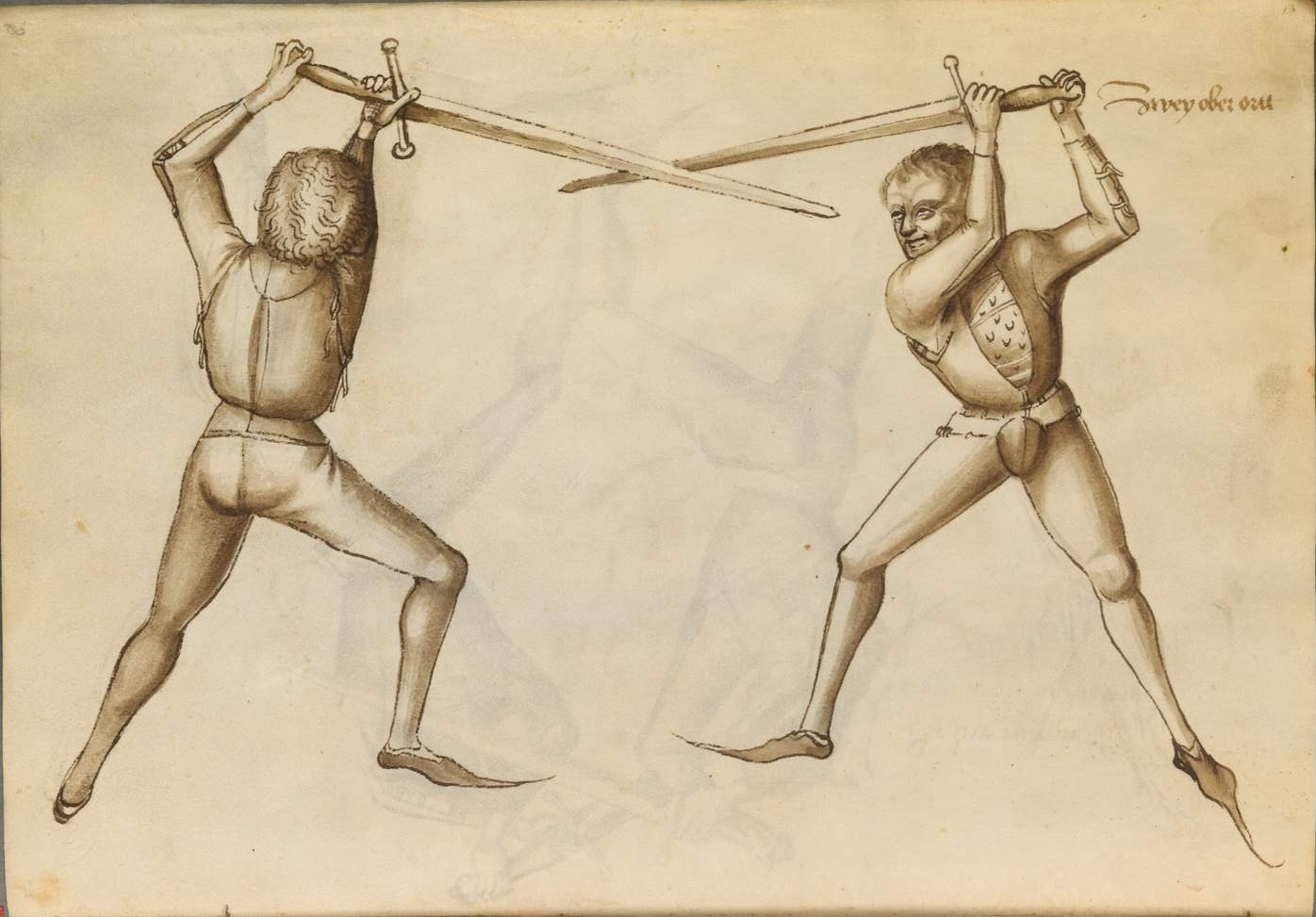
Not long after I watched that video we were discussing the Zornhau in class.  I was emphasizing how important it is to make the cut with your pommel well over to your left when executing a Zornhau from the right shoulder (see the picture above) regardless of whether you were cutting or displacing, rather than cutting with the pommel in line with your sternum as most people mistakenly do it today.  I asked my students whether they thought I was right in teaching it this way, and if they agreed that I was, how they could be  sure (I often make my students question my interpretations).

My senior student immediately answered that it was a matter of geometry, saying that if you cut with your pommel on your center line your opponent can hit you in the bind, or if you’re displacing, you won’t close the line well enough and the cut you’re trying to displace can still hit you.  He was right, of course—I consider this one of the most subtly brilliant parts of our art, and I was well pleased that he understood this.

It didn’t actually answer my question, however.  My student pointed out why it’s a good way to cut—why it works, and why it’s effective.  His answer, however, did not indicate how we know that to be the correct way to interpret Master Liechtenauer’s art, which was the key point I was trying to make.  It’s the point we must make every time we interpret a technique, and that we must bear in mind for every part of every technique.  How do you know this is how it was actually done in the Liechtenauer system in period?  Not “how might it be done” or “how can I make this work really well,” but “How did Master Johannes Liechtenauer and his students do it?”  The right way might not be the best way—the German masters were human, too.

To accomplish that, we have to really read what the masters had to say.  Master Peter von Danzig (we’ll presume it was he) wrote this about the Zornhau:
“The Zornhau breaks all cuts from above with the point and yet is nothing other than a strike which a peasant farmer would use. Use it as follows: if you come into the Zufechten and your opponent strikes from his right side to your head, then likewise also strike from your right side from above without displacing and bind strongly against his sword. If he is soft in the bind, shoot straight in and long with the point to his face or chest.” (Codex 44 A 8 fol. 13r.)

Later, writing about displacing, the master said:  “You are not to displace the way other fighters do. When they displace, they hold their point up or to the side. This means that they cannot attack the four openings in the displacement with the point. Because of this, they are often hit. If you want to displace though, then do it with a cut or a thrust and strive to reach the nearest opening Indes. This way, masters cannot come to blows against you without endangering themselves.” (Id. fol. 26v.)

What we learn from this is that we are not to make “empty displacements” that just strike into our opponent’s sword (as sword taggers all do today, and as bad swordsmen apparently did in period), but rather, we are to displace with a cut—the same kind of cut we’d use for an attack.  There aren’t really any “blocks” of the sort modern martial arts students use in our art; instead, we displace with regular cuts and thrusts in such a way that at the end, we threaten the enemy with our point.  That’s what Master Peter meant above by cutting from your right side “without displacing.”

But how can this be done safely?  Christian Tobler coined the phrase “make your sword your shield” many years ago, and I actually thought he took the phrase from a Fechtbuch at first because it so aptly matches what we have to do.  We must make our swords our shields, so that when we cut (or when we use cuts to displace) we are safe as we do so.

We know how the Zornhau is supposed to be done:  It is not a wide swinging action done with the arms from guard to guard as many of the ignorantsia (to coin a phrase) practice it today when playing silly games of sword tag or ludicrously incorrect test cutting, but rather is done in a straight line using a push-pull motion of the hands, as if a cord were tied from your edge to the target (see Ms 3227a fol. 14v), and ending with your point at or near your opponent (id. fol. 24r), not down near the ground, up in the air, or out to the side.

Understanding all of that, we then have to ask ourselves how we can use such a cut to safely displace a similar one.  As my students can tell you, using a Zornhau to displace a determined Zornhau will result in you getting hit unless you close your opponent’s line of attack as you displace by moving your pommel over to the left side of your chest (for a cut from the right).  They frequently do get hit in class when they try to displace without moving their pommels over to the left as they displace, unless they beat into their opponent’s sword in the kind of empty displacement Master Peter told us not to use.  That is where my senior student’s point about the geometry of the technique comes into play—that is how you make it work.  Now we are using that idea to answer the problem of making the masters’ instructions work when we do things the way they say to do it, and not just trying to figure out a way to do a thing from whole cloth because it works or seems like a smart or effective approach.

This essay is about the process of interpretation:  How do we work out the correct way of doing a given technique, going beyond the often incomplete descriptions the masters give us in the Fechtbücher?  The answer lies in correlating not just different parts of the same text, but all the related texts in order to find clues about how the technique has to work and what it’s supposed to  do when you use it, then using those clues to inform your interpretation.  Your interpretation should reconcile as much of the instructional material as possible and look for the best way to make the technique work in view of all those bits of information, eschewing your own personal ideas about how to do a thing garnered from other study or, heaven forfend, silly, meaningless games of sword tag or test cutting.  Our job is to resurrect a lost art as it was really done, not to invent a new one with no historical accuracy or relevance to our modern world.

Tuesday, September 18, 2018

A Description of a Pollaxe Bout From Histoire Plaisante et Cronicque du Petit Jehan de Saintré


One of the most instructive descriptions of a pollaxe bout in the literature: Look at the mention of strikes without specifying the part of the axe used (presumably meaning the mail was used by default), but then the strike to the fingers, which does, specifically saying the "sharp of his axe," meaning the taillent; the mention of striking the "bars of his visor" (meaning they were wearing grilled visors of the kind many of the LH crowd says didn't exist); the fact that he struck to the visor with the "handle" (i.e., the queue) of the axe, just as we're taught to do in Le Jeu; and the fact that he worked to disarm his opponent, which is one of the most highly favored tactics in Le Jeu.

CHAPTER XLII.

How they marched one against the other; each doing valiantly.

And when the Mareschal had given them leave to go, as they advanced one upon the other, you had thought they had been two lions unchained. But there was this difference; as Saintré was making for him, he cried aloud, that all might hear him, “Hah, my ever-gentle dame, and whose I am!” and then they began to fall upon one another. Then Sir Enguerrant, who was a most valiant Knight, strong and powerful, and larger built than Saintré, raised his axe, and dealt him such a blow upon the shoulder that he made him reel, while Saintré, in return, struck him with the handle of his axe upon the bars of his vizor, driving him several paces back. Then Sir Enguerrant elevated his axe to strike a second time; but Saintré, making for him, gave him such a cut over the hand with the sharp of his axe that neither guard nor anything else could avail, so that all his fingers were smashed and benumbed. Sir Enguerrant, who was now hot, nor knew anything of what had happened to his fingers, thought again to lift his axe, and it was only then he began to feel the pain, and that he could no longer wield it. So, as a wary and a dauntless Knight, holding his axe in his left hand, he opened his arms to seize Saintré by the waist. But when Saintré perceived his aim, he continued to strike, nor ever once let him approach. And when he saw his moment, all on a sudden he gave him such a blow on the hand in which he was holding the axe, that he sent it flying in the air; and when Sir Enguerrant saw that his axe was gone, in sheer desperation he rushed upon Saintré, to close with him, catching him by one arm. But when the King saw the axe of Sir Enguerrant upon the ground, and the two together by the middle, as Prince and Judge sovereign, he at once threw down his wardour, and said, "Ho, ho!" Then were the two champions separated by the guards. Then the King, by the Mareschal, called the two champions before him, and then had said to them, “You, Sir Enguerrant, and you, Jehan de Saintré, the King desires you should know, that you have each so nobly and so valiantly acquitted yourselves that it would have been impossible to have done better; but, according to the articles, the Lord, the King, who here is, has recognized that the combat was to end either when one or other of you were borne to the ground, or either had lost his axe from both his hands. So, by the terms, Jehan de Saintré, the Lord, the King, adjudges to you the prize.”

Vance, Alexander. The History and Pleasant Chronicle of Little Jehan de Saintré. London: Chapman and Hall, 1863, pp.128-130.

Saturday, September 15, 2018

Some Observations on the Judicial Duel as Practiced in Fifteenth-Century Germany

I have written a monograph on judicial combats in 15th-century Germany.  It focuses upon
information from the Fechtbücher, but examines other sources, too, both modern and historical.  Most of the scholarship available today regarding deeds of arms is focused on France and England, while this paper focuses strictly on judicial combats in Germany, and is intended  primarily  for students of historical European martial arts--especially those who follow the Liechtenauer school--who want to understand the context of the arts they study.

This paper may be distributed freely, within the rules of copyright.

http://www.schlachtschule.org/instruction/TheJudicialDuelV.2.pdf