Thursday, March 2, 2017

On Drills

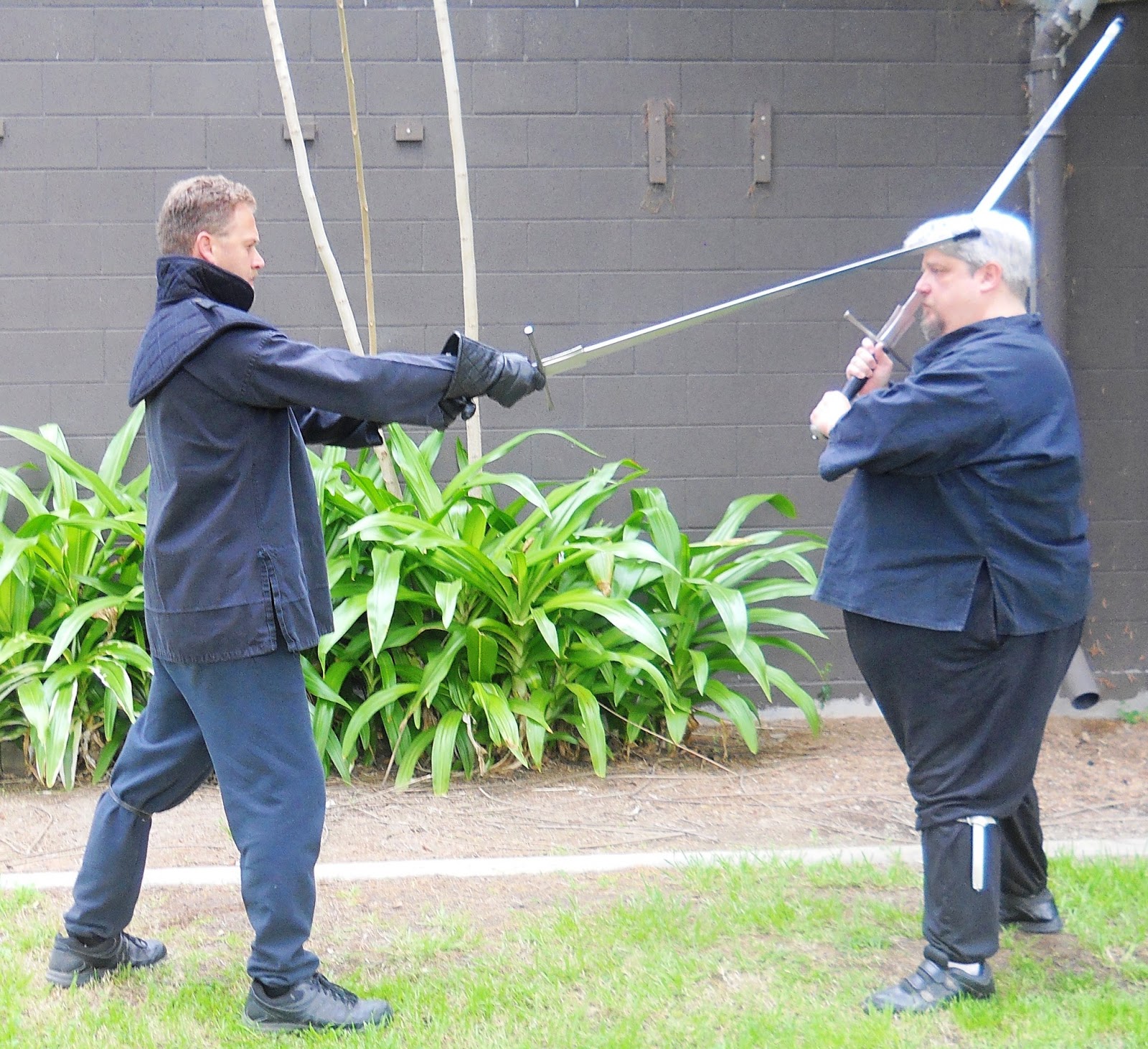
I worked up a new pollaxe drill yesterday, and it got me to thinking about what, exactly, a drill should be.  Judging by what I see on YouTube, most schools think a drill is either a solo exercise like a karate kata, or else a sort of repetitive exercise where they bang on each other’s swords, usually while aiming at one another’s blades rather than at their partner as they should.

Solo exercises are found in many martial arts, and have a minor value even in ours.  In my school, I use solo drills to help rank beginners work on guards and on simple cuts (to learn to cut solely with the hands, not the arms, and at the correct angle, etc.).  We later use the simple cutting drill on the pell to reinforce angles of attack so as to ensure we are cutting straight rather than flat (edge alignment).  After just a few months, the guards drill is absolutely useless because the student will be using the various guard in actual technique practice and in real drills (see below), and thus the guards drill is completely superfluous.  The simple cuts solo drill likewise becomes useless because of pell work and a simple partner cutting exercise we do.

Binding and working “am Schwert” (“on the sword”) is central to the Kunst des Fechtens.  Moving from one technique to another by oneself thus focuses on something practiced only minimally by us.  Of course, we do free cuts, but they are usually to or from a bind (although there are certain specialized exceptions); if you are moving from cut to cut without actions at the bind, it is extremely likely you have done way too much playing of sword tag and not nearly enough real KdF practice.  Thus, once you have learned how to make the basic movements, solo practice is nearly useless (not counting pell work as solo practice).

Likewise, repetitive banging on each others’ swords is pointless; it, too, derives from way too much completely undisciplined playing of sword tag in which am Schwert techniques are not even considered.  Central to that kind of “exercise” is the idea of leaving the bind without limiting your opponent’s response for safety, an idea entirely contrary to Master Johannes’ teachings, as is aiming at the blade rather than the man.

Both of these approaches are wrong for the practice of the KdF (except as noted).

Having already discussed the limited value of solo drills, let us turn to partner, or “structured” drills.  First, we must distinguish between what I call “drills” and “forms.”  A form (my term for them) is a choreographed exercise intended to teach the student how to execute techniques correctly in a sequence with good form.  Like drills, these are performed with a partner, but unlike drills, they are entirely predetermined; there are no choices or decisions in their execution.  Meyer uses these extensively, calling them “devices.”  They are somewhat like Japanese kenjutsu kata, and fulfill exactly the same purpose.

In contrast, a drill is an exercise wherein one partner preforms an action from a limited menu of allowed choices, and the other partner must respond correctly, then the partners reset, and the actor chooses a different action to which his partner must respond correctly.  I call the person who is acting from the menu of choices the “Teacher” and the one who must respond the “Student.”  These titles don’t have any reference out of the context of the drill, as the teacher may be of lower or higher rank, and they will switch places once one iteration of the drill is completed; they only refer to each partner’s role in any given drill.  The Teacher’s job is to act in such a way as to allow the Student to learn to do his techniques correctly under pressure and to be forced to do so when he doesn’t know what’s coming, just as in combat.

Here’s an example of a simplified longsword drill:   The Student attacks with a Zornhau.  The Teacher either:
(1.) Pretends to start to displace, but stops, thus ensuring that the student is really aiming for the cut, and is not going to turn to the Teacher’s sword, or,
(2.)  displaces the Student’s cut and remains hard in the bind, to which the Student should respond with the First Winden, or,
(3.)  displaces and then leaves the bind to cut at the other side of the Student’s head, to which the student should respond with bricht Abnehmen, or, … etc., etc. (This is a simplified version of one of our drills).

Some drills can be quite complex, requiring that when the Student responds correctly to a given technique, the Teacher then responds to that technique with another, forcing the Student to respond correctly to the second technique.  For example, in (2.) above, when the Student winds, the Teacher may push the Winden aside, requiring the Student to shift to the Second Winden in response.

Drills such as these come as close to real combat as is possible in the practice of the KdF.  Since it is not possible to do accurate free play with any of the unarmored forms, drills are essential to learning as much about how to fight as we can in these safety-conscious days.  The point is to force the Student to react correctly with a historically accurate and canonically correct response to an attack with correct form and function while under pressure.  This teaches students to learn to keep a flexible mind (i.e., not to anticipate, which is why (1.) above is so important), and to act with proper form even under pressure.  This is only possible when the student has truly learned to execute his techniques perfectly at a “muscle memory” level.

Contrast this kind of drill with the mere “banging swords” which seem almost universal elsewhere.  Sword banging (to coin a phrase) teaches nothing about the Kunst des Fechtens; in those, you don’t have to think, don’t have to plan, are taught to leave the bind without rendering your opponent harmless, and to attack the sword, not the man.

By practicing both correct drills and correct forms, students of the KdF come as close as possible to understanding the true art of combat without falling prey to the inaccuracies and bad habits inherent in the game of sword tag.

In my book on the longsword I included a handful of structured drills of the sort explained here, but I also included a structured way to create drills for any situation.  I have since come to realize that was a mistake, because people using my book to learn the art have a very tough time creating realistic drills which correctly express the central tenets of the art.  Thus, I have written a book which includes twelve structured drills of the sort described above, sixteen forms, instructions for pell work, solo drills for beginners, and much more to help with the actual training process.  I have taken it down from Lulu.com for revision, but look for the expanded second edition soon.

Here is a video of two of my students performing a structured drill:
Drill #8:  Sprechfenster
Setup:  Teacher starts in vom Tag and Student in left Langenort.
1.)  First Choice:  Teacher steps straight in and attempts to beat Student’s sword down to allow himself to get close.
Response:  Student responds with a Durchwechseln.
2.)  Second Choice:  Teacher steps around Student’s point with a slope step as he attacks with a Zornhau.
Response:  Student counters Teacher’s Zornhau with an Absetzen.
3.)  Third Choice:  Teacher simply waits in vom Tag.
Response:  If Teacher does not act within five seconds after assuming vom Tag, Student attacks with a long thrust into right Langenort.
3a.)  Advanced Choice:  Teacher counters Student’s long thrust (in (3.) above) with a lower Schielhau.
Response:  Student counters Teacher’s Schielhau with a Schnappen (not shown in the video as they were doing a simplified version.)
https://www.youtube.com/watch?v=V8Qa4JadPYk
(I apologize for the bad quality of the video, but I hope it gives an idea of what a drill looks like.)


-->
Copyright © 2017 by the author.  All rights reserved, but this article may be shared as long as full credit is given and it is distributed for free.

Monday, January 23, 2017

The Failure of Test Cutting: Or, the Bad Form Caused by Butchering Tatami

I have been roundly criticized by sword taggers and tatami butcherers for pointing out that both activities ruin one’s form and technique and violate the principles taught explicitly by the Masters.  I frequently post pictures and/or videos of both activities on the die Schlachtschule FaceBook page to show people how these practices force people to ignore the Fechtbücher.  Recently, I posted a truly awful (but, sadly, not atypical) picture of a young man performing an execrable test cut which led to my being attacked and vilified.  I am, they say, wrong, and the Fechtbücher are too unclear for us to say that their ways of cutting today are wrong.

On the contrary, the masters are quite explicit with regards to cutting and the kinds of errors to avoid.  To that end, let us look at a picture of someone performing test cutting and compare it to what we read in the Fechtbücher.  Please note that the attached picture is in no way unusual or atypical, it is merely one I recently posted; most test cutters look much like this.  Moreover, this and other, similar, pictures constantly receive warm congratulations and approbation for the form shown, making it clear this is what the HEMA mainstream finds laudable.   (NB:  I have no idea who this young man is, and I bear him no special animus.  His picture is typical of what I have seen, and was grabbed randomly.)


Lesson:  Do not fight in wide movements:
“For you should strike or thrust in the shortest and nearest way possible. For in this righteous fighting do not … fight in large movements by which people restrict themselves.”  (Ms 3227a fol. 14r.)
Analysis:  That he is fighting with a “large movement” is too obvious to require comment.

Lesson:  Wide strikes create openings your opponent can exploit:
“With their bad displacements and wide fighting they try to look dangerous with wide and long strikes that are slow and with these they perform strikes that miss and create openings in themselves.”  (Id. ff. 14r-v.)
Analysis:  This is obviously an extremely wide strike, and the fact that he is open to an attack while helplessly out of place cannot be denied.  “Slow” is something of a misnomer; the cut might have been performed at high speed, but the distance it travels takes a long time.

Lesson:  Stand in a well-balanced stance so you can move easily.
“Also know that when you fight with another you should step with caution and be sure in the movements as if you were standing on a scale and adapt accordingly if you go forward or backward as is fitting.”  (Id. fol. 15v.)
Analysis:  The word “scale” here is a reference to die Waage, or “the scale,” which is the term for the normal stance used in Master Johannes’ system.  It requires that we stand in a balanced position in order to be prepared to step in any direction instantly.  The stance seen in the photograph is obviously not a balanced stance, nor does it resemble die Waage when done correctly, as can be seen here:
http://wiktenauer.com/wiki/Codex_Wallerstein_(Cod.I.6.4%C2%BA.2)#/media/File:Cod.I.6.4%C2%BA.2_006v.jpg
The text says, in relevant part, “And stand firmly in the balance stance as shown here.”  (Codex Wallerstein fol. 6v.)

Lesson:  Don’t take large steps because you won’t be ready to step again if you need to do so:
“You should also … not step too wide, so that you can pull back and be ready for another step backwards or forwards.”  (Ms 3227a fol. 15v.)
Analysis:  He has taken such a large step that it is patent he would be incapable of a rapid step in any direction.  Obviously, his recognition of the fact that tatami mats don’t hit back has caused him to ignore correct form (if, indeed, he even knows anything about it).

Lesson:  Always aim at your opponent’s face or breast:
“No matter how you fight always aim the point at the opponent’s face or breast, then he will always have to worry that you will be faster since you will have a shorter way to go in to him than he has to you.”  (Id. fol. 25r.)
Analysis: This lesson teaches us to not cut past our opponent.  Doing so leaves us wide open to a counter attack since his point or edge will be closer to us than ours is to him; the proximity of his point or edge will allow it to hit sooner than we can respond.  In the picture the cutter’s sword is very far past his target and not aimed anywhere near his opponent’s face or breast, so we can see this problem quite clearly.

Lesson:  If you cut too widely or too hard you will create openings for your opponent:
“You shall be careful and note if you can get in behind his sword and always go the nearest way and never too wide, so that the opponent does not come before you.”  (Id.)
Analysis:  This instruction mirrors that above; if you cut wider than the masters teach, you will create an opening your opponent can exploit.

In short, then, he stepped much too far, his stance is dangerously unbalanced, and his cut is grossly overdone, leaving him helplessly exposed and unable to respond quickly to an attack.  He got literally every part of the cut that we can see in the picture wrong (we can’t discuss the technical execution of the cut itself without a video).

Test cutters claim they have to do test cutting or else they will be unable to be sure they are cutting correctly.  As this analysis shows, that is utter nonsense since their cuts in no way resemble the proper method of cutting.  They must overcut this way in order to make the ultra-clean cuts they erroneously believe to be important, and that error means they will always cut incorrectly.

They also argue that test cutting can teach edge alignment.  While there is a tiny grain of truth in that statement, they grossly exaggerate the point, as a brief historical analysis makes plain:  Simply put, there is not the slightest hint of proof for the practice of test cutting in period.  None.  If it was so important, why didn’t medieval masters teach their students to do it?  Rather, they taught their students to cut on pells, and that practice serves us well today, too.  Utter perfection of edge alignment simply isn’t as important as test cutters make it out to be, and careful attention to pell work is more than sufficient to the task without teaching the bad habits inherent in test cutting.

For more information see this more extensive discussion of the inherent evils of test cutting:
http://talhoffer.blogspot.com/2008/02/myth-of-test-cutting.html


-->
This should serve to utterly silence those who scream in outrage over my criticisms of this photograph and all others like it.  It’s wrong, period.  End of debate.

Tuesday, June 7, 2016

Pollaxe Workshop Sponsored by Historic Enterprise's KnightSchool

Hello to anyone still reading this blog!

I haven't posted anything on here for several years because life has been interfering.  However, I was recently honored to be invited to do a pollaxe workshop by Gwen Nowrick and Jeff Hedgecock of Historic Enterprises under the auspices of their excellent KnightSchool program in Ramona, CA.

While doing the workshop, I had one of my students, Chad Cordero, film most of the demonstration parts; the result is the YouTube video posted below.  I am pleased with how it came out.  The sound is poor due to a strong wind and some airplane and car noise, but I believe everything I say can be understood.

As always, I welcome responsible questions and comments.

https://www.youtube.com/watch?v=5iIIkAmeKKU

Saturday, May 18, 2013

Else What's a Buckler For?


I just had a teenager roundly criticize one of my sword and buckler videos because I did not displace with my buckler, but just kept it over my hand.  He mistakenly believes that bucklers are shields and must, therefore, be used to actively displace attacks.  His confusion is exacerbated by the fact that bucklers are used to displace attacks in Renaissance rapier or side-sword play.  I have received many such comments over the years, so I felt it was time to discuss the buckler and how it was actually used in the Middle Ages.  (NB:  Everything in this article relates to the Middle Ages; things were different in the Renaissance.)

There are four primary sources for sword and buckler techniques in the Middle Ages:  I.33, Hans Talhoffer (primarily his 1459 and 1467 editions),  Andreas Lignitzer, and Paulus Kal.  There are a few other sources that show the form, but they usually just copy these earlier sources (e.g., the re-drawing of I.33 in Wilhalm and Mair).  This is all we really can know about buckler combat; there are manuscript paintings showing the form, but they are too vague to tell us much.

When we look at the Fechtbuch sources, we see that none of them show a single active displacement with a buckler—not one—and yet that is precisely how most people, including the young “expert” above, who have not studied the art seriously think bucklers were used.  “After all, if you aren’t blocking with it, why have it?  It’s a shield, right?  And shields were used to block, right?”

There are some few plays shown in the Fechtbücher which can be confusing and which might lead someone who has not studied them carefully to believe he was seeing an active displacement.  For example, this plate from Paulus Kal looks like one.  Translation:  “The first technique:  Catch his weak on the buckler while striking down wherever you wish.” (Fol. 53v)

But when you study the source carefully, you find that the initial displacement was done with the sword, and the buckler was then used to pin his opponent’s sword, freeing him to leave the bind with his sword for the leg cut.  Here is the previous plate showing the actual displacement.  Translation:  “Do this in the first bind.”  (Fol. 53r)

So in the plates from Kal above, we are shown that you first displace his cut with your sword (53r), then you pin that sword in place with your buckler to make it safe to leave the bind to cut at his leg (53v).  Folio 53v does not show a displacement with the buckler, it shows what to do after the displacement with the sword in 53r.  This is in keeping with the teachings of the Liechtenauer tradition, which say that you never leave the bind unless you have first done something to prevent your opponent from killing you with a Nachreisen as you do so.

There are several sources that show this kind of pinning action.  For example, in this play from I.33, we see a bind with the sword (top), then the buckler is used to pin the attacker’s hands (and thus his sword) so the defender can safely cut him (bottom).

If bucklers were not used to displace attacks, for what then were they used?  There were several uses for the buckler; we have seen one of them already above: to pin the enemy’s sword so as to make it safe to leave the bind.  In addition, bucklers were used to strike one’s opponent, and for “zone denial.”  Their most important use, however, was to protect the fighter’s right hand—a sort of gauntlet, if you will, without the limits a gauntlet places on flexibility and sword handling.

Striking with the buckler is easy to understand.  While you are bound sword to sword (or, as in this case, cutting), you strike with the buckler as shown here.  Also, in Lignitzer’s last play of the buckler, you displace with your sword in a halfsword grip, then release your right hand, grab his buckler with it, and strike him with his own buckler (see Ringeck fol. 55v); Kal shows the same play (see Kal fol. 56r).

The next use, zone denial, is somewhat less obvious.  We usually see bucklers held out at arms’ length, as in this plate from Talhoffer 1459.  The reason for this is that by doing so, you create a cone-shaped zone in which you cannot easily be hit.  To understand this, we must look (just for a moment) to a master from the Renaissance, Giocomo di Grassi.  In the buckler chapter in his book, we see this picture.  As the lines on the picture show, the further the buckler is held from the body, the broader the area in the “shadow” (protection) of the buckler is.  When the buckler is held close to the body, it protects an area only the size of the buckler itself; at arms’ length, it protects an area several times that size.  This is not a displacement, it is a zone defense intended to force your opponent to strike where you are unprotected, thus limiting the angles at which he can attack.  When he does attack, you cannot just leave the buckler in place and hope it stops his attack, you must actively displace it with your sword.

The primary use of the buckler, however, is as a gauntlet for the right hand.  Unlike later weapons, medieval swords did not have elaborate guards around the sword hand to protect them from being hit.  Thus, an enemy could simply strike your hand or arm as you attack, as we see in this plate from Talhoffer 1467.  To prevent this, the masters taught us to cover the sword hand with the buckler both as we displace with the sword as we see in this plate from Talhoffer 1467, and to cover the hand as we attack, as shown in the top pair of figures from I.33 here.  (NB:  Mair shows figures performing some of these exact same techniques while wearing gauntlets, which can be confusing to some.  Remember that he was copying earlier works in his possession, and that he did not always copy them accurately.  For example, when showing Langenschilt dueling, which was never done in armor, Mair shows the techniques being performed by fully armored men.)

Again, please understand that the buckler is not used for an active displacement in any of these sources—not even once.  If you think that is what you are seeing, you need to study the source more carefully.

In conclusion, bucklers were used for a variety of purposes, including pinning an opponent’s hands or sword to make it safe to leave the bind; buckler strikes; zone denial; and as a pseudo-gauntlet for the right hand.  They were not used, however, for the thing most people who have not studied this art believe they were—actively displacing attacks.

One last note:  Whenever I post something like this, I usually receive comments arguing that “absence of evidence is not evidence of absence.”  In other words, they argue that I cannot claim bucklers were never used to displace attacks just because none of the extant sources do so, and claim that there may have been sources showing displacements which did not survive.  There is a microscopic grain of truth in this largely fatuous argument—one which holds in every real-world argument that claims a thing does not exist:  You can rarely prove a negative conclusively.  The fact remains, however, that we have varied sources that show consistency, and since we can only practice the art we are given, the argument is moot.

Saturday, May 11, 2013

The Intent of the Vorschlag


When we attack first, that attack is called a Vorschlag—a “before strike.”  We are
taught that to fight in the Vor is best, and that to attack first is the preferred (although, contrary to popular misconception, not the only) way to take the Vor.  Döbringer tells us: “The Vorschlag is a great advantage in fighting as you will hear in the text.”  Hs 3227a fol. 14v.  But when you attack with a Vorschlag, what is your intent—what should you be trying to do?  What is Döbringer’s “great advantage”?  Are you expecting your blow to hit your opponent and end the fight in a single action, or is there more to it than that?

Looked at in one way, the answer seems obvious:  When you use a Vorschlag you intend to strike your opponent, killing him and thus ending the fight as quickly as possible.  And yet, when we study the instructions for attacking with a Vorschlag that is not what we find.  Ringeck tells us this:  “If you strike an Oberhau from the right side then follow the blow with your right foot.”  Ringeck fol. 12v.  Following the blow means that you strike with your sword before you step forward—your cut precedes your step.

Following the blow is not, however, the fastest way to move your sword, and presumably, if our primary intent was to maximize the chance of our Vorschlag landing unopposed we would want to cut as fast as possible.  The fastest way to cut is actually to step first, then whip the sword in with a powerful snapping motion of the hands, and we are specifically told not to do that.  Thus, if your goal is to guarantee a hit, following the blow is not the ideal way to cut.  Nor should this really be surprising.  The fact of the matter is that if your opponent has judged measure correctly, you will have to take a step in order to hit him.  Since he can displace your attack just by moving his hands, and since his hands will always be faster than your step (unless he gets stupid), there should be little chance of making your Vorschlag hit regardless of how fast you are.

This leads to an inescapable conclusion:  There is little reason to perform a Vorschlag at top speed, because there is no advantage in doing so; in fact, there is a disadvantage in trying to go too fast because people tend to use too much muscle when they do so, making them too tight at the conclusion of the cut, and slow to go on to the next technique.  We have seen this in our classes when we practice drills in which the student is required to react to what his partner does, but does not know in advance what that will be:  When they cut too fast, fighters have a difficult time moving smoothly to the next technique they need to use when their Vorschlag is displaced because a kind of muscular and mental inertia takes place.

Moreover, a careful consideration of the Fechtbücher suggests that physical ability is not the most important factor in fighting.  Döbringer says:  “That is why Liechtenauer’s swordsmanship is a true art that the weaker wins more easily by use of his art than the stronger by using his strength. Otherwise what use would the art be?”  Hs 3227a fol. 22v.  The same may be said of speed and for exactly the same reason:  If you need to be exceptionally fast, then what use is art?  In fact, the real lesson is that art enables us to overcome physical ability—to defeat someone stronger and/or faster than we are.

This should not be taken to mean that we should act slowly—quite the contrary.  Döbringer says this about the Vorschlag: “And when you close with him thinking that you have the correct measure and believe that you can reach him, then you shall go at him quickly and with speed to the head and to the body.”  Hs 3227a fol. 16r.  The reason for this, however, is not because you should expect your Vorschlag to hit—we have already discussed why that is not very likely.  Rather, it is because moving quickly makes it more difficult for your opponent to see what you are doing and to formulate a careful response.  So yes, we should cut quickly, but we do not need to cut at top speed.  Be relaxed and cultivate a flexible mind so that you can see your opponent’s response and be prepared to react to it quickly and smoothly.  There is little point in executing an extremely fast Vorschlag but then not being able to move quickly to the next technique when you come into the Krieg.

So we return to our original question:  If a Vorschlag is unlikely to hit, then what is its intent?  Why bother trying to strike first at all?  Master Sigmund tells us this:  “Note: Above all other things, you must understand the principles of Vor and Nach, because the entire art of fighting is based upon them.  Vor means preempting him with a blow or thrust against an opening before he can hit you, so he must displace.”  Ringeck fol. 15r.  This passage tells us that the Vorschlag is not primarily about hitting first, but about preempting your opponent.  When you follow the blow your sword threatens your opponent, forcing him to displace your attack rather than attacking himself; this allows you to close safely and puts you in the Vor and him in the Nach.

This does not require great speed, it merely requires that you act first and that you present a serious threat.  In a sense, your cut actually clears a path for you to enter into the engagement while at the same time putting your opponent on the defensive.  Of course, if the Vorschlag does land then that is wonderful—the fight is over as quickly as possible and with as little danger to you as possible.  We should not expect that, however, and should not work to find ways to bring that about, such as cutting faster, taking larger steps, etc., because such actions tend to make the necessary next steps after the bind slower and more difficult.

Move quickly, but be relaxed and in control.  Move constantly, too; when your Vorschlag is displaced move immediately on to your next attack and to the next until your opponent is defeated.  Learn to overcome your opponent’s speed and strength with art so that you crush him with attack after attack, never letting up the pressure and never giving him a chance to attack until he is defeated.  Never make an empty displacement that allows your opponent to take the initiative from you.  Take the initiative with your Vorschlag and never relinquish it.  This does not require great speed or strength, it requires art.

Monday, January 14, 2013

Countering the Schnappen


I have long been troubled that the Schnappen, one of the most ubiquitous counter techniques in Liechtenauer’s longsword system, apparently had no canonical counter.  Sure, it’s possible to make a technique up like many people do, but our school is committed to practicing canonical techniques *only*, and this seemed like too large a hole to leave unplugged.

A friend of mine and I discussed this, and he suggested getting under with an Abschneiden, but I pointed out that that would only work if the Schnappen was done with the hands much too high (which, admittedly, is how most people do it, I’m sad to say).  Correctly done, however, a Schnappen is more of a thrust of the pommel over your opponent’s hands with almost no lifting of your hands at all.  And since the main Abschneiden from below requires the enemy’s hands to be raised up, that wasn’t it.  Nor could the Abschneiden against a Zwerchhau work since you can’t really get your blade around correctly.

But then I looked more closely at the other Abschneiden—the one I never see anyone demonstrate or include in books any more (Tobler has it in “Secrets of German Medieval Swordsmanship,” but he does it incorrectly).  The text says:

Item, wann du im mitt ainem haw oder sunst starck vff sin Schwert bindest, laust er dann sein schwert abschnappen von dem dinen vnnd schlecht dir oben zuo dem kopff, so verwende din schwert mitt dem gehültz für dein haupt vnd schnyd im vnden durch sin arm; vnd setz mitt dem schnitt den ort vnden an sin brust.

“If you bind strongly against his sword and he then snaps his sword over yours to strike at your head, wind your sword with the hilt in front of your head and slice under his arm. As you slice, set the point down into his chest.”  Ringeck ff. 45r-v.

To be honest, I hadn’t looked at this much because I was simply going by the interpretation in Tobler, and it didn’t seem to offer much that the other Abschneiden plays didn’t—except for that word “abschnappen” or “snaps.”  Despite the fact that it actually talks about an abschnappen, I had been looking at that word more generically—i.e., that he simply raises his hands and does a cut.  Then I realized how foolish I’d been:  Of course this was the counter to the Schnappen, and it had been staring me right in the face, if only I hadn’t been so canalized by accepting the incorrect interpretation in “Secrets.”

Tonight we tried this technique out for the first time, and it works amazingly well.  It will not succeed against a Schnappen that is done fast and correctly, but that’s true of many counters—they only work if your opponent hesitates slightly or does something a bit off.  But the action is fast and extremely effective when done correctly.  The biggest trick is to wind quickly and lightly under your opponent’s arms; don’t treat it like a wide, powerful Unterhau; this is a Schnitt, not a Hau.  Try to make first contact ahead of the middle of your blade on the underside of his arm, and then slice by pushing along under his arm as you drive your point into his chest.  Also, don’t pull back any farther than you need to—don’t make contact near your point because that will make the technique take too long.

You can see a video of the technique here:  http://www.youtube.com/watch?v=hh1UwpTLVoc

Edited to add:  I should point out that my friend and colleague, Dave Clarke, figured this out before I did, and I would have known that had I not misunderstood his e-mail to me on the subject.

Friday, November 16, 2012

Striking With A Spear

I have long been skeptical--OK, I have laughed mercilessly--of those who want to believe that spears were used like staves, that is, for striking actions as well as thrusting actions.  For one thing, there's no clear evidence for that in foot combat in any Fechtbuch.  For another, spears just aren't built for that.

There is a hint in one of the Talhoffer books that talks about a "schlag" or strike with a spear, but that word isn't as rigidly used as we tend to think of words being used today, and in the context I really think it just referring to a "strike" with the point, i.e., a thrust.

However, a recent post on Will McLean's blog opens a different possibility.  In a quote from a description of a 16th-century barrier combat, the text says:
"with the but ende of the spere strake the Almaine that he staggared"
In more modern English this would read:
"[the] German struck [him] with the butt end of the spear [so] that he staggered."

Now I still reject a striking action with the business end of the spear:  The fact is, as Will has shown, that spears were tapered toward the point, making them thinner there, so striking actions were almost certain to break the spear if any real force was used, and what good is a light stroke?  A strike with the other end, however, which is the thicker end, obviously, might be a different matter.  Having said that, we still must ask several questions.  First, was the strike a swinging blow or a thrust?  Don't assume the word "struck" in the text is definitive--we often see the word struck used for thrusts (e.g., in jousting descriptions).

Second, how relevant is 16th-century barrier combat to Kampffechten?  Many sources (e.g., Anglo's "Renaissance Martial Arts") are quite clear about how artificial such combats were, with everything from artificial techniques to weapons pre-scored to break spectacularly.  It might be that a stunning blow with the butt of a spear was useful in a "friendly" (Will would say "consensual" to distinguish it from a judicial combat) barrier fight but would have been laughed at by someone seeking to kill his opponent in Kampffechten.  We don't know.  And third, if this was a generally viable technique, why doesn't it show up in any Fechtbuch?

Having said all of that, there is one plate in a Fechtbuch that shows an attack with the butt of a lance; it's in the Roßfechten section of two of Jörg Wilhalm's books.  Here is the technique from one of them:

I'm not sure how this relates, however.  We know that the forward motion of a horse changes the effect of strikes (e.g., Dom Duarte's comments about using the motion to add force to a sword blow), and we have speculated that a pommel "thrust" with a sword in foot combat could be effective against someone even in a closed visor because of the percussive effect it would have.  Thus, it's entirely possible that a "thrust" with the butt of the spear would be similarly effective in foot combat.  And such an attack might have been useful, if you held the spear long your hands would be closer to the butt-end of the spear, so you would be able to use it better in close combat (where you couldn't use the point because you wouldn't have room).

So, once again, we have a fascinating bit of evidence that doesn't actually tell us anything definitive.  Sigh.  Still, sometimes by building up little tiny bits of apparently useless data we construct a good argument.  No deep, carefully researched conclusion here, just food for thought.