
Hello to anyone still reading this blog!
I haven't posted anything on here for several years because life has been interfering. However, I was recently honored to be invited to do a pollaxe workshop by Gwen Nowrick and Jeff Hedgecock of Historic Enterprises under the auspices of their excellent KnightSchool program in Ramona, CA.
While doing the workshop, I had one of my students, Chad Cordero, film most of the demonstration parts; the result is the YouTube video posted below. I am pleased with how it came out. The sound is poor due to a strong wind and some airplane and car noise, but I believe everything I say can be understood.
As always, I welcome responsible questions and comments.
https://www.youtube.com/watch?v=5iIIkAmeKKU
Tuesday, June 7, 2016

Saturday, May 18, 2013
Else What's a Buckler For?

I just had a teenager roundly criticize one of my sword and
buckler videos because I did not displace with my buckler, but just kept it
over my hand. He mistakenly believes
that bucklers are shields and must, therefore, be used to actively displace
attacks. His confusion is exacerbated by
the fact that bucklers are used to displace attacks in Renaissance rapier or
side-sword play. I have received many
such comments over the years, so I felt it was time to discuss the buckler and
how it was actually used in the Middle Ages.
(NB: Everything in this article
relates to the Middle Ages; things were different in the Renaissance.)
There are four primary sources for sword and buckler
techniques in the Middle Ages: I.33,
Hans Talhoffer (primarily his 1459 and 1467 editions), Andreas Lignitzer, and Paulus Kal. There are a few other sources that show the
form, but they usually just copy these earlier sources (e.g., the re-drawing of
I.33 in Wilhalm and Mair). This is all
we really can know about buckler combat; there are manuscript paintings showing
the form, but they are too vague to tell us much.
When we look at the Fechtbuch sources, we see that none of
them show a single active displacement with a buckler—not one—and yet that is
precisely how most people, including the young “expert” above, who have not
studied the art seriously think bucklers were used. “After all, if you aren’t blocking with it,
why have it? It’s a shield, right? And shields were used to block, right?”
There are some few plays shown in the Fechtbücher which can
be confusing and which might lead someone who has not studied them carefully to
believe he was seeing an active displacement.
For example, this plate from Paulus Kal looks like one. Translation: “The
first technique: Catch his weak on the
buckler while striking down wherever you wish.” (Fol. 53v)
But when you study the source carefully, you find that the
initial displacement was done with the sword, and the buckler was then used to
pin his opponent’s sword, freeing him to leave the bind with his sword for the
leg cut. Here is the previous plate
showing the actual displacement. Translation: “Do this
in the first bind.” (Fol. 53r)
So in the plates from Kal above, we are shown that you first
displace his cut with your sword (53r), then you pin that sword in place with
your buckler to make it safe to leave the bind to cut at his leg (53v). Folio 53v does not show a displacement with
the buckler, it shows what to do after the displacement with the sword in 53r. This is in keeping with the teachings of the
Liechtenauer tradition, which say that you never leave the bind unless you have
first done something to prevent your opponent from killing you with a
Nachreisen as you do so.
There are several sources that show this kind of pinning
action. For example, in this play from
I.33, we see a bind with the sword (top), then the buckler is used to pin the
attacker’s hands (and thus his sword) so the defender can safely cut him
(bottom).
If bucklers were not used to displace attacks, for what then
were they used? There were several uses
for the buckler; we have seen one of
them already above: to pin the enemy’s sword so as to make it safe to leave the
bind. In addition, bucklers were used to
strike one’s opponent, and for “zone denial.”
Their most important use, however, was to protect the fighter’s right
hand—a sort of gauntlet, if you will, without the limits a gauntlet places on
flexibility and sword handling.
Striking with the buckler is easy to understand. While you are bound sword to sword (or, as in
this case, cutting), you strike with the buckler as shown here. Also, in Lignitzer’s last play of the buckler, you displace
with your sword in a halfsword grip, then release your right hand, grab his
buckler with it, and strike him with his own buckler (see Ringeck fol. 55v);
Kal shows the same play (see Kal fol. 56r).
The next use, zone denial, is somewhat less obvious. We usually see bucklers held out at arms’
length, as in this plate from Talhoffer 1459. The reason for this is that by doing so, you create a
cone-shaped zone in which you cannot easily be hit. To understand this, we must look (just for a
moment) to a master from the Renaissance, Giocomo di Grassi. In the buckler chapter in his book, we see this picture. As the lines on the picture show, the further the buckler is
held from the body, the broader the area in the “shadow” (protection) of the
buckler is. When the buckler is held
close to the body, it protects an area only the size of the buckler itself; at
arms’ length, it protects an area several times that size. This is not a displacement, it is a zone
defense intended to force your opponent to strike where you are unprotected,
thus limiting the angles at which he can attack. When he does attack, you cannot just leave
the buckler in place and hope it stops his attack, you must actively displace it
with your sword.
The primary use of the buckler, however, is as a gauntlet
for the right hand. Unlike later
weapons, medieval swords did not have elaborate guards around the sword hand to
protect them from being hit. Thus, an
enemy could simply strike your hand or arm as you attack, as we see in this plate from Talhoffer 1467. To prevent this, the masters taught us to cover the sword
hand with the buckler both as we displace with the sword as we see in this plate from Talhoffer 1467, and to cover the hand as we attack, as shown in the top pair
of figures from I.33 here. (NB: Mair shows
figures performing some of these exact same techniques while wearing gauntlets,
which can be confusing to some. Remember
that he was copying earlier works in his possession, and that he did not always
copy them accurately. For example, when
showing Langenschilt dueling, which was never done in armor, Mair shows the
techniques being performed by fully armored men.)
Again, please understand that the buckler is not used for an
active displacement in any of these sources—not even once. If you think that is what you are seeing, you
need to study the source more carefully.
In conclusion, bucklers were used for a variety of purposes,
including pinning an opponent’s hands or sword to make it safe to leave the
bind; buckler strikes; zone denial; and as a pseudo-gauntlet for the right
hand. They were not used, however, for
the thing most people who have not studied this art believe they were—actively
displacing attacks.
One last note:
Whenever I post something like this, I usually receive comments arguing
that “absence of evidence is not evidence of absence.” In other words, they argue that I cannot
claim bucklers were never used to displace attacks just because none of the
extant sources do so, and claim that there may have been sources showing
displacements which did not survive.
There is a microscopic grain of truth in this largely fatuous argument—one
which holds in every real-world argument that claims a thing does not
exist: You can rarely prove a negative
conclusively. The fact remains, however,
that we have varied sources that show consistency, and since we can only
practice the art we are given, the argument is moot.
Saturday, May 11, 2013
The Intent of the Vorschlag
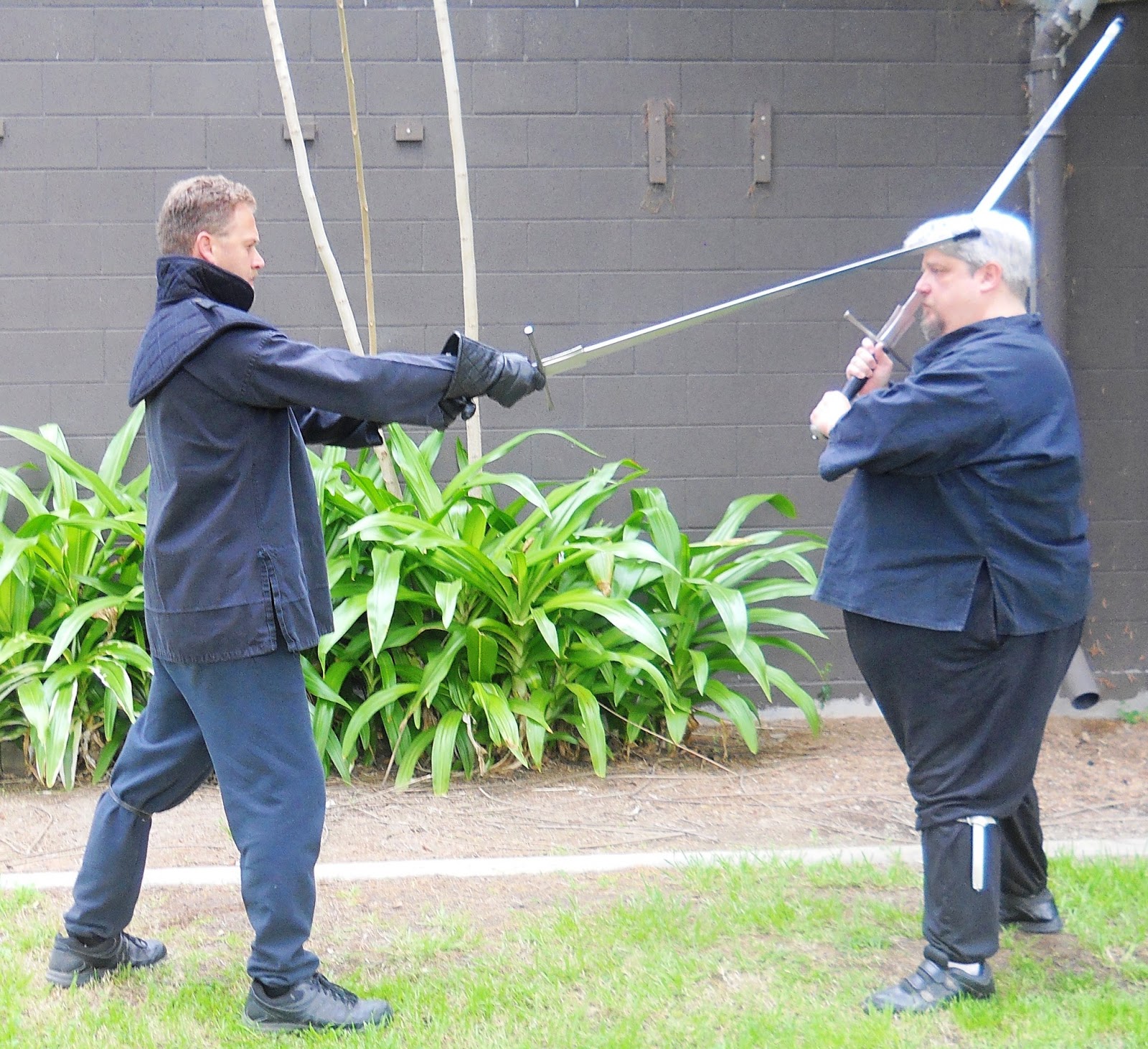
When we attack first, that attack is called a Vorschlag—a
“before strike.” We are
taught that to
fight in the Vor is best, and that to attack first is the preferred (although,
contrary to popular misconception, not the only) way to take the Vor. Döbringer tells us: “The Vorschlag is a great
advantage in fighting as you will hear in the text.” Hs 3227a fol. 14v. But when you attack with a Vorschlag, what is
your intent—what should you be trying to do?
What is Döbringer’s “great advantage”?
Are you expecting your blow to hit your opponent and end the fight in a
single action, or is there more to it than that?
Looked at in one way, the answer seems obvious: When you use a Vorschlag you intend to strike
your opponent, killing him and thus ending the fight as quickly as
possible. And yet, when we study the
instructions for attacking with a Vorschlag that is not what we find. Ringeck tells us this: “If you strike an Oberhau from the right side
then follow the blow with your right foot.”
Ringeck fol. 12v. Following the
blow means that you strike with your sword before you step forward—your cut
precedes your step.
Following the blow is not, however, the fastest way to move
your sword, and presumably, if our primary intent was to maximize the chance of
our Vorschlag landing unopposed we would want to cut as fast as possible. The fastest way to cut is actually to step
first, then whip the sword in with a powerful snapping motion of the hands, and
we are specifically told not to do that.
Thus, if your goal is to guarantee a hit, following the blow is not the
ideal way to cut. Nor should this really
be surprising. The fact of the matter is
that if your opponent has judged measure correctly, you will have to take a
step in order to hit him. Since he can
displace your attack just by moving his hands, and since his hands will always
be faster than your step (unless he gets stupid), there should be little chance
of making your Vorschlag hit regardless of how fast you are.
This leads to an inescapable conclusion: There is little reason to perform a Vorschlag
at top speed, because there is no advantage in doing so; in fact, there is a
disadvantage in trying to go too fast because people tend to use too much
muscle when they do so, making them too tight at the conclusion of the cut, and
slow to go on to the next technique. We
have seen this in our classes when we practice drills in which the student is
required to react to what his partner does, but does not know in advance what
that will be: When they cut too fast, fighters
have a difficult time moving smoothly to the next technique they need to use when
their Vorschlag is displaced because a kind of muscular and mental inertia
takes place.
Moreover, a careful consideration of the Fechtbücher
suggests that physical ability is not the most important factor in fighting. Döbringer says: “That is why Liechtenauer’s swordsmanship is
a true art that the weaker wins more easily by use of his art than the stronger
by using his strength. Otherwise what use would the art be?” Hs 3227a fol. 22v. The same may be said of speed and for exactly
the same reason: If you need to be
exceptionally fast, then what use is art?
In fact, the real lesson is that art enables us to overcome physical
ability—to defeat someone stronger and/or faster than we are.
This should not be taken to mean that we should act slowly—quite the contrary. Döbringer says this about the Vorschlag: “And when you close with him thinking that you have the correct measure and believe that you can reach him, then you shall go at him quickly and with speed to the head and to the body.” Hs 3227a fol. 16r. The reason for this, however, is not because you should expect your Vorschlag to hit—we have already discussed why that is not very likely. Rather, it is because moving quickly makes it more difficult for your opponent to see what you are doing and to formulate a careful response. So yes, we should cut quickly, but we do not need to cut at top speed. Be relaxed and cultivate a flexible mind so that you can see your opponent’s response and be prepared to react to it quickly and smoothly. There is little point in executing an extremely fast Vorschlag but then not being able to move quickly to the next technique when you come into the Krieg.
This should not be taken to mean that we should act slowly—quite the contrary. Döbringer says this about the Vorschlag: “And when you close with him thinking that you have the correct measure and believe that you can reach him, then you shall go at him quickly and with speed to the head and to the body.” Hs 3227a fol. 16r. The reason for this, however, is not because you should expect your Vorschlag to hit—we have already discussed why that is not very likely. Rather, it is because moving quickly makes it more difficult for your opponent to see what you are doing and to formulate a careful response. So yes, we should cut quickly, but we do not need to cut at top speed. Be relaxed and cultivate a flexible mind so that you can see your opponent’s response and be prepared to react to it quickly and smoothly. There is little point in executing an extremely fast Vorschlag but then not being able to move quickly to the next technique when you come into the Krieg.
So we return to our original question: If a Vorschlag is unlikely to hit, then what
is its intent? Why bother trying to
strike first at all? Master Sigmund
tells us this: “Note: Above all other
things, you must understand the principles of Vor and Nach, because the entire
art of fighting is based upon them. Vor
means preempting him with a blow or thrust against an opening before he can hit
you, so he must displace.” Ringeck fol.
15r. This passage tells us that the
Vorschlag is not primarily about hitting first, but about preempting your
opponent. When you follow the blow your
sword threatens your opponent, forcing him to displace your attack rather than
attacking himself; this allows you to close safely and puts you in the Vor and
him in the Nach.
This does not require great speed, it merely requires that
you act first and that you present a serious threat. In a sense, your cut actually clears a path
for you to enter into the engagement while at the same time putting your
opponent on the defensive. Of course, if
the Vorschlag does land then that is wonderful—the fight is over as quickly as
possible and with as little danger to you as possible. We should not expect that, however, and
should not work to find ways to bring that about, such as cutting faster,
taking larger steps, etc., because such actions tend to make the necessary next
steps after the bind slower and more difficult.
Move quickly, but be relaxed and in control. Move constantly, too; when your Vorschlag is
displaced move immediately on to your next attack and to the next until your
opponent is defeated. Learn to overcome
your opponent’s speed and strength with art so that you crush him with attack
after attack, never letting up the pressure and never giving him a chance to
attack until he is defeated. Never make
an empty displacement that allows your opponent to take the initiative from
you. Take the initiative with your
Vorschlag and never relinquish it. This does
not require great speed or strength, it requires art.
Monday, January 14, 2013
Countering the Schnappen

A friend of mine and I discussed this, and he suggested getting under with an Abschneiden, but I pointed out that that would only work if the Schnappen was done with the hands much too high (which, admittedly, is how most people do it, I’m sad to say). Correctly done, however, a Schnappen is more of a thrust of the pommel over your opponent’s hands with almost no lifting of your hands at all. And since the main Abschneiden from below requires the enemy’s hands to be raised up, that wasn’t it. Nor could the Abschneiden against a Zwerchhau work since you can’t really get your blade around correctly.
But then I looked more closely at the other Abschneiden—the one I never see anyone demonstrate or include in books any more (Tobler has it in “Secrets of German Medieval Swordsmanship,” but he does it incorrectly). The text says:
“Item, wann du im mitt ainem haw oder sunst starck vff sin Schwert bindest, laust er dann sein schwert abschnappen von dem dinen vnnd schlecht dir oben zuo dem kopff, so verwende din schwert mitt dem gehültz für dein haupt vnd schnyd im vnden durch sin arm; vnd setz mitt dem schnitt den ort vnden an sin brust.”
“If you bind strongly against his sword and he then snaps his sword over yours to strike at your head, wind your sword with the hilt in front of your head and slice under his arm. As you slice, set the point down into his chest.” Ringeck ff. 45r-v.
To be honest, I hadn’t looked at this much because I was simply going by the interpretation in Tobler, and it didn’t seem to offer much that the other Abschneiden plays didn’t—except for that word “abschnappen” or “snaps.” Despite the fact that it actually talks about an abschnappen, I had been looking at that word more generically—i.e., that he simply raises his hands and does a cut. Then I realized how foolish I’d been: Of course this was the counter to the Schnappen, and it had been staring me right in the face, if only I hadn’t been so canalized by accepting the incorrect interpretation in “Secrets.”
Tonight we tried this technique out for the first time, and it works amazingly well. It will not succeed against a Schnappen that is done fast and correctly, but that’s true of many counters—they only work if your opponent hesitates slightly or does something a bit off. But the action is fast and extremely effective when done correctly. The biggest trick is to wind quickly and lightly under your opponent’s arms; don’t treat it like a wide, powerful Unterhau; this is a Schnitt, not a Hau. Try to make first contact ahead of the middle of your blade on the underside of his arm, and then slice by pushing along under his arm as you drive your point into his chest. Also, don’t pull back any farther than you need to—don’t make contact near your point because that will make the technique take too long.
You can see a video of the technique here: http://www.youtube.com/watch?v=hh1UwpTLVoc
Edited to add: I should point out that my friend and colleague, Dave Clarke, figured this out before I did, and I would have known that had I not misunderstood his e-mail to me on the subject.
Friday, November 16, 2012
Striking With A Spear
 I have long been skeptical--OK, I have laughed
mercilessly--of those who want to believe that spears were used like staves,
that is, for striking actions as well as thrusting actions. For one thing, there's no clear evidence for
that in foot combat in any Fechtbuch.
For another, spears just aren't built for that.
I have long been skeptical--OK, I have laughed
mercilessly--of those who want to believe that spears were used like staves,
that is, for striking actions as well as thrusting actions. For one thing, there's no clear evidence for
that in foot combat in any Fechtbuch.
For another, spears just aren't built for that.
There is a hint in one of the Talhoffer books that talks
about a "schlag" or strike with a spear, but that word isn't as
rigidly used as we tend to think of words being used today, and in the context
I really think it just referring to a "strike" with the point, i.e., a thrust.
However, a recent post on Will McLean's blog opens a
different possibility. In a quote from a
description of a 16th-century barrier combat, the text says:
"with the but ende of the spere strake the Almaine that
he staggared"
In more modern English this would read:
"[the] German struck [him] with the butt end of the
spear [so] that he staggered."
Now I still reject a striking action with the business end
of the spear: The fact is, as Will has
shown, that spears were tapered toward the point, making them thinner there, so
striking actions were almost certain to break the spear if any real force was
used, and what good is a light stroke? A
strike with the other end, however, which is the thicker end, obviously, might
be a different matter. Having said that,
we still must ask several questions.
First, was the strike a swinging blow or a thrust? Don't assume the word "struck" in
the text is definitive--we often see the word struck used for thrusts (e.g., in
jousting descriptions).
Second, how relevant is 16th-century barrier combat to
Kampffechten? Many sources (e.g., Anglo's
"Renaissance Martial Arts") are quite clear about how artificial such
combats were, with everything from artificial techniques to weapons pre-scored
to break spectacularly. It might be that
a stunning blow with the butt of a spear was useful in a "friendly"
(Will would say "consensual" to distinguish it from a judicial
combat) barrier fight but would have been laughed at by someone seeking to kill
his opponent in Kampffechten. We don't
know. And third, if this was a generally
viable technique, why doesn't it show up in any Fechtbuch?
Having said all of that, there is one plate in a Fechtbuch
that shows an attack with the butt of a lance; it's in the Roßfechten section
of two of Jörg Wilhalm's books. Here is the
technique from one of them:
I'm not sure how this relates, however. We know that the forward motion of a horse changes
the effect of strikes (e.g., Dom Duarte's comments about using the motion to
add force to a sword blow), and we have speculated that a pommel
"thrust" with a sword in foot combat could be effective against
someone even in a closed visor because of the percussive effect it would
have. Thus, it's entirely possible that
a "thrust" with the butt of the spear would be similarly effective in
foot combat. And such an attack might
have been useful, if you held the spear long your hands would be closer to the
butt-end of the spear, so you would be able to use it better in close combat
(where you couldn't use the point because you wouldn't have room).
So, once again, we have a fascinating bit of evidence that
doesn't actually tell us anything definitive.
Sigh. Still, sometimes by building
up little tiny bits of apparently useless data we construct a good argument. No deep, carefully researched conclusion
here, just food for thought.
Sunday, July 15, 2012
The Four Oppositions
 In Hs 3227a, the anonymous author talks about his “five words,” although he really expresses several others as important as well. I’ve been looking at these things for years, trying to find the core, root principles of the Kunst des Fechtens—the universal ones that apply to all forms in the art, not just to the longsword.
Not all ideas are universal: For example, with the longsword we are taught to attack on a diagonal from the Zufechten, but this doesn’t apply to halfswording. Others, however, are universal: The idea of the strong and weak of a weapon is important even in grappling (although the strong and weak usually refer to places on your opponent’s arm).
The primary idea in all of these oppositions is to know what condition prevails in a fight. We aren’t to prefer one over the other, but rather to accept it and know what to do from that condition. As we are told, react to “strength with weakness and weakness with strength”—neither is given as “better,” we just have to know what to do in either condition without trying to force the one we want.
Some may think that the Vor is always to be preferred over the Nach, but that is a misconception. Many people believe Liechtenauer instructs us to always act in the Vor, but von Danzig calls Long Point the best of all positions from which to fight (talking about waiting in it for the enemy to act), and, of course, the plays of the third halfsword guard are all waiting techniques in the same way. Sometimes it is very dangerous to attack a skilled, prepared opponent in the Vor from the Zufechten. No, the real idea is to take the Vor and then keep it, but there are plenty of times when it is far preferable to allow your opponent to start in the Vor and then take it from him when he acts. Again, the important thing is to know what to do in either situation.
Likewise with the strong or weak of a weapon. We shouldn’t care where the bind occurs as much as we should be concerned with knowing how to act in either situation. Granted, there are times we must select one or the other, such as in the Zornhau Ort when we have to make the initial bind with our strong on our opponent’s weak, but if he prevents that from happening we have to know how to act. The same with whether the bind is hard or soft, you simply have to know how to act in either case.
The danger in preferring one of the oppositions over the other is that you will often try to “force” a technique in the wrong situation if you prefer one over the other. By not really caring one way or the other you have less mental inertia to overcome and can act with less hesitation. That doesn’t prevent you from trying to do a technique that requires one over the other (e.g., the displacement I mentioned above), simply that you not be wedded to it; after all, it is a universal maxim that few plans survive contact with the enemy, and the consequences of that truth can best be managed with mental flexibility.
Fühlen and Indes are a special case, one that I didn’t really see for a long time. They may seem too different to be specifically opposed, but in a way they really are contradictory. We are told to act Indes, immediately, or instantly, but we are also told to feel the bind, a thing that takes a moment to do. There is no mystical secret, as some believe, that allows us to disconnect our brains and instantly feel a bind then instantly act in that same moment—we simply aren’t wired that way. This recognition led me to examine many of the techniques and their alternative actions which in turn led to something I call “Active Fühlen.”
Let’s take, as an example, the Zwerchhau counter to the Zornhau. We are told that if the enemy binds with the cut, we must feel the bind, and if he is hard in the bind we can either use a Duplieren or a Cross Knock, while if he is soft in the bind we should use a neck Schnitt. That’s fine, but he’s not likely to sit there and wait even the nanosecond it takes for us to use Fühlen, he’s going to go on to the next thing on his agenda. But instead of passively feeling the bind, we can test it actively by using the technique we would use if the bind were found to be soft—the Schnitt in this case, and doing so Indes, without pause or hesitation. If he’s actually soft in the bind, no problem—we have acted Indes and he dies from a terrible shaving cut. If he’s hard in the bind, however, the technique won’t work, but he will usually push back into the bind as we move against it—in effect, pinning him for just a moment, and in that moment we change gears—mental flexibility through not preferring either one—and do, say, the Cross Knock.
Likewise, if someone is soft in the bind and you use a technique that moves his blade (as most do), he may suddenly and instinctively go hard in the bind to prevent your technique from working. Again, that’s fine—you don’t care what the bind is, you merely care about acting correctly in it. You actively test the bind in a way that tends to cause your opponent not to move on, giving you time in which to act.
Thus, Fühlen and Indes are opposed, but that opposition simply tells us how to use them together.
I am not trying to develop any new ideas through this analysis—any readers of my work will know I completely reject any attempt to “improve” Liechtenauer’s art. Instead, I’m simply trying to find a different way of looking at what we’ve been told in order to better understand it and to find better ways transmit it to my students. So the next time you do a technique, in any form, be it longsword, dagger, pollaxe or grappling, analyze it according to the Four Oppositions.
Wednesday, July 20, 2011
Halbschwert Ort Breaks Winden

http://media.bibliothek.uni-augsburg.de/file/82660/33346593581.png

in which you bind, then your opponent tries to take control of the bind with a Winden, and you counter the Winden by lifting your blade over his and going to a halfsword grip on the other side of his blade so you can set aside his thrust with a halfsword thrust. You can see my video interpretation of this technique here:
http://www.youtube.com/watch?v=FoftDERAzE4
If you look closely, you will see that my version differs slightly from what we appear to be seeing in Codex Wallerstein: Specifically, I push Matthew’s sword off to my right side, whereas in Codex Wallerstein, Rudolph’s sword point appears to be on Ludwig’s *left* side. I believe the way it seems to be shown is very dangerous, because you can easily be sliced by your opponent’s sword if you let it stay on your left where it is virtually in contact with your body.
Because of this, I believe that the picture in Codex Wallerstein is actually poorly drawn, and that the sword is not fully depicted; in other words, I believe the sword is supposed to be on Ludwig’s right side, but the artist made a mistake of some sort. Possibly he might simply have made Rudolph’s sword too short, in which case we are not supposed to be seeing it on Ludwig’s left side at all. Until now, however, this has remained pure speculation.
If you have a copy of my longsword book, which is available here:
http://www.lulu.com/product/paperback/the-knightly-art-of-the-longsword/6526382
you can read a more detailed discussion of this issue on pages 128-130.
In looking at the so-called “Rast Fechtbuch” (Reichsstadt Schätze Nr. 82) I now believe I see support for my position. Folio 53 recto, shown here:
http://www.marylandkdf.com/w/images/2/24/Sch%C3%A4tze_82_Reichsstadt_53r.jpg

shows a much better-defined image, and clearly shows Rudolph’s sword to be off to Ludwig’s right side, just as I demonstrate it in the video linked above.
Since this portion of the Rast Fechtbuch is probably just a copy of part of Codex Wallerstein we cannot take this plate as positive proof of my position because we cannot know whether the Wallerstein artist got it right and the Rast artist got it wrong by miscopying the earlier work. Alternatively, the anonymous master who wrote Codex Wallerstein may have intended it to be as shown in that book, but later masters may have disagreed with his interpretation for the reasons I give above, and the Rast depiction would then represent a newer version of the technique. Either way, I feel much more comfortable with my interpretation now, and feel that it is, at least, arguable.
Subscribe to:
Posts (Atom)