
Folks, without intellectual honesty we cannot have meaningful discussions. Without meaningful discussions, we cannot explore important areas of our art that are unclear. As one example, admit when you are wrong! Everyone makes mistakes, everyone spouts off comments “from the cuff” in informal discussions, and everyone of us is misinformed about certain areas of our art. None of these things marks you as an idiot or a failure, so admit to them when they are pointed out. Case in point, here is a conversation I just had on a discussion list:
He: “Unlike Fiore, [the Germans] NEVER [emphasis his—HTK] wait to counterstrike/exchange thrusts.”
Me: Yes, sometimes they do. I provided specific examples of the Sprechfenster, plays of the 3rd guard of the halfsword and others, along with a link to my blog entry giving a detailed analysis of this issue.
He: Your analysis is flawed. You do not know what you are talking about (no evidence, no citations, just the blanket statements).
Me: Direct quote from von Danzig telling us to assume Long Point *before* the combat starts and wait to see what the enemy will do. I cited the exact page where the quote could be checked for accuracy.
He: Claimed that was a threatening guard so it did not apply. What he *really* meant was that the Germans never do it the way *Fiore* does it, but he did not specify how that was different. (To make it worse, he confused Döbringer with Liechtenauer, thus demonstrating his lack of familiarity with the material, but I let that pass with only a polite correction after he had made the same mistake several times.)
Me: Deep sigh—here we go. First, showed him Fiore’s Long Guard which is exactly analogous to our Long Point, so it was clear Fiore *did* do it that way. Second, gave him a link to a video clip of a technique from the 3rd guard of the halfsword in which you do not threaten, you merely wait, and documented this with a clear citation for the technique. Next, showed a very similar technique in Fiore, thus clearly proving that, while I do not believe the German and Italian systems to be at all similar, the Germans *do* do some things that the Italians do, too.
He: Well, I am not going to take your undocumented video of a technique as evidence. Besides, I do not agree with your Sprechfenster argument. Besides, your video was poorly done (but no statement as to why).
Me: Well, I *did* provide a citation for the technique, but here is the text for you to examine so you do not have to look it up. And the Sprechfenster *does*deny your original argument, but I gave you a different example so as to deny your ability to twist the argument around. And the video is well done, but even if it were not well done it still proves the point because it matches the text exactly. None of this is open to interpretation: I have shown you an almost exact match of ideas proving that, at least in a limited number of cases, the Germans use the same approach of waiting that Fiore does.
He: Well, you are just an egotistical jerk.
Me: Let us leave personality out of this and avoid ad-hominem attacks. What is your response to the example from the 3rd guard I provided?
He: I will retreat into lofty silence to prove you are a jerk for being so insistent because I am a *real* scholar while you are not. What you should have done was to simply agree to disagree. That you did not proves you to be a jerk.
Me: When an issue is debatable or open to question then we can agree to disagree. When someone is patently wrong he should admit it; you have not supplied any evidence or documentation to contradict what I have written, nor even addressed most of it.
The funny thing is his signature line on his e-mails is from Mark Twain: “Far better to remain silent, and let others wonder at the extent of one's ignorance, than to open one's mouth and remove all doubt.” If only he had thought about that!
So folks, when you are wrong, admit it. Do not try to turn things into an ad-hominem slugfest; all that does is to prove that you have no more arguments to make and cannot respond to the ones on the table. And if you do, and your opponent responds in kind, that does not prove him to be a bigger jerk than you—he probably sees no reason to keep providing you with evidence when, clearly, you have no interest in it nor in reasoned debate. I have to admit that when I am attacked personally I often respond in kind merely because it is so much fun, but I acknowledge that it is unprofessional. Fortunately, in this case, I avoided the temptation.
This was a clear case of a guy who spouted off about a subject about which he was un- or misinformed. No harm, no foul—that applies to all of us in at least some areas, including me, and besides, this issue (Germans waiting to be attacked) is one about which very few people know the facts. In fact, as regular readers of this blog know, I actually *post* my mistakes here for all to see because I would rather admit to an error than to continue to be wrong because while ignorance is both inevitable and forgivable, blind obstinacy is not.
Monday, October 11, 2010

Wednesday, August 25, 2010
Active Fühlen

“You shall learn and understand both the word Fühlen and the word Indes because these two belong together and together they account for the greatest art and skill in fighting. Therefore remember, if one binds against the others’ sword, you shall notice—right in the moment when the blades make contact—whether he has bound hard or soft. And as soon as you have noticed this, remember the word Indes: this means that you should attack the next opening immediately and nimbly, hard or soft so he will be defeated before he knows it himself.” (Ringeck ff. 38r-v)
In other words, Ringeck is saying that when a bind occurs you should feel (Fühlen) it to determine whether the enemy is hard or soft in the bind and then instantly (Indes) use the best play for whichever kind of bind it is. Here is an example: The attacker strikes a Zwerchhau, to which the defender responds by striking into the cut to displace it. The attacker must then feel the bind to determine whether his opponent is hard or soft in the bind. If the attacker is soft in the bind, the attacker should lift his sword up and over the defender’s head to apply a slicing cut to his neck. If, however, the defender is hard in the bind, then the attacker should use either a Duplieren or a cross-knock from the bind. In either case, whichever response the attacker uses from the bind must be performed Indes—in other words, it must happen the instant the swords clash together.
Unfortunately, these two goals—the process of Fühlen and the requirement to act Indes—seem to be mutually exclusive. It takes a moment, albeit a brief one, to determine whether your opponent is hard or soft in the bind, a moment in which you cannot be acting, thus the response is delayed. It would therefore appear you can use Fühlen or you can act Indes, but not both. And yet, it is likely Ringeck understood the principle about which he wrote; after all, he was not the only one to write about this, and it seems to be a central principle of the art.
In order to reconcile this apparent discrepancy it is necessary to look at Fühlen in a different way, a way which I have chosen to call “Active Fühlen.” The core idea of Active Fühlen is quite simple: When a bind occurs, the swordsman instantly responds with the correct technique to use if the enemy is soft in the bind—no stopping to feel the bind, you simply acts Indes. If the technique works, all is well: The enemy was, in fact, soft in the bind, and he should now be dead.
If, however, the enemy was hard in the bind then it is very likely the technique intended for someone soft in the bind will fail; in the case of the example given above the attacker will be unable to lift his sword up and over his opponent’s head for the slice without actively fighting his strength—which would violate another core principle of our art. In that case, the attacker instantly (Indes!) knows that his opponent is hard in the bind, and can go on to do the appropriate technique.
Thus, Active Fühlen refers to testing the bind without pause or hesitation. There is no moment of consideration in which the enemy can take the initiative of the fight because you are never still once the bind occurs (which we know to do from Hs 3227a). Most techniques intended for use in a soft bind will not work in a hard bind, so this is a very good test of the bind. Another advantage is that it makes the decision about which technique to use more automatic; there is no hesitation as you think about the correct technique to use in that situation which, again, helps to maintain the initiative of the fight.
The reason for automatically using the technique appropriate to a soft bind is that if it fails then nothing is likely to happen—you simply will not be able to do the technique, but will remain safely in the bind. If anything, it will probably cause your opponent to put even more force into the bind when he feels you moving against him. If, however, you tried to use a technique intended for a hard bind and your opponent was soft in the bind there is a good chance he would be able to hit you while you are acting; a soft bind is often indicative of someone pulling out of the bind to do something, for example. Thus, it is essential to test the bind with a technique intended for use in a soft bind.
We examined one example of Active Fühlen above with the Zwerchhau, now let us look at two more. If the attacker strikes with a Zornhau, then the defender can respond with the Zornhau Ort. The defender strikes down into the attacker’s sword with his own Zornhau, then thrusts Indes into the attacker from the bind. This is Active Fühlen because the Zornhau Ort will only work when the attacker is soft in the bind. Recognizing this fact is what first indicated this might be the solution to the Fühlen/Indes problem. If the attacker is hard in the bind the defender has a variety of choices about what to do depending upon whether the attacker pushes his sword out, down, or holds fast (the Zucken, Durchwechseln and Winden respectively), but in each case the attacker will make a specific motion which instantly tells the defender what he should do.
For the final example, let us turn to the pollaxe: In Le Jeu de La Hache we are told that when a bind of the queues (the tails of the axes) occurs we are to either push around and down, ripping the enemy’s queue away, then strike, or we are to leave the bind, dipping under the enemy’s queue and then knocking it away on the other side before striking as before (Le Jeu paragraphs 35-41). It is clear that to push your opponent’s queue around and down he must be soft in the bind, thus it is obvious which technique to use Indes in the bind. If that does not work, then the enemy is clearly hard in the bind and you should drop under his axe to backhand it away from below.
Not all techniques specify a hard or soft bind; in those cases Active Fühlen has no place. For example, in the queue displacement against an overhand blow in Le Jeu de La Hache (paragraphs 3-5) we are given only one type of response. This is because the displacement itself sets the nature of the bind, thus obviating any need to test it.
While no Fechtbuch discusses Active Fühlen in plain terms, this appears to be the only way to reconcile the instructions to both wait to feel the bind and also to act instantly without hesitation, and careful full-speed experimentation demonstrates that the principle works very well. Moreover, the play of the Zornhau Ort discussed above seems to suggest exactly this process; perhaps there is a very good reason this is the first technique in most longsword texts. Thus, Active Fühlen should not be seen as an addition or a change to Liechtenauer’s canon, but rather an attempt to explain what was meant all along.
Wednesday, August 11, 2010
Controlling Measure

Most techniques can be characterized as either first attacks or counterattacks. Most counterattacks can be broken into two parts, the defensive and the offensive. The simplest version of this is a block followed by an attack. This applies even to single-time techniques, although with such techniques the defensive and offensive parts are combined so that they are performed simultaneously. Even if the defender avoids an attack (with no block) and strikes, the avoiding action still counts as the defensive part of the play, because something has to be done to negate the incoming attack.
In armored combat, choosing what action to use for the offensive part of the counterattack is a complex process. The primary decision factors include the nature of the combat, the nature and protection of the target area, and the actions of the attacker during the counterattack. One factor, however, that has very little bearing on the decision of which offensive action to use is the distance between the attacker and defender: Contrary to the misguided notions expressed in a recent pollaxe video, the defender does not make his choice of defensive action based on his distance from the attacker, because a skilled fighter sets that distance himself during the defensive phase of the counterattack. More on this below.
Medieval armored combat came in several flavors, but in the broadest sense it can be broken into just two: Sportive and lethal. Sport combat refers to friendly (a relative term, of course) deeds of arms in which the primary intent was to avoid killing or seriously wounding one’s opponent, even when sharp weapons of war were used. A variety of methods were used to make such fights safer, including limiting thrusting attacks and having the presiding noble stop the fight when especially dangerous situations arose. Lethal combats, contrariwise, were intended to end in death, and the techniques used favored those which would kill quickly, such as thrusts to unarmored targets.
In a friendly deed of arms fought with pollaxes, a strike to the head might be displaced with the shaft of the axe followed by a hook with the fluke on the back of the axe to pull the attacker to the ground (often grounds for the presiding noble to stop the fight). While that same technique might be used in a lethal fight (followed by falling on the attacker and going after gaps in his harness with a dagger), a better option might be to simply thrust into a gap in the attacker’s harness with the spike of the axe. This is an example of how the nature of the combat could effect the choice of which offensive action the defender might use during a counterattack.
The nature of the target was another factor to be considered. Although it might seem counterintuitive, in most friendly deeds of arms the combatants fought with their visors closed for maximum protection (Jacques de Lalaing being a notable exception that proved the rule), while in many lethal combats they fought with their visors open for better vision. Thus, in a lethal combat the defender might choose to thrust to the face against an attacker whose visor was open, or he might choose to strike his head or grapple if the visor was closed. (NB: These are simplified examples; in a real life encounter the choices were more complex.)
Finally, the choice of offensive action might be influenced by the actions of the attacker. For example, if the defender attempts to thrust at the attacker’s face with the queue of his axe and the attacker steps back to avoid the thrust, the defender can simply follow after him with a strike to the head. Or, if the attacker makes as if to displace the counterattack, the defender can shift the target somewhere else, such as the attacker’s hand. This, however, is something that defender cannot know about in advance (although it must be planned for), and so has little bearing on this discussion.
In order to keep all of these options open, the defender must take control of the measure of the fight. This means that during the defensive phase of the counterattack, the defender must move in such a way as to place himself where he needs to be to do the offensive choice that best suits the situation. He can step into the displacement with a longer or a shorter step, or he can stand fast, or he can step backwards, again with steps of varying lengths.
This idea is expressed brilliantly in the first three plays of Le Jeu de La Hache (an anonymous fifteenth-century pollaxe book): In each case, the attacker steps forward to strike the defender’s head with his mail (the hammer head of his axe), to which the defender responds by displacing the attack with the tail of his axe and then either thrusting into the attacker’s face with his queue (the spike on the bottom of the shaft) or striking the attacker’s head with his mail (which requires an extra step). So essentially the same technique is shown three times, but in different circumstances: In the first and third techniques, the defender is standing with the head of his axe forward, while in the second he is standing with the tail of his axe forward. In the first technique the defender steps forward to effect the displacement, in the second he steps not at all, and in the third he steps backward. Clearly, then, the defender is controlling the measure of the fight during the defensive phase of the counterattack. He is not stepping to some random spot and then using an offensive action that works best at whatever distance he happens to be from his attacker, he is stepping so as to be at the right distance to use the technique he wants to use.
Therefore, in conclusion, it should be clear that the defender should control the distance of the fight during the defensive phase of his counterattack, and the nature of the offensive phase of the counterattack should be determined not by the distance from the attacker, but according to the nature of the fight and the target to be attacked. The notion that the offensive phase of a counterattack is determined by the distance to the enemy reflects a lack of understanding of the basic principles of armored combat. Of course, one must be flexible: It is easy to make a mistake in the judgment of measure, making it necessary to switch to a different technique based on the distance to the attacker, but this should be considered an emergency choice based on error.
Sunday, August 1, 2010
Roles in Formal Exercises

Like traditional Japanese martial artists, I recognize that free play is completely useless and meaningless when it comes to learning unarmored forms of combat, and that repetitive drills and formal exercises (called kata in Japan) are vastly superior and far more realistic when it comes to learning a true martial art.
When I first started teaching the Kunst des Fechtens, we simply called the attacker in these drills or formal exercises the “bad guy” and the defender the “good guy.” This nomenclature emerged as a joke, really, but as I thought about it I came to realize that this joke cost me a training opportunity, namely, being able to reinforce their real roles to the partners. Now, we refer to the attacker as the “teacher” and the defender as the “student,” regardless of their actual relative ranks, and emphasis is placed upon having the teacher lead the student through the exercise through correct use of measure, timing, etc. Again and again we emphasize that the student cannot learn properly unless the teacher teaches him the correct lesson—that is, does his attack correctly in all respects.
In his book on the ten kata of modern kendo, Paul Budden expresses this idea precisely, and also gives us some vital insights into the nature of formal exercises. Kata are often thought of derisively by poorly-trained modern martial artists because they never have the discipline necessary to advance far enough in training to fully understand them. Done properly, however, formal exercises, like kata, become living things that teach the reality of combat far better than two partially-trained students who just want to fight will ever learn in their clumsy attempts at free play.
“The idea that kata is practice for killing is a misconception. True representation is the high level training method as performed by two noble beings, correct in posture, dress and attitude, preparing to exact the practice of swordsmanship with true dignity and although both totally committed to the technique, they work within the dedicated guidelines to the utmost of their ability and control. It is a confrontation, with the resolve to carry it through to its conclusion. This conclusion is not stylized death with cuts that kill or pretend to. The feeling is of uchidachi [the attacker—HTK] as the teacher because he must lead shidachi [the defender—HTK] through the kata. His sole purpose is to teach to the student the responses and techniques offered through his attack. Timing is created by uchidachi’s lead, thereby establishing the correct distance, the necessary responses and zanshin (awareness, unbroken concentration). To this end, it is necessary for uchidachi in each kata to strike or thrust at specific areas for shidachi to learn and practice the correct responses. Each response... clearly demonstrates the complete control and the technique… The most important part of kata must be the ‘feeling,’ practicing with true sentiment but in very simple terms…
This almost electric feeling is sometimes apparent in the highest level demonstration by true exponents of the art. Keep your body strong by the correct use of breathing, kiai and awareness, and observe your opponent as a whole being rather than just watching his sword, feet or eyes…
This is the essence of the Kata, making it a living, vital and realistic form. It is not the clockwork motion that unfortunately is often the nature of kata today.”
(Budden, P., Looking At A Far Mountain, Tuttle, 2000, pp. 21-23)
Thursday, July 1, 2010
Correcting An Interpretation From Christian Tobler's Pollaxe DVD
In a review of Christian Tobler’s recent pollaxe DVD I noted that Tobler failed to document the techniques in his DVD, making it very difficult for scholars of the art to know the sources of the techniques being demonstrated, which, in turn, made it difficult to analyze Tobler’s interpretations.
Last week I posted a video demonstrating that one of the techniques shown in Tobler’s pollaxe DVD was executed poorly. Replying in the comments section to my video, Tobler demonstrated the validity of my allegation about his failure to cite his sources. He claimed that my video, even though it matched the one shown in his DVD precisely, was not the technique he was trying to show; he also claimed that because of this, my complaint was invalid (see 28:07 on the DVD in the chapter on the Durchwechseln). The video clip and Tobler’s comments can be seen here.
According to Tobler, the technique he meant to show is one taken from the Paulus Kal Fechtbuch in Vienna’s KHM, manuscript KK 5126, specifically the fourth technique. In his recent book In Saint George’s Name (Freelance Academy Press 2010), Tobler gives this translation for the technique:
“Item: If binds to you such that both hammers stand above and strikes with brute force (lit. “peasant’s strike”), then sense this and pretend as if you intend to parry and let his blow pass before you so that you have the hook at the neck or a free stroke to the head, shoulder or arm.” (Tobler 2010 p. 68)
The technique shown in his DVD, however, represents an inaccurate interpretation of the fourth technique, and lacking any citation, this made it very difficult to identify the technique he was trying to show.
The version of the fourth technique shown on the DVD went like this: The attacker winds up for a powerful “peasant stroke,” and the defender started to move to displace the attack. The attacker never tried to hit the defender, instead, he swung his attack in front of the defender to bind with the defender’s displacement. Thus, the attacker’s axe is well out to the defender’s right side in the bind. From there, the defender simply pulls his axe back out of the bind, then strikes the attacker on the other side of the attacker’s axe.
The problem with this interpretation is that it does not reflect a plausible combat action. Had the defender started to counterattack it would be plausible for the attacker to change the angle of his attack to bind with the defender’s attack (but unlikely since we are told it is a “peasant’s stroke” or huge, powerful swing—not something easy to redirect in mid swing), but that is not what the text says: It specifically says that the defender feigns a Versetzen or displacement (Tobler prefers the word “parry,” however, that word should be used for deflections, not hard stops as shown here), not an attack. There would be no reason whatsoever for the attacker to change the angle of his attack, even supposing he could, to bind with a displacement; it makes no sense. The entire reason for using a huge, over-powered swing is to blast through any possible defense, so it is unreasonable to assume someone doing so would give up his attack for an unnecessary bind (since the defender's displacement does the attacker no harm) with no possibility of causing damage.
Also, note that the text says nothing about a bind actually occurring as is shown in Tobler’s DVD, it says to pretend as if you were going to do so.
Thus, Tobler’s interpretation clearly does not match the intent of the text. It is simply not reasonable to assume that a wild, overdone blow can be redirected in mid swing, and it is unreasonable to assume the user would want to even if he could.
A more reasonable interpretation of the fourth play focuses on getting the attacker’s axe to pass in front of the defender in a way that might actually happen in a realistic fight, and the author gives us the clue to understand that by specifying a “peasant’s strike.” Assuming the attacker has any sense of measure, he is striking at the correct range to hit the defender. Therefore, in order to cause the attacker’s axe to pass harmlessly to his front, the defender must slip back as the attack comes in. Then, since the attacker used a “peasant’s strike”—that is, one that is hard to stop or redirect—the attacker’s axe will swing harmlessly by, and the defender can step in at his leisure to hook or strike his opponent. This is the entire reason the anonymous author specified the “peasant’s strike,” to make it clear this is a case where a strike actually aimed at a real target (i.e., the defender’s head, not his axe) could be made to swing past harmlessly. This one clue makes the entire play make sense.
My students and I have prepared a new video demonstrating both Tobler’s flawed interpretation of the fourth play and a more reasonable interpretation as described above. That video can be seen here.
Last week I posted a video demonstrating that one of the techniques shown in Tobler’s pollaxe DVD was executed poorly. Replying in the comments section to my video, Tobler demonstrated the validity of my allegation about his failure to cite his sources. He claimed that my video, even though it matched the one shown in his DVD precisely, was not the technique he was trying to show; he also claimed that because of this, my complaint was invalid (see 28:07 on the DVD in the chapter on the Durchwechseln). The video clip and Tobler’s comments can be seen here.
According to Tobler, the technique he meant to show is one taken from the Paulus Kal Fechtbuch in Vienna’s KHM, manuscript KK 5126, specifically the fourth technique. In his recent book In Saint George’s Name (Freelance Academy Press 2010), Tobler gives this translation for the technique:
“Item: If binds to you such that both hammers stand above and strikes with brute force (lit. “peasant’s strike”), then sense this and pretend as if you intend to parry and let his blow pass before you so that you have the hook at the neck or a free stroke to the head, shoulder or arm.” (Tobler 2010 p. 68)
The technique shown in his DVD, however, represents an inaccurate interpretation of the fourth technique, and lacking any citation, this made it very difficult to identify the technique he was trying to show.
The version of the fourth technique shown on the DVD went like this: The attacker winds up for a powerful “peasant stroke,” and the defender started to move to displace the attack. The attacker never tried to hit the defender, instead, he swung his attack in front of the defender to bind with the defender’s displacement. Thus, the attacker’s axe is well out to the defender’s right side in the bind. From there, the defender simply pulls his axe back out of the bind, then strikes the attacker on the other side of the attacker’s axe.
The problem with this interpretation is that it does not reflect a plausible combat action. Had the defender started to counterattack it would be plausible for the attacker to change the angle of his attack to bind with the defender’s attack (but unlikely since we are told it is a “peasant’s stroke” or huge, powerful swing—not something easy to redirect in mid swing), but that is not what the text says: It specifically says that the defender feigns a Versetzen or displacement (Tobler prefers the word “parry,” however, that word should be used for deflections, not hard stops as shown here), not an attack. There would be no reason whatsoever for the attacker to change the angle of his attack, even supposing he could, to bind with a displacement; it makes no sense. The entire reason for using a huge, over-powered swing is to blast through any possible defense, so it is unreasonable to assume someone doing so would give up his attack for an unnecessary bind (since the defender's displacement does the attacker no harm) with no possibility of causing damage.
Also, note that the text says nothing about a bind actually occurring as is shown in Tobler’s DVD, it says to pretend as if you were going to do so.
Thus, Tobler’s interpretation clearly does not match the intent of the text. It is simply not reasonable to assume that a wild, overdone blow can be redirected in mid swing, and it is unreasonable to assume the user would want to even if he could.
A more reasonable interpretation of the fourth play focuses on getting the attacker’s axe to pass in front of the defender in a way that might actually happen in a realistic fight, and the author gives us the clue to understand that by specifying a “peasant’s strike.” Assuming the attacker has any sense of measure, he is striking at the correct range to hit the defender. Therefore, in order to cause the attacker’s axe to pass harmlessly to his front, the defender must slip back as the attack comes in. Then, since the attacker used a “peasant’s strike”—that is, one that is hard to stop or redirect—the attacker’s axe will swing harmlessly by, and the defender can step in at his leisure to hook or strike his opponent. This is the entire reason the anonymous author specified the “peasant’s strike,” to make it clear this is a case where a strike actually aimed at a real target (i.e., the defender’s head, not his axe) could be made to swing past harmlessly. This one clue makes the entire play make sense.
My students and I have prepared a new video demonstrating both Tobler’s flawed interpretation of the fourth play and a more reasonable interpretation as described above. That video can be seen here.
Friday, June 25, 2010
A Review of Christian Tobler's Pollaxe Video
A REVIEW OF GERMAN MEDIEVAL MARTIAL ARTS VOLUME 1: THE POLEAXE (SIC) BY CHRISTIAN HENRY TOBLER
Reviewed by Hugh T. Knight, Jr.
Christian Henry Tobler is a widely respected figure in the Historical European Martial Arts (HEMA) community. He has produced four books on various aspects of Johannes Liechtenauer’s art, and some of them have been excellent. Tobler shines as one of the preeminent translators working with German Fechtbücher today.
Tobler’s most recent effort is a DVD purporting to teach a complete system of knightly pollaxe combat based exclusively on German sources. The DVD itself is exceptionally well made in every regard. The box is handsome and well printed. The cinematography, done by Speaking Window Productions, is superb. The pictures are clear and well framed, the sound is excellent, and the editing is very clean and avoids the “cute” transitions seen in some videos.
The material in the DVD, however, does not come close to matching the quality of the production itself. The “complete course” fails dramatically in both scholarship and execution. Space does not permit a complete discussion of all of the errors in this DVD, nor even of all of the types of errors, but the most egregious can be broken down into a failure to document the material included in the curriculum, the inclusion of techniques from non-pollaxe forms of combat, errors of execution, and errors of omission.
Those working to interpret HEMA source documents should share the results of their efforts with other scholars of the art, both to disseminate information and to have their work peer reviewed. When presenting an interpretation, the scholar should include citations referencing the original material upon which those interpretations are based. Failing to do so, as Tobler did in this case, suggests an approach which is beyond question and not open to review. No one’s work, especially at this early stage in the study of HEMA, should be considered above review. Tobler’s failure in this regard makes it extremely difficult for those studying the DVD to check Tobler’s interpretations against the original sources.
The long-lost arts of medieval combat that are being resurrected today represent a fascinating glimpse into the Middle Ages. For the most part, however, they do not represent a viable system of self defense for our modern world. Some of the grappling material is well suited for real-world use today, but other forms, especially armored forms such as pollaxe combat, have no practical relevance whatsoever today except as matters of scholarship. If we still fought armored duels today then adapting techniques from other forms of combat to the one we need to learn to win a life-or-death fight might be justifiable, but such things simply do not happen. Therefore, the only valid approach to resurrecting these lost arts is to remain absolutely faithful to the original source material, and there is no justifiable reason for making up new techniques, even when those techniques are based upon techniques from other forms of historical combat.
Tobler has argued in the past that this kind of extrapolation is justified because when looking at the material we have we often see similar techniques represented in different forms of combat. For example, the Zornhau Ort, or “thrust of wrath” is found in both the longsword (e.g., Cod. 44 A 8 ff. 13r-v) and the sword and buckler traditions (e.g., Cod. 44 A 8 fol. 80r). Note, however, that it was necessary to modify the technique to some degree based upon the weapons being used. How the technique is modified makes a significant difference in its execution, and absent a teacher from the Middle Ages, we cannot know if our modifications would have met their understanding of the technique. Moreover, there is no reason to adapt techniques from one form to the other because we do not have to depend upon these techniques to preserve our lives as they did.
In spite of this, Tobler has chosen to extrapolate a large number of techniques from various other forms into his armored pollaxe curriculum. This fact alone significantly decreases the value of this DVD, especially since the error is compounded by his failure to include documentation for his source techniques as this prevents his viewers from recognizing and weeding out the inauthentic techniques.
Worse, in at least one case, Tobler extrapolated a technique from a different form (halfsword) to show a counter to a pollaxe technique in spite of the fact that the existing pollaxe sources show a counter to the technique already. After demonstrating his “collar throw,” Tobler demonstrates how to counter it by grabbing your opponent’s hand or arm and throwing him forward over your leg (see 25:00). This interpretation was flawed both canonically and in execution: First, the counter Tobler extrapolated comes from the armored halfsword material (several authors show it, e.g., von Danzig fol. 63r), not from the pollaxe material. Even if the reader does not agree that extrapolating from one form to the other is a serious mistake, certainly he should agree that doing so when we already have a technique in the pollaxe material for the purpose certainly is so.
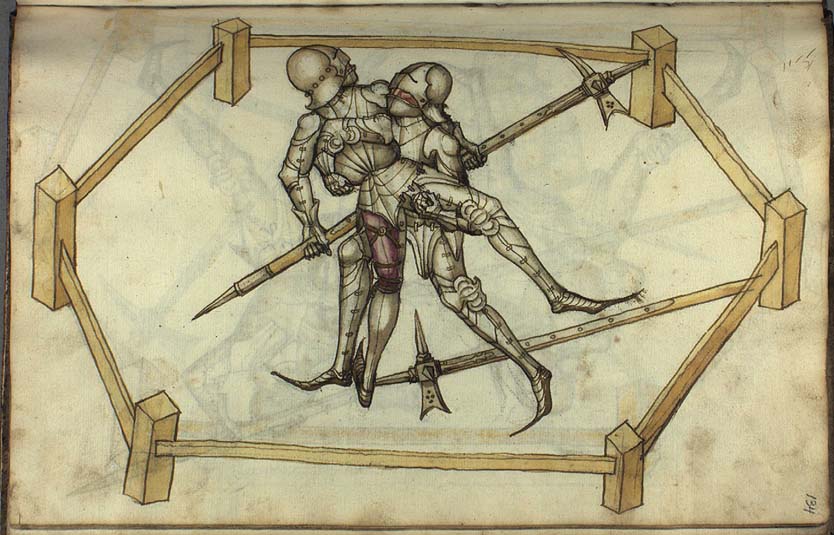
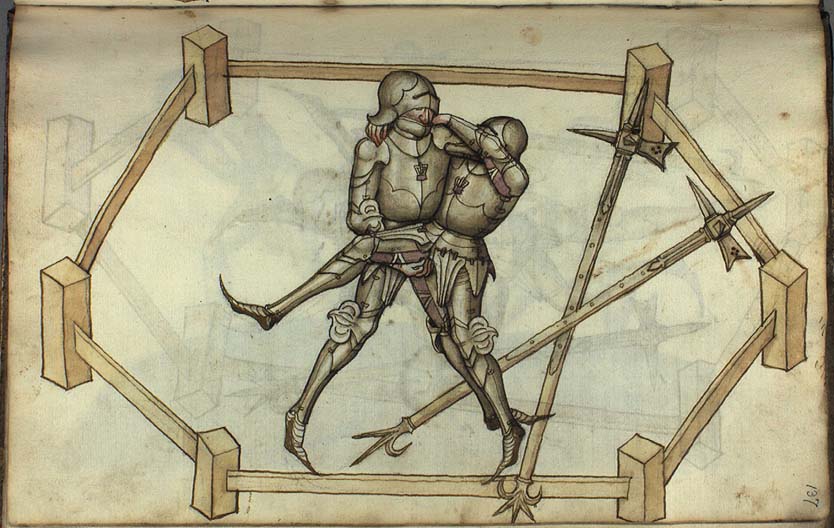
In fact, we have a specific counter to the “collar throw” in Talhoffer 1467 (BSB Cod.icon. 394 a ff. 43v-44r): Here we see the takedown, and here we see the counter. Clearly, the second plate shows a different technique from the one Tobler included. Thus, not only did Tobler extrapolate a technique from a different form, he did so when we already had a perfectly viable pollaxe technique in the canon, making his extrapolation unnecessary.
Second, Tobler demonstrates the technique in a way that suggests he has never actually performed it at full speed against a resisting opponent. The subject in the DVD is barely even unbalanced because Tobler does nothing to break his balance nor to control his motion. Doing this throw correctly requires much better control over your opponent’s arm in order to actually throw him—merely trapping his hand up against your shoulder will not work against a resisting opponent. The best pictorial source for this is in the Goliath Fechtbuch (see MS 2020 fol. 63r) and can be seen here.

As can plainly be seen, the thrower in the picture above has much better control because he is using both hands (although it can be done one-handed) and because he has pulled his opponent’s arm down across his shoulder to break his balance and to create leverage. So Tobler should not have extrapolated this technique from one form to another because a counter to the takedown already exists, but having done so, he should have demonstrated it correctly.
The greatest advantage of a DVD over a book, when it comes to interpreting a martial art, is that the book can never show the flow of a technique nearly as well as a video can. Most books include only a few photographs for each technique, and the reader must connect them in his own brain to understand what the technique should look like. This DVD, however, contains so many errors of execution that they overcome this advantage. The most common problem, and it manifests in almost every technique demonstrated in the video, is one of measure, that is, the distance between the opponents as they perform the technique.
This excerpt from Tobler’s video illuminates the problem very well. Look at the first set of exchanges: The attacker (on the right) strikes well in front of his opponent directly into the defender’s axe. He makes no effort to strike his opponent at all. As a result, the defender does not really have to make any defense whatsoever; he could just as easily step straight forward after his opponent attacks and hit him with no difficulty. Now watch the rest of the clip: This error is not the exception, it is the rule in every single case, and not just in this excerpt, it is the case in almost every demonstration throughout the entire video. If the attacker had struck at the side of his opponent’s head, as he should have, then many of the techniques could not have been performed as shown in the video because the defender would have to first move the attacker’s axe over to the other side of his head. Thus, there are techniques in the video that literally cannot be done against an opponent who strikes correctly.
For example, at the end of the chapter on the Durchwechseln, Tobler says that if we bind we can leave the bind and strike around to the other side in a play reminiscent of Ringeck’s play of the Zucken (“twitching”) with the longsword (see 28:07). In effect, you bind, then pull your axe directly back from the bind and strike again immediately on the other side of the enemy’s shaft. As with other techniques in the DVD, this technique is both non-canonical and flawed in execution.
The problem of execution has to do with the afore-mentioned problem of measure: Since the attacker is striking well in front of the defender this seems as though it should work. Against a proper blow aimed correctly at the left side of the defender’s head, however, it will not work. This is because when your opponent tries to strike you in the head his axe head will not be able to move around your axe. When you displace it, his axe will still be to your left. In order to pull back and then strike around to the other side of your opponent’s axe, you must find a way to put his axe on your right side, which cannot be done unless he, too, pulls his axe back, in which case you do not need the technique in the first place—you can just hit him. A video demonstrating why this technique does not work can be seen here.
This failure of measure is indicative of the broader problem with the execution of many of the techniques in the video: It is apparent from the way many of the techniques are executed that Tobler and his students have not practiced these techniques in a full-speed, full-power environment against an opponent who is resisting their efforts. If they had, they would have realized that some of the techniques that Tobler extrapolated from other forms cannot be made to work with pollaxes, and that some of the pollaxe techniques have to be performed somewhat differently from the way they are presented here. Without that sort of experience, gained over years of effort, it is impossible to truly understand this material, and that lack of understanding is patently manifest here.
Finally, we must consider one other area. We have discussed some of the things shown in the DVD, but we must also discuss the things not included in the DVD. Tobler claims to present a complete system of German pollaxe combat, and yet some of the principles and techniques of the art are simply ignored.
One of the defining differences between unarmored and armored combat is that in the former, relatively little force is required to severely wound your opponent with a cutting technique. When striking at an opponent in armor, however, the circumstances are quite different. Armor is highly effective at dispersing the force of a blow, and only a very powerful blow can hope to stun an opponent or smash bones through armor. At the same time, one must bear in mind the unbalanced nature of the pollaxe, which, unlike a sword, has the majority of its mass concentrated in the head. This forward concentration of mass tends to cause powerful pollaxe blows which miss their targets to whip past the center line of the engagement, travelling well out to the side or down to the ground, and leaving the attacker helplessly exposed to a counter strike from his opponent.
The anonymous Burgundian pollaxe manual Le Jeu de La Hache specifically addresses this subject: “Whichever guard you are on, you can try to hit him on the head. Not so that if you should miss your axe passes beyond him, because that would be dangerous” (Le Jeu paragraph 22). Learning to strike with enough power to do your opponent injury while, at the same time, controlling your attack so that if you miss your pollaxe does not swing wildly past him, leaving you exposed, is something that takes a fair bit of time and knowledge to master. It is difficult to understand, then, why a DVD touted as a “complete, 500 year old system of knightly combat” (see the back cover of the DVD case), fails to even mention this subject.
In fact, Tobler discusses very few of the issues relating to attacking an armored man, other than a brief discussion of different ways to strike the face depending upon the position of the visor and a few vague notes about aiming for gaps in the harness. Different targets require different approaches; targets for the thrust must be handled differently according to whether the target is protected by mail or not, and only certain targets (e.g., the head and hands) are ideal for striking blows. Understanding not just how to strike or thrust but where, and how to do so differently according to the nature of the target, are critical elements of any complete system.
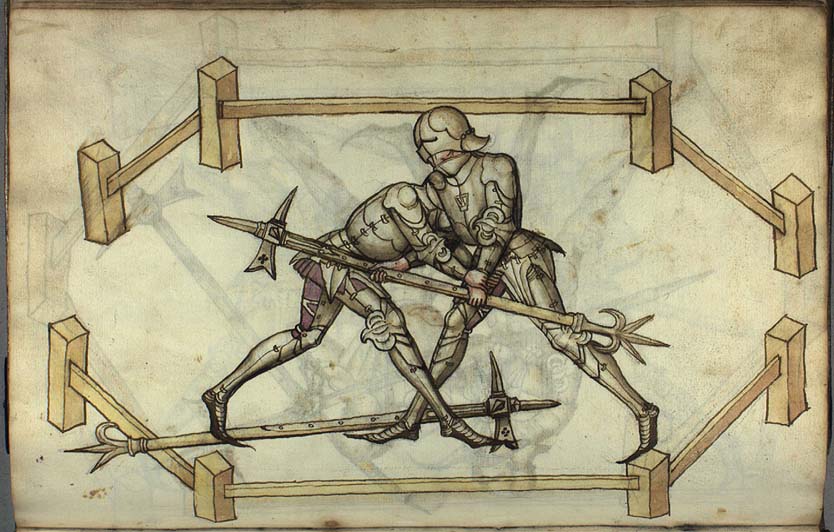
As for missing techniques, consider this technique from Talhoffer 1467 fol. 49r, an excellent and highly effective elbow push from the bind, or this technique from the same source (fol. 51r) which demonstrates a very effective Hinderbinden or “bind behind” counter to an Oberschlag.
By far the largest group of techniques left out of the DVD, however, are the grappling techniques. Grappling was a part of all German forms of combat, but was especially important in armored combat given the effectiveness of the armor against strikes and thrusts. It is confusing, therefore, that Tobler gives us only a few hooks and the collar takedown, leaving out all mention of the many other grappling techniques depicted in the Fechtbücher, such as these: Talhoffer 1467 fol. 45r, Talhoffer 1459 ff. 134r, 135v, and 137r. Surely, a “complete” system of instruction would have addressed these important principles and techniques.
Conclusion:
This DVD is well produced, but contains large numbers of errors in scholarship, execution and omission. As a result, this DVD cannot be recommended for any purpose.
Review by Hugh T. Knight, Jr. Copyright © 2010, all rights reserved. This review may not be copied or presented in any format whatsoever without the author’s express permission.
Thursday, June 17, 2010
An Error In My Longsword Book

I just discovered an error in my longsword book. On page 155, "The Right Abschneiden From Above," in the last paragraph the text says to pull down into a right Unterhengen using a thumb grip. In fact, this should not be a thumb grip and I have never taught it that way; this was probably a matter of getting confused as to which page I was on at the time, and, unfortunately, it slipped through the editing process. I apologize for any confusion this error may have caused.
Subscribe to:
Posts (Atom)