Friday, April 25, 2008

What Is Intent?


The word “intent” gets bandied about a lot in WMA circles these days, and with good reason: Intent determines the realism of practice. I think, however, that sometimes people mistake the meaning of the word in our context so perhaps a little insight into this much-misunderstood word might be in order.

In my Jujutsu days we used to speak of someone as being a “good uke”, and it’s worth looking at that idea as a way of understanding intent. In Jujutsu the person who “loses” the engagement when executing a technique (not that anyone loses—but that’s for another discussion; in this case we’ll use the term for simplicity’s sake) is called the “uke” while the person who executes the final technique is called “tori.”

When some people talk about a good uke they mean he attacks in a way that makes it easy for tori to do the technique—a slow and obvious attack—and then goes along with the counter easily, making a big, flashy fall regardless of how well tori actually executed the technique. Some older instructors who are past their prime need students like that to “prove” they still have “it.” But this kind of uke teaches no one anything; his actions aren’t realistic and so a student doing the technique never learns anything.

Others say a good uke is someone who smashes a student with a powerful attack he can’t possibly counter at his current level of development so he sees what it’s “really like.” These folks are usually insecure “instructors” who are referring to themselves and want to make those around them see how powerful they are: “Look at me, I’m so good you can’t even do this technique to me because of the power of my mighty attack.” Another flavor of this problem is those who want to act absurdly macho; they usually speak too much of “real fighting” and “street practicality” (not that these concepts aren’t important—they are, but you can’t drop most students in at the deep end and expect them to swim straight away) and not enough of form and technique and discipline. These are usually very young people with little real understanding of serious combat who have watched too much television about “gangstas” and far too much absurd MMA; they are usually identifiable by their counter-culture look, their rejection of traditional martial arts methods and values and their lack of serious progression. These two flavors of mistake fail just as miserably as the uke above who goes along too easily: Both create students with no understanding of the real fundamentals.

A good uke is someone who acts and reacts “with intent” but who balances intent with an understanding of the person acting as tori. That means uke must have the insight to see tori’s level of development and must attack with just the right amount of intensity: enough to challenge tori, but not so much that it will overwhelm him if he really *tries*. Likewise, uke must respond to tori's technique realistically: If tori does the technique that’s being practiced correctly—given his current level of development—it should succeed; if not, it should fail.

So, in short, a good uke is one who does his job in such a way that if tori does everything to the best of his ability then the technique they’re practicing together (there really are no winners and losers) will work the way it’s supposed to.

Those who know me know that I work very hard to keep my Japanese martial arts experience from tainting my German martial arts practice; they are not at all the same, and I would consider it a shame to have the one taint the other. On the other hand, some training principles are perfectly suited to both, and this is one of them.

I think by now my definition of the word “intent” should be perfectly clear. Attacking with intent means that you attack as you would in a real fight, but that you temper that based on two things: First, the skill level of the person you’re attacking, and second the purpose of the drill, which should be to practice a specific technique or sequence of techniques. If you fail to consider the first thing you’ll never teach your students anything; all you’ll really do is make them either think themselves incapable of learning or make them believe the art itself is flawed.

If you fail to consider the purpose of the drill your student will never learn how the specific technique you’re practicing actually works and will therefore never be able to apply it in a realistic situation. Case in point, let’s consider the Block Croix technique with the pollaxe from Le Jeu de La Hache (para. 7-8): If the teacher attacks too gently (for the student’s level of skill, remember!) the student will never feel what it takes to stop the initial swing; if he swings too hard he will blow through the student’s defense and prevent the student from learning how the technique works. If the teacher doesn’t swing at the student’s head (many people, scared of hitting others, swing “short”, so that the blow would not have been able to hit the student) the student will never learn the “measure” (Liechtenauer: “all arts have length and measure!”) of the technique, which is fairly tricky with this particular technique. If the teacher does something “tricky” as he swings his blow the technique will fail and the student will be confused as to what the technique is actually supposed to do. (You can see the Block Croix in the video clip below.)

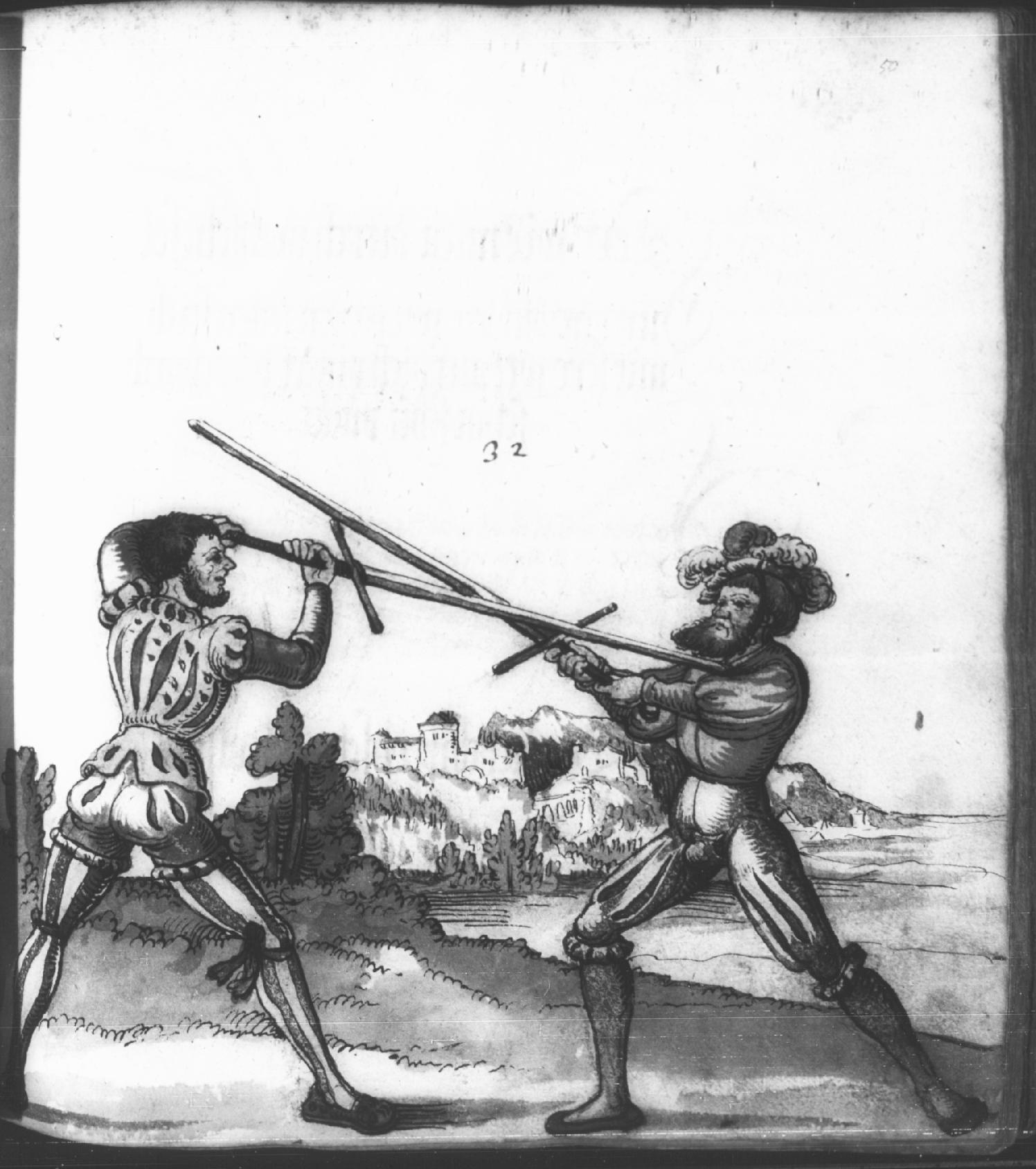
Acting with intent is important for the student, too. It’s easy enough to do on a single technique, but in a technique with multiple parts students often fail because they focus too much on the last part of the play. For example, let’s consider the cross-knock used when someone binds against your Zwerchau with the longsword: The teacher attacks with an Oberhau and the student responds with a Zwerchau to the teacher’s head that is intended to displace the blow and kill in one motion. The teacher then changes the arc of his cut to bind hard against the student’s Zwerchau in order to prevent himself from being hit, so the student knocks the teacher’s blade to the right with his cross to prevent him from responding for a moment while the student whips his sword around to strike another Zwerchau at the other side of the teacher’s head.

In order for the student to properly understand this sequence both the teacher and student must do things in a very specific way: The teacher must cut directly at the student’s head with an appropriate level of speed and force. The student must respond with a real attempt at a Zwerchau; here’s where most students err—they know they’re practicing the cross knock so they do a half-hearted Zwerchau that wouldn’t have worked at all. The teacher must then bind hard against the middle of the student’s blade or else the student won’t get the play; the cross knock doesn’t work, for example, if you bind at the point of the sword (in which case the student should Durchwechseln), so the teacher would be cheating his student. Then the teacher should hold fast in the bind so that the cross knock actually does what it’s supposed to.

(NB: Once a student has mastered the basics, of course, the teacher can build drills that create choices; for example, the teacher might do everything up to the bind described above, then vary his bind either to middle of the sword or to the point, forcing the student to actually read the bind and respond correctly. But this can’t be done until the student is doing the individual techniques correctly and without conscious effort.)

Another example is the Winden: When swords bind the teacher must hold a hard bind with his point on line (i.e., aiming at the student), and the student responds with the Winden. If the teacher pushes too much then the Winden won’t work; that’s not a failing of the Winden, it’s a different situation to which the student should respond by moving smoothly into the second Winden. But there’s no reason to push that way at first while the student is still learning the first Winden! The teacher must act correctly for the specific technique being practiced. Likewise, when the student is learning the second Winden he should still perform the first Winden with intent and only move to the second Winden when forced to do so by pressure on his blade from the teacher. After both Winden are learned well enough the teacher can make the exercise into a drill wherein the student must do the correct thing, either thrusting through with the first Winden or changing to the second, but in that case the teacher must limit his actions; pushing his sword up into Kron, for example, doesn’t belong in that specific drill.

Intent, then, isn’t about battering your training partners or students into humility, it’s about making your practice as realistic as possible based on the skill levels of the two people involved. Attack hard and fast, yes, but not more than your partner or student can handle. Make it as challenging as you can, and don’t let a poor technique succeed, but don’t create a no-win situation, either. Do *each* part of a technique or sequence of techniques as perfectly and as realistically as possible, as if you didn’t know what the next part was going to be. To the extent your gear and training permits, always aim for the correct targets. And, of course, always remember that you’re not out to really hurt anyone; use control. A little pain is good, of course, especially when it comes as a result of doing something wrong—our Schule motto is “Was Sehrt, das lehrt” (what hurts teaches)—but no one should be really damaged, and pain is pretty useless with a complete novice since they’re doing everything wrong at first.

So do techniques as fast, as hard and as accurately as possible while considering the skill levels of the people doing the techniques and the needs of safety (within reason). That is acting “with intent.”

Monday, April 21, 2008

A Correction To My Book: "Fencing With Spear And Sword"

I've been refining my Gladiatoria Fechtbuch translation in preparation for trying to find a publisher, and in so doing I've discovered an error that I made both in my translation and in the interpretation of the play I put into my book Fencing With Spear And Sword.

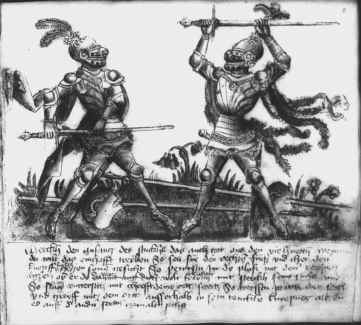
This is the plate: fol. 8r

The text says:
Merckh den anfang des stuckhs das auch get aus den vir huetten wenn du wilt das enthafft treyben So setz für den rechten füesz vnd cher den knopff fur sich gegen seinem gesicht So pewtstu Im dy plosz mit deinem rechten vgsen ob er dy ploz wolt trayben oder suchen mit sterckh seins stichs vnd So slach vnttersich mit chrefft deins ortt swertz So weysstu Im aus den stich vnd greyff mit dem ortt ausserhalb in sein tenckhe knyepueg als du es auff der andern seytten gemalt sichst

Which I now translate as:
Note the beginning of the technique that also derives from the four guards. When you want to do this seriously move your right foot forward and turn your pommel forward towards his face, thus you offer him an opening at your right armpit. If he means to seek or exploit your opening with a strong thrust then stab down with strength with your sword’s point. So you displace his thrust, and grab with the point from the outside in his left hollow of knee like you see it in the next picture. [Continued on fol. 8v]

Originally, I translated the text to mean Ralph (i.e., the figure on the right) steps forward with his right foot and moved his pommel forward to void Larry's (i.e., the figure on the left) thrust; the idea was that Larry makes a thrust from below at Ralph's left armpit (which is exposed when he's in the upper guard) so Ralph steps in while changing the side that’s forward in order to make Larry's attack miss.

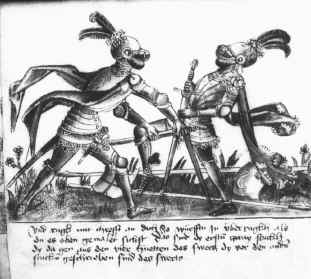
In re-examining my translation, I now see that the text really says Ralph switches to the right-leg lead shown in the plate to invite an attack to his right armpit so he is better set up for a leg hook. The leg hook itself is then shown in the subsequent plate, fol. 8v.

You can see this play in my Fencing With Spear And Sword book on p. 76: "Left Knee Lift Counter to an Unterstich".

My motions are still exactly correct, it's just that I should change feet before the thrust rather than in response to it.

My sincere thanks to Dr. Jeffrey Forgeng for the patiently-given insights that helped with this correction.

I'm sorry for any judicial combats you have lost as a result of reading my book and doing this technique incorrectly.

Tuesday, April 15, 2008

What is a Master?


Let’s shatter some modern cultural assumptions, shall we? In this country we have a certain idea about the word “master” that doesn’t translate well to the medieval mindset. Raised on bad kung-fu movies (and my, but isn’t that redundant!), many Americans associate the word master with a wizened little Asian man capable of leaping tall buildings while kicking down trees, all the while uttering clumsily cryptic nonsense with a sage expression on his face. A master seems to be someone who has spent a lifetime learning his art and who’s ability is so far beyond other practitioners that it seems magical.

Since this blog is about western martial arts I won’t get into why that use of the word doesn’t really apply to Asian martial artists the same way (Shihan means Shihan; the word we associate with it isn’t a good definition if the connotation is unjustified). Instead, let’s look at what the word “master” meant in medieval Europe.

In Europe a child destined for a skilled trade would leave his parents at a very young age (often his early teens) to be apprenticed to a craftsman. He would spend several years as an apprentice, learning the trade while doing labor to pay for his keep. When the apprentice had learned enough to really be of use to his master in the craft he was studying he would be called a “journeyman”, and would spend several more years working at that level. Finally, when he was ready to go out on his own, he would prepare a “masterwork”—an example of his work that would demonstrate to the guild in which he worked that he was ready to take the next step.

Incidentally, this is another way we’ve ruined our own language: Today, we use the word “masterwork” to refer to an object that represents the apex of a long life of dedicated work and study; we see a “masterwork” as an example of the very highest skill that can exist in a craft. Michaelangelo’s David is often called a “masterwork.” Nonsense. If that was the standard called for to achieve the rank of master in a craft guild then almost no masters would ever have existed. The very basis of how we think about words has been corrupted.

Going back to our young journeyman, he would prepare a masterwork to be judged by a council of guild masters. Think of it like a final exam, if you will. If they judged his work to be acceptable (not exceptional—acceptable) they would confer upon the young man the rank of master and he’d happily go off to set up his own shop. Thus, we can see that in medieval Europe a “master” was someone just getting started on his own in a craft or trade—nothing at all like we think of the word today.

While we don’t have information on rank structure among fencers from medieval Germany—our primary focus here, of course—we do have some from Renaissance England. A student of the sword in late-period England was called a schollar. After some period of training (probably a couple of years, but my sources aren’t specific meaning it probably varied considerably) a schollar would be tested in practice bouts and if he passed he’d become a provost—the lowest rank that was allowed to teach. After some time as a provost he would fight more practice bouts against other provosts in front of “ancient masters” (presumably high-ranking guild officers) and, if he did well enough (he didn’t need to win all his bouts, just demonstrate an acceptable level of proficiency), he would be granted the rank of master. One source, at least, says that you had to be a provost for seven years before attempting to test for master, but there are records of men doing it in far fewer. (Wagner, P., Master of Defense: The Works of George Silver, Paladin Press, 2003, pp. 11-12) Note that: The bouts fought were against other provosts, not high-ranking masters, and the prospective master didn’t need to win all of his bouts. This clearly shows how skewed the modern notion of a master being a godlike killing machine really is.

This system still exists today in some crafts: The art of falconry is still practiced in the United States today; it is one of the most carefully-regulated arts extant, with very precise rules about who may do what and when. When someone starts to learn falconry he must spend two years as an apprentice under the direct supervision of a more experienced (but not necessarily master-level) falconer called the “sponsor.” After that, if the sponsor agrees he’s done well enough the falconer becomes a “general falconer”, a rank which he holds for five years. At the end of five years the general falconer automatically becomes a master falconer. I’ve heard many master falconers say they may be masters but that they haven’t yet “mastered” their craft; here we see a different use of the root word, and this use is perfectly valid: master is a rank, and not a very high one, but mastery is something few masters obtain but for which all should strive. Ignorance of this lexicological distinction is one of the main reasons why people today don’t understand the correct use of the word.

While we’re on this subject, let’s consider the word “Fechtmeister”: The word means “fight master” or “fencing master”, and is a job title, not a claim to rank. It is analogous to a “choir master” or “dance master.” Someone fresh out of school with a still-damp degree in music might be hired at a church, for example, as a choir master without a lifetime of practice and experience. A Fechtmeister is the same thing: He is someone who runs a school that teaches German martial arts, nothing more. Too many of the people who teach der Kunst des Fechtens are afraid to use the title Fechtmeister today for fear of ridicule, but that merely shows they are deserving of ridicule for not understanding the structure of what they do. If you aren’t skilled enough to teach don’t open a school; if you are and you do then you’re a Fechtmeister. People need to get over their misunderstanding.

In conclusion, those who decline the title of master out of some misplaced sense of false modesty need to set aside their ignorance and learn to use the word in its medieval sense. Those who laugh at them for doing so merely bray out their own ignorance.

Tuesday, April 1, 2008

Attacks as Transitions From Guard to Guard


Some modern books on German swordsmanship have argued that all attacks are transitions from one guard to another in spite of the fact that no Fechtbuch makes that claim. This is an issue because adherents of test cutting who struggle to justify their pernicious practice argue the existence of the guard Alber proves the Oberhau is done from vom Tag to the ground, as if there were no reason for any guard except to be an endpoint to an attack.

In fact, guards are never the endpoint of attacks except incidentally. Instead, attacks are done from guards (usually) to either Langenort (‘long point’) or to one of the four Hengen (‘hangings’). Hanko Döbringer (or whomever wrote Hs. 3227a) tells us this about cutting: “And this art is quite earnest and righteous, and it goes from the nearest in search of the closest and goes straight and right when you wish to strike or thrust. So that when you want to attack someone it is as if you had a cord tied to the point or edge of your sword and this leads the point or edge to an opening.” (fol. 13v). This means we’re supposed to cut in a straight line from guard to the target, not a big swing. He adds to this later when he says: “For you should strike or thrust in the shortest and nearest way possible. For in this righteous fencing do not make wide or ungainly parries or fence in large movements by which people restrict themselves…they try to look dangerous with wide and long strikes that are slow and with these they perform strikes that miss and create openings in themselves.” (ff. 14r-v)

In other words, real swordsmanship is about making cuts as small and controlled as possible; not to the ground, but to Langenort. In fact, the earliest Fechtbuch, I.33, specifically says: “Note that the entire heart of the art lies in this final guard, which is called Longpoint; and all actions of the guards or of the sword finish or have their conclusion in this one and not in the others.” (Forgeng, J., The Medieval Art of Swordsmanship, Chivalry Bookshelf, 2003, p. 23).

You see, when you cut to Langenort you are stopping in a position in which your point threatens your opponent if you have missed, and thus you maintain control over the fight. If you cut to the ground you are not really threatening him at all. We know this approach is correct because Döbringer tells us so: “No matter how you fence always aim the point at the opponent’s face or breast, then he will always have to worry that you will be faster since you will have a shorter way to go in to him than he has to you.” (fol. 24r); and later: “Whether you hit or miss, always seek the openings with both your hands and learn to bring the point to the eyes.” (fol. 29v) So the idea is to cut into a position in which your point is in line for an immediate threat if you miss with your cut—something a cut to the ground can not do.

We read more evidence to this effect in Codex Wallerstein, which says: “So you fight against someone, and you come at him at the length of the sword, so both of you are going head to head. Then you should stretch out your arms and your sword far from you and put yourself in a low body position so that you have a good reach and extension with your sword and so that you may attack and defend yourself against all that is necessary. The reach is in your standing behind your sword and bending yourself; the distance is in your staying low, as shown here, and making yourself small in the body so you are great in your sword.” (fol. 3r) This is yet more evidence that when you cut you create a barrier between yourself and your opponent with your sword; something that cutting to the ground can not accomplish.

It must be admitted that you can cut to the ground on purpose as a way to lure your opponent into acting as you want him to; this technique is called the Wechselhau and is seen, among other places, in Lignitzer’s third play of the buckler, but note that it is a special case in which you are deliberately acting to provoke a response. Note, too, that the Wechselhau is not Alber, so the argument that the existence of Alber proves you are supposed to cut to the ground is specious.

Not only does cutting to the ground cost you the defensive capabilities of your point and yield the important center of the fight, but it is also dangerous because it gives your opponent an extra “fencing time” in which to act. The masters tell us to react to someone who does this with a technique called the Nachreisen (‘following after’): “When he strikes an Oberhau and brings the blade down with the strike, travel after him with a strike on the head before he can get his sword up again.” (Tobler, C., Secrets of German Medieval Swordsmanship, Chivalry Bookshelf, 2001, p. 93) What this means is that if someone is foolish enough to over cut in such a way as to lower his point to the ground he has to cut, stop at the bottom of his cut, then pick his weapon back up before he can do anything. In the case of the Wechselhau this can be done because you intended it all along, but in the case of someone who merely missed his target you create a moment in time for your opponent to act.

By using short cuts to Langenort do we make our cuts ineffectual? Not at all: Not only does cutting to the ground expose you to a Nachreisen, but it is not necessary for a fight-ending blow. Medieval swords were sharp; not as razor-like as people like them today (such edges are usually delicate because they are thin), but sharp none the less. It takes very little strength or effort to cut into a skull or hack into an arm with a good sword. The cut may not be perfectly clean, and the head or arm may not be cut completely off, but then you do not need to do that to win the fight, and not giving your opponent the initiative of the fight more than outweighs the loss of a perfectly smooth cut.

Having thus proven that cutting to the ground with an Oberhau is based on a misunderstanding of der Kunst des Fechtens (except for the special case of the Wechselhau) let us now go on to explore the other kinds of attacks of the system. All of the other attacks in the German system except for the Oberhau and the Zornort (‘thrust of wrath’: a thrust done into Langenort) end up not in guards, but in one of the Hengen. There are four Hengen, and they correspond to the guards Ochs and Pflug, but are done, usually, with the arms more extended. The problem with seeing this lies in the fact that the precise nature of the Hengen is determined by the range to your opponent rather than a precisely-determined position relative to you. Worse, some authors (e.g., the Goliath Fechtbuch) are sloppy about terminology, using the names of the guards indiscriminately in place of the Hengen.

As an example we will consider a Zwerchau: Some have likened the Zwerchau to a transition from vom Tag to Ochs along a horizontal line. In reality, however, Ochs is a specific position with your hilt near the right side of your head: If your opponent is farther from you than your sword can reach in that position you must extend your arms to hit the target. Thus, we can more accurately say that the Zwerchau is a cut executed in a horizontal line from vom Tag to the Oberhengen on your left side. Of course, if your opponent is closer the Oberhengen might be in roughly the same position as Ochs, but that is coincidental. Thus we see that the guards are determined by the position of your sword relative to you but the Hengen are determined by the position of your sword relative to your opponent; a subtle but very important distinction.

As another example consider the Winden; here we are explicitly told to move our sword from Langenort, winding it am Schwert (’on the sword’ or in contact with the opponent’s blade) back towards the weak of his blade (near the tip) into the Oberhengen. If you displaced your opponent’s original cut so that his sword never reached your head then winding back to Ochs will actually move your sword off of your opponent’s blade. In actuality all you need to do is to wind back far enough that you are on the weak of his blade before thrusting, and this is always going to be forward of the guard Ochs: It is an Oberhengen, as can be seen here, not Ochs.

The same is true of all of the techniques in der Kunst des Fechtens: The upper Absetzen is not a transition from Pflug to Ochs, it is a transition from Pflug (or Alber; this is a lovely and sneaky variation—see below) to the Oberhengen. Likewise, the lower Absetzen is a transition from Pflug to an Unterhengen. Döbringer explicitly tells us this: “One technique is called the Baking Master [Weckemeister]. And it comes from the Unterhengen on the left side, seeking with the point after the Absetzen.” (fol. 47v)

The Schielhau is a transition from vom Tag to an Oberhengen, just as the Zwerchau, but in this case the transition is vertical rather than Horizontal; it is as plain as day when you think about it and study the Fechtbücher. Here is a picture of Ochs from the Meyer Fechtbuch (the figure on the right) and here is a picture of the Schielhau showing clearly that the wielder is in an Oberhengen. Clearly the wielder’s hands are well forward of Ochs.

What, then, is the purpose of Alber if not a mere ending to an Oberhau? If merely an end to a cut it would not rate as a guard, and yet it is one of only four guards. In reality, Alber is a subtle, dangerous position used as a guard of provocation. You assume it not as the result of a cut that missed its intended target, but in the Zufechten (‘pre-fencing’; the time before an engagement begins). As we said before, cutting to Alber if you missed your target will get you killed by an opponent using the Nachreisen or Uberlaufen. But if you start in Alber you are encouraging your opponent to attack in the way you want or else you are attempting to appear helpless.

Admittedly the Fechtbücher give us relatively few techniques to use from Alber, but there are some and they suggest more. Consider Döbringer, who tells us to use this guard (although he uses a different name for it; like Talhoffer he calls it the Iron Gate) against multiple opponents: “If you are set upon by four or six peasants, then place either foot forward and with the gate you will create a shield by placing the point towards the ground. Hear how you should do this, place yourself so that they are right in front of you and that no one can get in behind you. Now hear what you should do, when they strike or thrust at you, Absetzen with strength going up from the ground and then you will shame them well.” (fol. 44v) Note that this uses Alber from the Zufechten, where it is safe to assume, not in the Krieg ('the war'; the term refers to the phase of the fight that occurs after you have engaged) where it is dangerous to do so because you move away from a threatening position without doing anything to render your opponent helpless.

In conclusion, most of the people who argue attacks are transitions from guard to guard are either seeking a philosophical symmetry in fighting that does not exist and is certainly not mentioned in any of the Fechtbücher or else seek to justify the pernicious practice of test cutting. As I have shown, neither position is valid: Attacks are transitions from guards, which are assumed in the Zufechten, to either Langenort or to one of the four Hengen. Attacks can, of course, also originate in one of the Hengen or in Langenort: if you attack and are displaced you can assume Langenort and use Fühlen to determine your opponent’s intention and then act from there (this is part of the concept called the Sprechfenster), etc., but that part is never in dispute. And while the Hengen can resemble the guards Ochs and Pflug, they are distinctly different because guards are determined by the position of your sword relative to you while the Hengen are determined by the position of your sword relative to your opponent.

Sunday, March 30, 2008

Practice Longswords

Frankly, I think Albion makes the best swords I have ever seen; I am currently trying to save for an Earl, I'd sell my soul for their Munich, and I wish I could justify buying their Poitier—it's the best-handling arming sword I've ever touched. Unfortunately, there's no reason at all, from a WMA standpoint, to ever own a sharp—they're purely for decoration. You can't practice with a partner with a sharp because you'll kill each other, yet all practice should be done with a partner or on a pell, and the pell will ruin your edge (in period they used double-weighted swords or swords of wood on pells), and you should never engage in test cutting because it will ruin your ability to cut correctly (see why here).

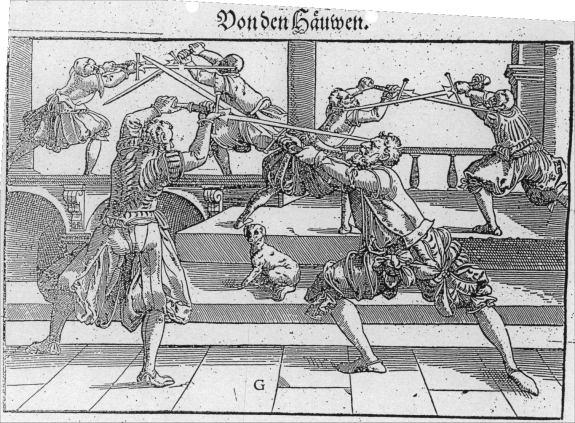
On the other hand, I'm extremely disappointed in Albion's line of practice longswords. They offer two longswords, the Liechtenauer and the Meyer, and neither is worth owning. We already know how medieval sword makers made practice swords because there are two extant models at the Met (these were copied by Arms & Armor for the Fechterspiel; you can see them in the picture at the beginning of this essay) and another in Switzerland (which was copied by Hanwei for their Federfechter), but Albion ignored these excellent examples and, like SCAdians with no discernable interest in history, decided to figure things out on their own.

A practice sword should have thick edges to minimize injuries during practice, but doing so makes the blade far too heavy. As a result, medieval sword makers made swords with very narrow blades and thick edges; in essence, the same amount of steel as a sharp, just redistributed. They also added a very wide reinforcement called a Schilt ("shield") near the cross to reinforce an area that would be very prone to breakage if it had a narrow blade. When you do all of that you have a weapon identical to the Arms & Armor Fechterspiel, and that's why our Schule uses them exclusively.

Albion, on the other hand, chose to ignore the medieval way of doing things and simply make a wide, deep fuller down the length of their blade in order to reduce overall blade weight. This works, but it's not a medieval practice and therefore has no value: After all, why practice a medieval art while eschewing medieval practices? Worse, Albion's Meyer is a Fechterspiel-style sword of the sort depicted in Meyer's Fechtbuch, but still used the wide, deep fuller to lighten the blade, even though they added a Schilt as Meyer's Fechtbuch shows; in other words, they're the same style of trainer as the ones at the Met that Arms & Armor copied for their Fechterspiel, but either Albion doesn't know that (which would be a terrible shame), or they just don't care—which would be an even worse disgrace.

The Arms & Armor Fechterspiel is a superb weapon. It handles as well as any sword I’ve ever used, is designed and built according to medieval designs and principles, is durable and very safe to use (bearing in mind that it’s still a weapon, and while not sharp is still capable of lethal blows) and is quite handsome as well. The balance is spectacular. The Fechterspiel comes in two versions, one with polished furniture and the other with rough castings, but frankly, there’s little to choose between them. I own two, one finished and one not, and they have held up marvelously in heavy practice.

The point of the Fechterspiel is simply rounded off, and while nice for some kinds of practice, tends to slide off too easily during actual thrusting practice. To compensate I purchased rubber bird blunts from an archery supply house and taped them in place. When you thrust against a mask they “stick” enough to simulate an effective thrust. In addition, the flex in the Fechterspiel blade is such that it absorbs most reasonable thrusts so they don’t hurt as much.

The only slight criticism I can make of the Fechterspiel is that the leather on the hilt has a thick seam which can rub your hands badly over the course of a long practice. I wish Arms & Armor could find a better way to sew the leather, but I’d rather have it as it is than have a glued edge that comes apart in the course of heavy practice as often happens with lesser weapons.

Of course, just as with any tool the Fechterspiel requires maintenance. They’re made of steel and so prone to rust, and while the steel is hardened well it still tends to get nicked in practice. I assembled a small kit for sword maintenance: It contains silicone-impregnated cloths from a firearms supply company, blocks of polishing compound suspended in a rubber matrix much like large pencil erasers, a file, a rag, a bottle of machine oil, and spare rubber blunts and tape. When I get home from practice I use the file to eliminate nicks and burrs in the blade and cross, then smooth the filed areas with the polishing blocks. I then wipe the blades and furniture with the silicone cloth unless I don’t intend to use them for quite some time, in which case I oil them carefully. It is very important to dress nicks and burrs right away because otherwise they can lead to weak spots in the blade and because they can draw blood from your partner when practicing things like slicing techniques.

The Fechterspiel is the only steel longsword allowed for practice in my Schule.

I have not yet had the pleasure of handling the CAS/Hanwei Federfechter, but like the Fechterspiel, it is a copy of an extant medieval practice sword currently in a museum in Switzerland. I have, however, had occasion to discuss this sword with people I trust. In general, most people found the sword to be an acceptable practice weapon with a few caveats: First, the blade has too much flex, which makes Winden practice problematic. Second, some of the parts are too “squared off”, which tends to make them a bit sharp (a few minutes with a file could probably solve this). Finally, some of the blades have broken in the course of normal practice. Whether these breaks are the result of an inherent flaw in the weapon or exceptions that represent swords slipping through quality control can’t be known at this time. I have to admit, however, that I find these swords extraordinarily ugly. They’re not inaccurate in design, but in the middle ages, just as today, some work was more elegant and more beautiful than others; these simply represent an aesthetic I can’t find appealing. Of course, that should have no bearing on their value as practice swords, it’s merely my taste. Even with all the flaws these swords have, they are very inexpensive for what they are and may deserve some careful consideration.

Friday, February 29, 2008

The Myth of Test Cutting


People love to take up their shiny, sharp swords and hack through various objects ranging from pool noodles to water bottles to rolled tatami. Doing so makes them feel cool and fierce and warlike when, in fact, all it really does is to lead them astray. This essay will show that test cutting has no value, no historical provenance, leads to bad swordsmanship, and confuses people about how swords work.

The idea of test cutting comes to us from Kendo and Iaido practitioners. Vast hordes of them practice test cutting of various sorts because they believe it will help them to cut better; they wax rhapsodically about it, actually, telling us that you can tell how perfect a swordsman’s cut is by how cleanly it cuts through the target while at the same time telling us that their swords are perfect razors whose merest touch will slice off a hand, apparently not seeing the inherent contradiction: If the sword is actually that sharp even a clumsy cut will kill—why do more?

In actuality, test cutting is not part of Japanese sword practice (well, not exactly). I know, I know, that sounds heretical, but it’s true. Bushi (what are know as Samurai today) didn’t do test cutting. “What?!” you cry, leaping to the scent of blood, “Have you never heard of Tameshigiri? Do you think we made that up?!” No, you didn’t make it up, you’ve been lead astray as to what it is.

“Tameshigiri was used to test the sharpness and quality of a sword: often it was carried out on dead bodies, tied-up living criminals, or bamboo straw test objects that had been secured to something. Educated or high-ranking bushi did not practice Tameshigiri, as it was purely a test of the sword’s sharpness, and in no way a measure of the samurai’s skills.” (Fumon, T., Samurai Fighting Arts: The Spirit and Practice, Kodansha Int’l., 2003, P. 49)

Bushi *did* practice one kind of cutting practice called “suemonogiri”, but that had a specialized purpose. When a bushi was going to commit seppuku, or ritual suicide, he would be assisted by another bushi called the kaishaku; his job was to cut off the head of the bushi performing seppuku (or almost cut it off—there were different kinds of cutting, but that’s outside the scope of this essay). Seppuku was considered an important ritual, and the kaishaku’s role was critical. Bushi spent hours practicing a huge, cleaving, ritualized cut (some ryu-ha have a kata devoted to it) to be used for the decapitation, and suemonogiri was an important tool in this process. But it *wasn’t* combat swordsmanship, and wasn’t practiced as such!

So: Test cutting had no relationship to combat.

Flash over to medieval Europe: We have no records of medieval knights practicing test cutting of any sort. There is one apocryphal story of Richard I but it didn’t actually happen, and it didn’t have any real combat relevance anyway. When we read about training in Europe we actually read only of training on a Pell; this is an excerpt from the anonymous Poem of the Pell:
“Of fight the disciplyne and exercise,
Was this. To have a pale or pile [pell] upright
Of mannys light [of a man's height], thus writeth old and wise,
Therewith a bacheler, or a yong knyght,
Shal first be taught to stonde and lerne to fight
And fanne [shield] of double wight tak him his shelde,
Of double wight a mace of tre [wood] to welde."

So we’ve established that test cutting has no historical provenance and no relationship to sword training. Now let’s look at what it does to your technique: When people practice test cutting they strive heroically to make a cut that’s smoother than the last time and which slices effortlessly through the target. Read any review of a new sword on the internet written by someone who believes in test cutting and a significant portion of his review will discuss how well they were able to do test cutting with it. But in order to get these smooth, perfect cuts the practitioners invariably (look at any video on YouTube) make huge, overblown cuts reminiscent of suemonogiri. They learn to make cuts that start from a high guard and end up with the point near the ground because this kind of follow through yields the smoothest cut.

But Hanko Döbringer (or whomever wrote Hs. 3227a) tells us this about cutting:
“And this art is quite earnest and righteous, and it goes from the nearest in search of the closest and goes straight and right when you wish to strike or thrust. So that when you want to attack someone it is as if you had a cord tied to the point or edge of your sword and this leads the point or edge to an opening.” (fol. 13v). This means we’re supposed to cut in a straight line from guard to the target, not a big swing. He adds to this later when he says: “For you should strike or thrust in the shortest and nearest way possible. For in this righteous fencing do not make wide or ungainly parries or fence in large movements by which people restrict themselves…they try to look dangerous with wide and long strikes that are slow and with these they perform strikes that miss and create openings in themselves.” (ff. 14r-v)

In other words, real swordsmanship is about making cuts as small and controlled as possible; not to the ground, but to a position usually called Langenort (“long point”). In fact, the earliest Fechtbuch, I.33, specifically says: “Note that the entire heart of the art lies in this final guard, which is called Longpoint; and all actions of the guards or of the sword finish or have their conclusion in this one and not in the others.” (Forgeng, J., The Medieval Art of Swordsmanship, Chivalry Bookshelf, 2003, p. 23). You see, when you cut to Langenort you’re stopping in a position in which your point threatens your opponent if you’ve missed, and thus you maintain control over the fight. If you cut to the ground you’re not really threatening him at all. (NB: You can cut to the ground on purpose as a way to lure your opponent into acting as you want him to; this technique is called the Wechselhau and is seen, among other places, in Lignitzer’s third play of the buckler, but note that it’s a special case in which you’re deliberately acting to provoke a response.)

Not only that, but cutting to the ground is dangerous because it gives your opponent an extra “fencing time” in which to act. The masters tell us to react to someone who does this with a technique called the Nachreisen (“following after”): “When he strikes an Oberhau and brings the blade down with the strike, travel after him with a strike on the head before he can get his sword up again.” (Tobler, C., Secrets of German Medieval Swordsmanship, Chivalry Bookshelf, 2001, p. 93)

Why do we cut to Langenort instead of to the ground? Simple: Not only does cutting to the ground expose you to a Nachreisen, but it isn’t necessary. That’s right, there’s no reason to do so. Medieval swords were sharp; not as razor-like as people like them today (such edges are usually brittle), but sharp none the less. It takes very little strength or effort to cut into a skull or hack into an arm with a good sword. The cut may not be perfectly clean, and the head or arm may not be cut completely off, but then you don’t need to do that to win the fight, and avoiding giving your opponent the initiative of the fight more than outweighs the loss of a perfectly smooth cut.

Another ugly habit that test cutting fosters is pulling the hands back slightly to prepare for the cut. It should be obvious why this is incorrect, but I have recently read people arguing in favor of it on various Internet sites. If you pull your hands back to “wind up” for a cut, even the most miniscule amount, you’re telegraphing your intentions to your opponent. Fencers who did this in the middle ages were called Buffel (“buffalos”; slang for a fighter who relies on huge, powerful strokes). They could be defeated either with the Meisterhau known as the Schielhau (“squinter”) or by a different variation of the Nachreisen: “If he raises the sword to strike, travel after him with a strike or a thrust and hit him in the upper opening before he can complete the strike. (Tobler 2001, p. 92).

So, test cutting has no historical provenance, no relationship to sword training, and teaches sword habits that can, at best, be termed “dreadful”. All it does is pander to a misplaced romantic desire to “cut something” with your sharp new sword, and there’s simply no value in that. Is there ever *any* value to be had in test cutting? Perhaps; people have, as I’ve said, an exaggerated sense of the lethal sharpness of swords (and I see the contradiction; I wish they did). The German tradition recognizes three primary kinds of attacks with a sword: Cuts (or blows with the edge), thrusts and slices. Many people believe that the merest touch of a blade on the flesh will give a lethal cut, and this simply isn’t so. This misconception leads to mistakes in the practice of slicing cuts, called Schnitten in the German tradition, in which the swordsman merely lays his edge on the target and pushes or pulls it along his opponent’s flesh. As anyone who’s ever carved a roast at dinner should know, this won’t be enough: you have to Schnitt powerfully with a heavy pressure of your hands to make a deep enough cut to be effective. There may be some justification for learning such techniques by test cutting, provided a realistic material can be found.

In general, however, the simple version is this: Just say no to test cutting.

Tuesday, February 26, 2008

A New Book on Medieval Grappling and Dagger Combat


I am very proud to announce the publication of the second book in the die Schlachtschule unarmored combat series entitled The Last Resort: Unarmored Grappling and Dagger Combat by Hugh T. Knight, Jr.

This book is intended to introduce the reader to the sophisticated techniques of medieval grappling and dagger combat as communicated to us from fifteenth-century German fighting manuals such as Hans Talhoffer’s fight books, Sigmund Ringeck’s “Knightly Art of the Longsword”, the anonymous “Codex Wallerstein”, Peter von Danzig’s fight book, the anonymous Gladiatoria fight book and several others. The intent of this book is to use a “dossier” approach to combine the techniques of several masters whose work is similar both stylistically and temporally to show a unified system of grappling and dagger combat as it would have been practiced in fifteenth-century Germany.

Mr. Knight begins with a discussion of the root principles of the German school of martial arts and how they apply to grappling to build a strategic framework for the art. He then goes on to use more than four hundred fifty photographs to take the reader step-by-step through breakfalls (not described in the fight books but necessary for safe practice); fundamentals such as stances, footwork, breaking your opponent’s balance, and strikes and kicks; more than forty grappling techniques, including counters and ways to counter resistance to your techniques; counters to common holds and strikes; dagger combat, including techniques for dagger-against-dagger fighting as well as unarmed techniques to use against a dagger-wielding opponent; and finally a section detailing groundwork techniques for finishing a fight.

This book will be of interest to anyone with an interest in medieval combat, history or martial arts in general.

The Last Resort: Unarmored Grappling and Dagger Combat has been published through Lulu.com and is only available for internet purchase at this time:

http://www.lulu.com/content/2077141

The author is the founder and head instructor of die Schlachtschule: The School of Battle in North Hollywood, CA, a school dedicated to rediscovering and practicing the knightly arts of combat from medieval Germany. He has more than 30 years of martial experience ranging from traditional Japanese sword and grappling arts to over ten years of German martial arts. He founded die Schlachtschule in 2003 and teaches a curriculum that includes sword, spear, pollaxe, grappling and dagger combat both in and out of armor. More information can be found on the school’s web site:
www.schlachtschule.org