
In a review of Christian Tobler’s recent pollaxe DVD I noted that Tobler failed to document the techniques in his DVD, making it very difficult for scholars of the art to know the sources of the techniques being demonstrated, which, in turn, made it difficult to analyze Tobler’s interpretations.
Last week I posted a video demonstrating that one of the techniques shown in Tobler’s pollaxe DVD was executed poorly. Replying in the comments section to my video, Tobler demonstrated the validity of my allegation about his failure to cite his sources. He claimed that my video, even though it matched the one shown in his DVD precisely, was not the technique he was trying to show; he also claimed that because of this, my complaint was invalid (see 28:07 on the DVD in the chapter on the Durchwechseln). The video clip and Tobler’s comments can be seen here.
According to Tobler, the technique he meant to show is one taken from the Paulus Kal Fechtbuch in Vienna’s KHM, manuscript KK 5126, specifically the fourth technique. In his recent book In Saint George’s Name (Freelance Academy Press 2010), Tobler gives this translation for the technique:
“Item: If binds to you such that both hammers stand above and strikes with brute force (lit. “peasant’s strike”), then sense this and pretend as if you intend to parry and let his blow pass before you so that you have the hook at the neck or a free stroke to the head, shoulder or arm.” (Tobler 2010 p. 68)
The technique shown in his DVD, however, represents an inaccurate interpretation of the fourth technique, and lacking any citation, this made it very difficult to identify the technique he was trying to show.
The version of the fourth technique shown on the DVD went like this: The attacker winds up for a powerful “peasant stroke,” and the defender started to move to displace the attack. The attacker never tried to hit the defender, instead, he swung his attack in front of the defender to bind with the defender’s displacement. Thus, the attacker’s axe is well out to the defender’s right side in the bind. From there, the defender simply pulls his axe back out of the bind, then strikes the attacker on the other side of the attacker’s axe.
The problem with this interpretation is that it does not reflect a plausible combat action. Had the defender started to counterattack it would be plausible for the attacker to change the angle of his attack to bind with the defender’s attack (but unlikely since we are told it is a “peasant’s stroke” or huge, powerful swing—not something easy to redirect in mid swing), but that is not what the text says: It specifically says that the defender feigns a Versetzen or displacement (Tobler prefers the word “parry,” however, that word should be used for deflections, not hard stops as shown here), not an attack. There would be no reason whatsoever for the attacker to change the angle of his attack, even supposing he could, to bind with a displacement; it makes no sense. The entire reason for using a huge, over-powered swing is to blast through any possible defense, so it is unreasonable to assume someone doing so would give up his attack for an unnecessary bind (since the defender's displacement does the attacker no harm) with no possibility of causing damage.
Also, note that the text says nothing about a bind actually occurring as is shown in Tobler’s DVD, it says to pretend as if you were going to do so.
Thus, Tobler’s interpretation clearly does not match the intent of the text. It is simply not reasonable to assume that a wild, overdone blow can be redirected in mid swing, and it is unreasonable to assume the user would want to even if he could.
A more reasonable interpretation of the fourth play focuses on getting the attacker’s axe to pass in front of the defender in a way that might actually happen in a realistic fight, and the author gives us the clue to understand that by specifying a “peasant’s strike.” Assuming the attacker has any sense of measure, he is striking at the correct range to hit the defender. Therefore, in order to cause the attacker’s axe to pass harmlessly to his front, the defender must slip back as the attack comes in. Then, since the attacker used a “peasant’s strike”—that is, one that is hard to stop or redirect—the attacker’s axe will swing harmlessly by, and the defender can step in at his leisure to hook or strike his opponent. This is the entire reason the anonymous author specified the “peasant’s strike,” to make it clear this is a case where a strike actually aimed at a real target (i.e., the defender’s head, not his axe) could be made to swing past harmlessly. This one clue makes the entire play make sense.
My students and I have prepared a new video demonstrating both Tobler’s flawed interpretation of the fourth play and a more reasonable interpretation as described above. That video can be seen here.
Thursday, July 1, 2010

Friday, June 25, 2010
A Review of Christian Tobler's Pollaxe Video
A REVIEW OF GERMAN MEDIEVAL MARTIAL ARTS VOLUME 1: THE POLEAXE (SIC) BY CHRISTIAN HENRY TOBLER
Reviewed by Hugh T. Knight, Jr.
Christian Henry Tobler is a widely respected figure in the Historical European Martial Arts (HEMA) community. He has produced four books on various aspects of Johannes Liechtenauer’s art, and some of them have been excellent. Tobler shines as one of the preeminent translators working with German Fechtbücher today.
Tobler’s most recent effort is a DVD purporting to teach a complete system of knightly pollaxe combat based exclusively on German sources. The DVD itself is exceptionally well made in every regard. The box is handsome and well printed. The cinematography, done by Speaking Window Productions, is superb. The pictures are clear and well framed, the sound is excellent, and the editing is very clean and avoids the “cute” transitions seen in some videos.
The material in the DVD, however, does not come close to matching the quality of the production itself. The “complete course” fails dramatically in both scholarship and execution. Space does not permit a complete discussion of all of the errors in this DVD, nor even of all of the types of errors, but the most egregious can be broken down into a failure to document the material included in the curriculum, the inclusion of techniques from non-pollaxe forms of combat, errors of execution, and errors of omission.
Those working to interpret HEMA source documents should share the results of their efforts with other scholars of the art, both to disseminate information and to have their work peer reviewed. When presenting an interpretation, the scholar should include citations referencing the original material upon which those interpretations are based. Failing to do so, as Tobler did in this case, suggests an approach which is beyond question and not open to review. No one’s work, especially at this early stage in the study of HEMA, should be considered above review. Tobler’s failure in this regard makes it extremely difficult for those studying the DVD to check Tobler’s interpretations against the original sources.
The long-lost arts of medieval combat that are being resurrected today represent a fascinating glimpse into the Middle Ages. For the most part, however, they do not represent a viable system of self defense for our modern world. Some of the grappling material is well suited for real-world use today, but other forms, especially armored forms such as pollaxe combat, have no practical relevance whatsoever today except as matters of scholarship. If we still fought armored duels today then adapting techniques from other forms of combat to the one we need to learn to win a life-or-death fight might be justifiable, but such things simply do not happen. Therefore, the only valid approach to resurrecting these lost arts is to remain absolutely faithful to the original source material, and there is no justifiable reason for making up new techniques, even when those techniques are based upon techniques from other forms of historical combat.
Tobler has argued in the past that this kind of extrapolation is justified because when looking at the material we have we often see similar techniques represented in different forms of combat. For example, the Zornhau Ort, or “thrust of wrath” is found in both the longsword (e.g., Cod. 44 A 8 ff. 13r-v) and the sword and buckler traditions (e.g., Cod. 44 A 8 fol. 80r). Note, however, that it was necessary to modify the technique to some degree based upon the weapons being used. How the technique is modified makes a significant difference in its execution, and absent a teacher from the Middle Ages, we cannot know if our modifications would have met their understanding of the technique. Moreover, there is no reason to adapt techniques from one form to the other because we do not have to depend upon these techniques to preserve our lives as they did.
In spite of this, Tobler has chosen to extrapolate a large number of techniques from various other forms into his armored pollaxe curriculum. This fact alone significantly decreases the value of this DVD, especially since the error is compounded by his failure to include documentation for his source techniques as this prevents his viewers from recognizing and weeding out the inauthentic techniques.
Worse, in at least one case, Tobler extrapolated a technique from a different form (halfsword) to show a counter to a pollaxe technique in spite of the fact that the existing pollaxe sources show a counter to the technique already. After demonstrating his “collar throw,” Tobler demonstrates how to counter it by grabbing your opponent’s hand or arm and throwing him forward over your leg (see 25:00). This interpretation was flawed both canonically and in execution: First, the counter Tobler extrapolated comes from the armored halfsword material (several authors show it, e.g., von Danzig fol. 63r), not from the pollaxe material. Even if the reader does not agree that extrapolating from one form to the other is a serious mistake, certainly he should agree that doing so when we already have a technique in the pollaxe material for the purpose certainly is so.
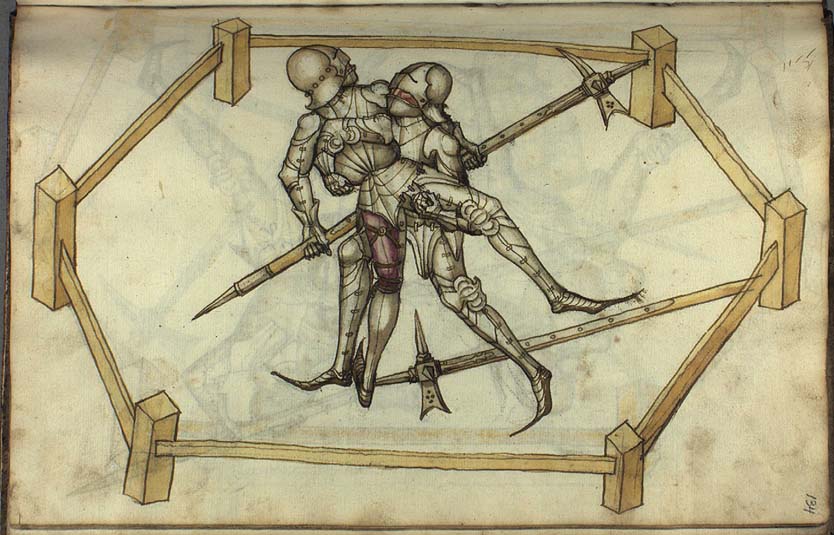
In fact, we have a specific counter to the “collar throw” in Talhoffer 1467 (BSB Cod.icon. 394 a ff. 43v-44r): Here we see the takedown, and here we see the counter. Clearly, the second plate shows a different technique from the one Tobler included. Thus, not only did Tobler extrapolate a technique from a different form, he did so when we already had a perfectly viable pollaxe technique in the canon, making his extrapolation unnecessary.
Second, Tobler demonstrates the technique in a way that suggests he has never actually performed it at full speed against a resisting opponent. The subject in the DVD is barely even unbalanced because Tobler does nothing to break his balance nor to control his motion. Doing this throw correctly requires much better control over your opponent’s arm in order to actually throw him—merely trapping his hand up against your shoulder will not work against a resisting opponent. The best pictorial source for this is in the Goliath Fechtbuch (see MS 2020 fol. 63r) and can be seen here.

As can plainly be seen, the thrower in the picture above has much better control because he is using both hands (although it can be done one-handed) and because he has pulled his opponent’s arm down across his shoulder to break his balance and to create leverage. So Tobler should not have extrapolated this technique from one form to another because a counter to the takedown already exists, but having done so, he should have demonstrated it correctly.
The greatest advantage of a DVD over a book, when it comes to interpreting a martial art, is that the book can never show the flow of a technique nearly as well as a video can. Most books include only a few photographs for each technique, and the reader must connect them in his own brain to understand what the technique should look like. This DVD, however, contains so many errors of execution that they overcome this advantage. The most common problem, and it manifests in almost every technique demonstrated in the video, is one of measure, that is, the distance between the opponents as they perform the technique.
This excerpt from Tobler’s video illuminates the problem very well. Look at the first set of exchanges: The attacker (on the right) strikes well in front of his opponent directly into the defender’s axe. He makes no effort to strike his opponent at all. As a result, the defender does not really have to make any defense whatsoever; he could just as easily step straight forward after his opponent attacks and hit him with no difficulty. Now watch the rest of the clip: This error is not the exception, it is the rule in every single case, and not just in this excerpt, it is the case in almost every demonstration throughout the entire video. If the attacker had struck at the side of his opponent’s head, as he should have, then many of the techniques could not have been performed as shown in the video because the defender would have to first move the attacker’s axe over to the other side of his head. Thus, there are techniques in the video that literally cannot be done against an opponent who strikes correctly.
For example, at the end of the chapter on the Durchwechseln, Tobler says that if we bind we can leave the bind and strike around to the other side in a play reminiscent of Ringeck’s play of the Zucken (“twitching”) with the longsword (see 28:07). In effect, you bind, then pull your axe directly back from the bind and strike again immediately on the other side of the enemy’s shaft. As with other techniques in the DVD, this technique is both non-canonical and flawed in execution.
The problem of execution has to do with the afore-mentioned problem of measure: Since the attacker is striking well in front of the defender this seems as though it should work. Against a proper blow aimed correctly at the left side of the defender’s head, however, it will not work. This is because when your opponent tries to strike you in the head his axe head will not be able to move around your axe. When you displace it, his axe will still be to your left. In order to pull back and then strike around to the other side of your opponent’s axe, you must find a way to put his axe on your right side, which cannot be done unless he, too, pulls his axe back, in which case you do not need the technique in the first place—you can just hit him. A video demonstrating why this technique does not work can be seen here.
This failure of measure is indicative of the broader problem with the execution of many of the techniques in the video: It is apparent from the way many of the techniques are executed that Tobler and his students have not practiced these techniques in a full-speed, full-power environment against an opponent who is resisting their efforts. If they had, they would have realized that some of the techniques that Tobler extrapolated from other forms cannot be made to work with pollaxes, and that some of the pollaxe techniques have to be performed somewhat differently from the way they are presented here. Without that sort of experience, gained over years of effort, it is impossible to truly understand this material, and that lack of understanding is patently manifest here.
Finally, we must consider one other area. We have discussed some of the things shown in the DVD, but we must also discuss the things not included in the DVD. Tobler claims to present a complete system of German pollaxe combat, and yet some of the principles and techniques of the art are simply ignored.
One of the defining differences between unarmored and armored combat is that in the former, relatively little force is required to severely wound your opponent with a cutting technique. When striking at an opponent in armor, however, the circumstances are quite different. Armor is highly effective at dispersing the force of a blow, and only a very powerful blow can hope to stun an opponent or smash bones through armor. At the same time, one must bear in mind the unbalanced nature of the pollaxe, which, unlike a sword, has the majority of its mass concentrated in the head. This forward concentration of mass tends to cause powerful pollaxe blows which miss their targets to whip past the center line of the engagement, travelling well out to the side or down to the ground, and leaving the attacker helplessly exposed to a counter strike from his opponent.
The anonymous Burgundian pollaxe manual Le Jeu de La Hache specifically addresses this subject: “Whichever guard you are on, you can try to hit him on the head. Not so that if you should miss your axe passes beyond him, because that would be dangerous” (Le Jeu paragraph 22). Learning to strike with enough power to do your opponent injury while, at the same time, controlling your attack so that if you miss your pollaxe does not swing wildly past him, leaving you exposed, is something that takes a fair bit of time and knowledge to master. It is difficult to understand, then, why a DVD touted as a “complete, 500 year old system of knightly combat” (see the back cover of the DVD case), fails to even mention this subject.
In fact, Tobler discusses very few of the issues relating to attacking an armored man, other than a brief discussion of different ways to strike the face depending upon the position of the visor and a few vague notes about aiming for gaps in the harness. Different targets require different approaches; targets for the thrust must be handled differently according to whether the target is protected by mail or not, and only certain targets (e.g., the head and hands) are ideal for striking blows. Understanding not just how to strike or thrust but where, and how to do so differently according to the nature of the target, are critical elements of any complete system.
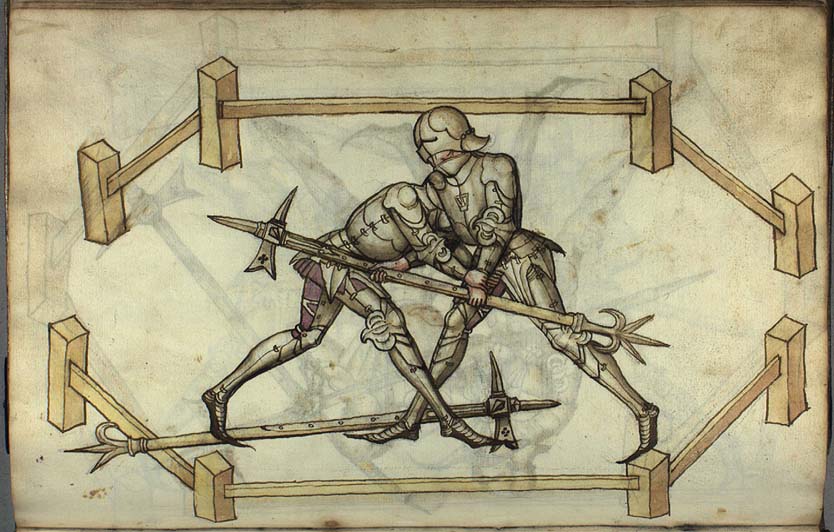
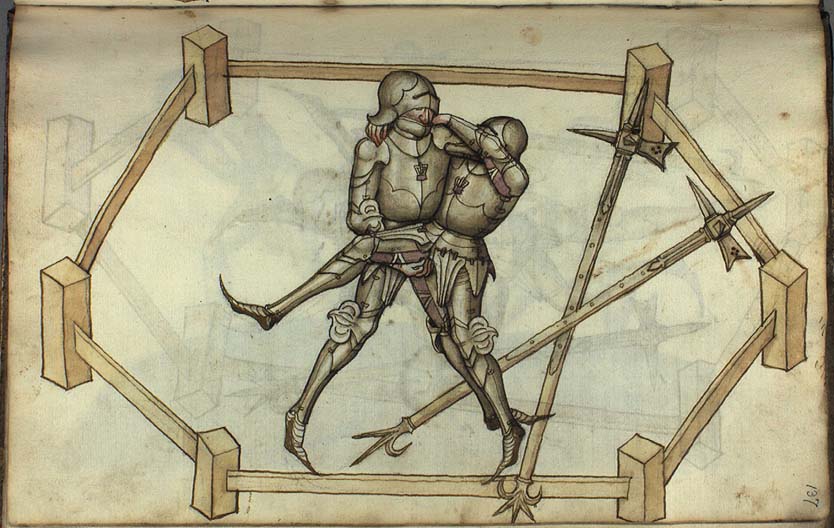
As for missing techniques, consider this technique from Talhoffer 1467 fol. 49r, an excellent and highly effective elbow push from the bind, or this technique from the same source (fol. 51r) which demonstrates a very effective Hinderbinden or “bind behind” counter to an Oberschlag.
By far the largest group of techniques left out of the DVD, however, are the grappling techniques. Grappling was a part of all German forms of combat, but was especially important in armored combat given the effectiveness of the armor against strikes and thrusts. It is confusing, therefore, that Tobler gives us only a few hooks and the collar takedown, leaving out all mention of the many other grappling techniques depicted in the Fechtbücher, such as these: Talhoffer 1467 fol. 45r, Talhoffer 1459 ff. 134r, 135v, and 137r. Surely, a “complete” system of instruction would have addressed these important principles and techniques.
Conclusion:
This DVD is well produced, but contains large numbers of errors in scholarship, execution and omission. As a result, this DVD cannot be recommended for any purpose.
Review by Hugh T. Knight, Jr. Copyright © 2010, all rights reserved. This review may not be copied or presented in any format whatsoever without the author’s express permission.
Thursday, June 17, 2010
An Error In My Longsword Book

I just discovered an error in my longsword book. On page 155, "The Right Abschneiden From Above," in the last paragraph the text says to pull down into a right Unterhengen using a thumb grip. In fact, this should not be a thumb grip and I have never taught it that way; this was probably a matter of getting confused as to which page I was on at the time, and, unfortunately, it slipped through the editing process. I apologize for any confusion this error may have caused.
Friday, April 30, 2010
Are the Gladiatoria MSS Part of the Liechtenauer Canon?
 Some readers of this blog may know of my fascination with the so-called "Gladiatoria" family of Fechtbücher, and one or two may even have read my translation of the Krakow edition. Recently, some excellent work by Dierk Hagedorn of Hammaborg has shed an interesting new light on the relationship between these MSS and the Liechtenauer school.
The issue is whether or not the Gladiatoria MSS are to be considered part of the Liechtenauer canon or their own, unique line.
Christian Tobler was the first to argue that many of the plays shown in Gladiatoria are "boilerplate" techniques that match very closely with ones shown in pure Liechtenauer sources such as Ringeck, von Danzig, etc. I agree with him completely on this issue, and have used this to justify the inclusion of Gladiatoria plays in die Schlachtschule’s purely Liechtenauer curriculum. It's possible, however, that the similarity of material was merely an example of parallel evolution; after all, while there are strong similarities, there are also plays that are very different from any shown in any Liechtenauer source (e.g., unscrewing your pommel and throwing it). I, personally, believe these different techniques simply reflect the fact that the Gladiatoria material is much, much more extensive when it comes to Harnischfechten than are other sources; in other words, we might consider the Gladiatoria Fechtbücher to be advanced texts on the subject, so it’s only natural that they should contain material not seen in the other sources.
Dierk Hagedorn has contributed a transcription of one of the more unusual Gladiatoria sources, Cod. Guelf. 78.2 Aug. 2. from the Herzog August Bibliothek—the so-called Wolfenbuettel Fechtbuch. This is an unusual manuscript in that it contains drawings of a wide variety of unarmored forms together with a selection of plates matching the regular Gladiatoria MSS and then a wide variety of war machine drawings (like those seen in Talhoffer 1459); it must be considered an outlier in the Gladiatoria family because of the “extras” it includes. The transcription can be seen here:
http://www.hammaborg.de/en/transkriptionen/gladiatoria_wolfenbuettel/start.php
Looking at Hagedorn’s transcription, we can see that the first two pages show a version of Liechtenauer’s standard Merkeverse. While it is possible that this material was included merely because the author wished to be associated with the famous Liechtenauer line (a claim that could be made for Talhoffer as well, who did the same thing in his 1459 Fechtbuch), it nevertheless does add to the likelihood that the Gladiatoria material belongs within the Liechtenauer canon proper, a contention with which I strongly agree.
Tuesday, March 30, 2010
A Review of "In Saint George's Name" by Christian Henry Tobler
A BOOK REVIEW OF:
IN SAINT GEORGE’S NAME: AN ANTHOLOGY OF MEDIEVAL GERMAN MARTIAL ARTS
BY CHRISTIAN HENRY TOBLER, FREELANCE ACADEMY PRESS, 2010
Review by Hugh T. Knight, Jr.
Overall, this is an excellent book. In Saint George’s Name is, as the subtitle proclaims, an anthology. Excluding the introduction, preface, etc., the book consists of nine sections or chapters, each dealing with an unrelated essay or translation or set of technique interpretations. It concludes with a glossary of German terms which includes a pronunciation guide. This review will address each chapter in turn.
The Book Itself
The book appears well produced and serviceable. It is perfect bound, is properly and cleanly executed, and the cover seems durable. The coloration and printing of the front and back covers is clear and vibrant, with no smudges or print misalignments. The cover is in full color and the interior is in black and white; the book is approximately 6.9 x 9.9 inches in size. The text, which consists of 207 pages, appears clean and properly printed; there are no crooked, folded, or otherwise misprinted pages. The photographs are clear and of a good size.
Chickens and Eggs: Which Master Came First?
The first chapter of the book is an essay which discusses the extent of our knowledge regarding the dating and authorship of several Fechtbücher. In it, Tobler points out that we can be sure of very few facts about either subject. Some few Fechtbücher contained precise information regarding dates and authorship, but most did not, and the common assumptions made by modern scholars about those that did not are based on very little hard data.
Tobler makes all of this clear and attempts to roughly date some of the sources (his argument about the MS attributed to Ringeck is especially interesting), however, his main point is that many Fechtbücher were compilations and that even when an author is associated with one section, it is a mistake to assume that author had anything to do with other parts of the MS or that the date of one section necessarily corresponds to any of the others.
Master Peter Falkner’s Dagger
In this section, Tobler gives us his interpretation of some (he states it is approximately half, p. 11) of the dagger plays from Peter Falkner’s Fechtbuch.
Tobler’s introduction begins with a very interesting insight into dagger combat: He breaks all dagger fighting into four different classifications, viz. left handed displacements, one-handed dagger displacements, two-handed upper and lower shields, and unarmed displacements.
Tobler then goes on to discuss dagger guards. Unfortunately, he chose to use the “guards” depicted in Hans Talhoffer’s 1449 Ambraser Codex as the exemplar for his guards. In that work, Talhoffer depicts four figures about to thrust with daggers. In one figure the text does mention a guard: “Here he stands in the lower guard with the third stab” (Knight 2008* p. 90), but the other captions make it clear they refer to attacks, not to guards. For example, the first says: “Here is the thrust from above which is also the first thrust” (Knight 2008 p. 88). It seems clear that these four figures, then, represent not guards, but four different attacks. This makes sense, since it would be foolish in the extreme to have a separate guard for each thrust; such a system would instantly alert one’s opponent to the attack about to be made. Guards need to be more neutral—places from which multiple attacks can be launched without telegraphing the nature of the attack in advance. We can infer from the third figure that there is at least one guard—a lower one—which suggests there might be an upper one as well, but if so we are not shown such a guard. Moreover, even the lower guard is not shown clearly; note that the text says he is performing the third stab from the lower guard, not the starting position of the guard itself.
Tobler next discusses the simple attacks of the dagger, basing these upon the four figures in the Ambraser Codex discussed above. These figures, he says, give us four thrusts: One from above with a reversed grip, a backhanded thrust with a reversed grip, a thrust from below with a natural grip, and a two-handed thrust from above intended for armored combat (which, while depicted in several sources, is never shown being actually used, as Tobler points out).
Tobler does not discuss the so-called “French Thrust” performed from above using a natural grip shown, for example, in Codex Wallerstein (see Codex Wallerstein fol. 28v), however, it may well be that that thrust is not mentioned in Falkner, and so was left out of this work. Tobler also fails to mention cuts with the dagger such as those seen in Paulus Kal’s Fechtbuch (see Kal ff. 75v-76r) and in Talhoffer’s 1467 Fechtbuch (see Talhoffer 1467 fol. 87v), but, again, it is to be presumed he left them out because none are mentioned in Falkner.
Next, Tobler gives his technique interpretations, giving examples of techniques from each of the four categories discussed above. Rather than including a series of photographs showing each step of the technique, he instead gives us a copy of the appropriate plate from Falkner’s Fechtbuch to illustrate the technique along with a detailed verbal description of his interpretation of how the technique should be performed. Unfortunately, Tobler does not give us Falkner’s actual text accompanying the techniques. As a result, we are unable to evaluate the accuracy of Tobler’s interpretations, which reduces the value of this section significantly. To be fair, however, Tobler indicates in his introduction that this section of his book represents what he calls “class notes,” and thus may not be as developed as he might have wished. He intends to publish a facsimile and translation of Falkner’s entire book at a later time, so we should be able to analyze this material more fully then.
“Lance, Spear, Sword, and Messer”
This section of the book was a significant disappointment. In it, Tobler attempts to argue that students of the Kunst des Fechtens should study more than just one form of combat (e.g., not just longsword or grappling) in order to see how they all fit together under the framework of a single set of basic principles which will, in turn, help to make those basic principles clear. This is perfectly valid, and needs to be understood by more people. He then gives a brief description of several weapon forms, with a very brief discussion of their similarities and differences.
Tobler then proceeds to argue that not only do the basic principles of Liechtenauer’s art apply to all forms, but that techniques can be extrapolated from one form to another. To illustrate his point, Tobler gives us examples of two extended (meaning several actions that develop from a starting technique) techniques with the longsword, and he then shows how to do the same (or almost the same) series of techniques with other weapons. Each example is accompanied by several photographs showing modern interpreters demonstrating the techniques. This is problematic, however, because it amounts to creating techniques that we have no evidence belonged to the Liechtenauer canon.
IN SAINT GEORGE’S NAME: AN ANTHOLOGY OF MEDIEVAL GERMAN MARTIAL ARTS
BY CHRISTIAN HENRY TOBLER, FREELANCE ACADEMY PRESS, 2010
Review by Hugh T. Knight, Jr.
Overall, this is an excellent book. In Saint George’s Name is, as the subtitle proclaims, an anthology. Excluding the introduction, preface, etc., the book consists of nine sections or chapters, each dealing with an unrelated essay or translation or set of technique interpretations. It concludes with a glossary of German terms which includes a pronunciation guide. This review will address each chapter in turn.
The Book Itself
The book appears well produced and serviceable. It is perfect bound, is properly and cleanly executed, and the cover seems durable. The coloration and printing of the front and back covers is clear and vibrant, with no smudges or print misalignments. The cover is in full color and the interior is in black and white; the book is approximately 6.9 x 9.9 inches in size. The text, which consists of 207 pages, appears clean and properly printed; there are no crooked, folded, or otherwise misprinted pages. The photographs are clear and of a good size.
Chickens and Eggs: Which Master Came First?
The first chapter of the book is an essay which discusses the extent of our knowledge regarding the dating and authorship of several Fechtbücher. In it, Tobler points out that we can be sure of very few facts about either subject. Some few Fechtbücher contained precise information regarding dates and authorship, but most did not, and the common assumptions made by modern scholars about those that did not are based on very little hard data.
Tobler makes all of this clear and attempts to roughly date some of the sources (his argument about the MS attributed to Ringeck is especially interesting), however, his main point is that many Fechtbücher were compilations and that even when an author is associated with one section, it is a mistake to assume that author had anything to do with other parts of the MS or that the date of one section necessarily corresponds to any of the others.
Master Peter Falkner’s Dagger
In this section, Tobler gives us his interpretation of some (he states it is approximately half, p. 11) of the dagger plays from Peter Falkner’s Fechtbuch.
Tobler’s introduction begins with a very interesting insight into dagger combat: He breaks all dagger fighting into four different classifications, viz. left handed displacements, one-handed dagger displacements, two-handed upper and lower shields, and unarmed displacements.
Tobler then goes on to discuss dagger guards. Unfortunately, he chose to use the “guards” depicted in Hans Talhoffer’s 1449 Ambraser Codex as the exemplar for his guards. In that work, Talhoffer depicts four figures about to thrust with daggers. In one figure the text does mention a guard: “Here he stands in the lower guard with the third stab” (Knight 2008* p. 90), but the other captions make it clear they refer to attacks, not to guards. For example, the first says: “Here is the thrust from above which is also the first thrust” (Knight 2008 p. 88). It seems clear that these four figures, then, represent not guards, but four different attacks. This makes sense, since it would be foolish in the extreme to have a separate guard for each thrust; such a system would instantly alert one’s opponent to the attack about to be made. Guards need to be more neutral—places from which multiple attacks can be launched without telegraphing the nature of the attack in advance. We can infer from the third figure that there is at least one guard—a lower one—which suggests there might be an upper one as well, but if so we are not shown such a guard. Moreover, even the lower guard is not shown clearly; note that the text says he is performing the third stab from the lower guard, not the starting position of the guard itself.
Tobler next discusses the simple attacks of the dagger, basing these upon the four figures in the Ambraser Codex discussed above. These figures, he says, give us four thrusts: One from above with a reversed grip, a backhanded thrust with a reversed grip, a thrust from below with a natural grip, and a two-handed thrust from above intended for armored combat (which, while depicted in several sources, is never shown being actually used, as Tobler points out).
Tobler does not discuss the so-called “French Thrust” performed from above using a natural grip shown, for example, in Codex Wallerstein (see Codex Wallerstein fol. 28v), however, it may well be that that thrust is not mentioned in Falkner, and so was left out of this work. Tobler also fails to mention cuts with the dagger such as those seen in Paulus Kal’s Fechtbuch (see Kal ff. 75v-76r) and in Talhoffer’s 1467 Fechtbuch (see Talhoffer 1467 fol. 87v), but, again, it is to be presumed he left them out because none are mentioned in Falkner.
Next, Tobler gives his technique interpretations, giving examples of techniques from each of the four categories discussed above. Rather than including a series of photographs showing each step of the technique, he instead gives us a copy of the appropriate plate from Falkner’s Fechtbuch to illustrate the technique along with a detailed verbal description of his interpretation of how the technique should be performed. Unfortunately, Tobler does not give us Falkner’s actual text accompanying the techniques. As a result, we are unable to evaluate the accuracy of Tobler’s interpretations, which reduces the value of this section significantly. To be fair, however, Tobler indicates in his introduction that this section of his book represents what he calls “class notes,” and thus may not be as developed as he might have wished. He intends to publish a facsimile and translation of Falkner’s entire book at a later time, so we should be able to analyze this material more fully then.
“Lance, Spear, Sword, and Messer”
This section of the book was a significant disappointment. In it, Tobler attempts to argue that students of the Kunst des Fechtens should study more than just one form of combat (e.g., not just longsword or grappling) in order to see how they all fit together under the framework of a single set of basic principles which will, in turn, help to make those basic principles clear. This is perfectly valid, and needs to be understood by more people. He then gives a brief description of several weapon forms, with a very brief discussion of their similarities and differences.
Tobler then proceeds to argue that not only do the basic principles of Liechtenauer’s art apply to all forms, but that techniques can be extrapolated from one form to another. To illustrate his point, Tobler gives us examples of two extended (meaning several actions that develop from a starting technique) techniques with the longsword, and he then shows how to do the same (or almost the same) series of techniques with other weapons. Each example is accompanied by several photographs showing modern interpreters demonstrating the techniques. This is problematic, however, because it amounts to creating techniques that we have no evidence belonged to the Liechtenauer canon.
It might be argued that if a technique works with one form it can certainly be done with another, and, indeed, we see some of this in the extant material. Some of Lignitzer’s plays of the buckler, for example, closely resemble some of Liechtenauer’s longsword plays, suitably modified, of course, for use with an arming sword and buckler. Such an argument, however, must needs take into account the words “suitably modified” because most techniques do not transfer directly without some modification to allow for the differences in weapons. The problem with that lies in the fact that when we, as modern interpreters, convert techniques from one form to another we are necessarily doing so without knowing how the original masters would have done so. It is possible we might come up with a conversion with which Liechtenauer would have agreed, but we cannot know that for sure. If we had to make such conversions in order to survive fights today that might be reasonable, but we do not. We should be studying historical martial arts, without adding anything to them, not developing a new art by adding our own techniques, regardless of whether we believe those technique to be accurately extrapolated from primary sources.
An example of this problem can be seen when Tobler shows the play of the Zornhau Ort with the short spear (pp. 29-31). In that case, Tobler opens the engagement by having the attacker execute a strike (i.e., a blow, not a thrust) with the blade end of a spear, which the defender then displaces with an overhand blow from his own spear followed by a thrust, and the play continues as with the Zornhau Ort with the longsword. Unfortunately, there do not appear to be any plays in any of the German sources that indicate a striking blow done with the head of a spear (or, if there are, Tobler did not document them here). One probable reason for this is that most medieval spears were tapered from the butt to the head in order to prevent them from being tip heavy once the steel spearhead was attached. This taper renders the front end of the spear relatively fragile and unsuitable for striking. Thus, it seems this extrapolation is invalid until and unless someone publishes documentation from a Fechtbuch showing a blow from the head of a short spear, and, even then, it would be necessary to document using the Zornhau Ort with that weapon.
One confusing (albeit minor) point of nomenclature: Tobler refers to the above mentioned thrust into Long Point after the initial bind as a Zornort, yet in Ringeck’s Fechtbuch it is called a Zornhau Ort: “Wer dir ober hawet, zorn haw ort im dröwet” (Ringeck fol. 19r). In the final commentaries on the sword, Ringeck uses the term Zornort specifically to refer to the winding up into the upper hanging (fol. 58r). Likewise, Talhoffer also uses Zornort to refer to the thrust from the Winden, not from Long Point: “Zorn ortt Im dröw” (Talhoffer 1467 fol. 3r), as does Jörg Wilhalm: “Das ist der Zornortt” (CGM 3711 fol. 4v). Thus, it seems the term Zornhau Ort was used in period to refer to the bind and thrust into Long Point, while the Zornort should refer to a thrust from a Winden (or, at least, from an upper hengen done am Schwert) after the bind. It is not clear why Tobler did not follow that nomenclature, however, this is a very minor point.
This chapter of Tobler’s book goes well beyond what we can reasonably accept as valid interpretation. We can examine similar techniques from different weapon forms that we discover in the various Fechtbücher with an appreciative eye, recognizing the brilliance of the concepts underlying our art, but in this reviewer’s opinion, we should not make up such techniques ourselves because doing so defeats the purpose of studying an historical martial art.
The Messerfechten of Master Paulus Kal
This chapter explores five plays of the Messer taken from Paulus Kal’s Fechtbuch. It is laid out in the same way as the chapter on Falkner’s dagger techniques above, with extensive interpretive text by Tobler accompanied by reproductions of the matching plates from the actual Fechtbuch but no modern photographs. While the actual text from Kal is left out, just as in the dagger techniques by Falkner, in this case the Kal Fechtbuch is readily available in translation (by Tobler), making this less problematic. These techniques are relatively clean and straightforward and appear to be very accurate interpretations of Kal’s teachings.
Hot, Wet, Cold, and Dry: The Four Guards
In this chapter, Tobler discusses the guards of the Liechtenauer longsword in terms of their possible relationship to astrological and alchemical superstitions held by medieval men. The scholarship is excellent.
A Late 15th Century German Poleaxe Treatise
In this chapter, Tobler translates and interprets several plays of the pollaxe taken from a version of Paulus Kal’s Fechtbuch held in the Kunsthistorisches Museum in Vienna. These techniques are very important because they have not been published prior to this. There are seven techniques listed, and they consist only of text, with no associated drawings.
Tobler presents each technique in turn, giving first a transcription of the original German text, then a translation into English, then a detailed explanation of his interpretation of the technique. In addition, he includes several photographs showing the technique being demonstrated by interpreters in full harness—a nice touch.
This chapter is very well done. The material is laid out both clearly and completely, and the photographs do a good job of demonstrating Tobler’s interpretations. This is, without doubt, one of the most important sections of the book, and it is pleasing to see that here Tobler has given us enough information to realistically analyze the accuracy of his interpretations.
Master Paulus Kal’s Four Hip Wrestlings
This chapter gives us Tobler’s interpretation of the four wrestlings at the hip from Paulus Kal’s Fechtbuch. It follows exactly the same format as the chapters on Falkner’s dagger and Kal’s Messer discussed above, with Tobler’s interpretations written out and supplemented by plates from Kal’s Fechtbuch. As with the other examples mentioned, the original text is not included, nor are there any photographs of modern interpreters.
The Von Danzig Fechtbuch
The last chapter of the book is also the largest, representing more than half the length of the book. It consists of a complete translation of the so-called von Danzig Fechtbuch (Cod. 44 A 8) preceded by a brief chapter of introduction. One gets the impression that the purpose of the book was really to present this translation, but that the author felt it was too short to justify being published on its own, and that the other material was included to round out the size of the book and to present other materials that were also too short to publish on their own (not that there is anything wrong with that). Regardless, this section of the book is worth the entire price of the book, and would have been had the book cost the same amount with nothing else included.
Whatever one may think of Tobler’s interpretations, it must be agreed that his skills at translation are superb, and this chapter proves that beyond any doubt. He manages to present a translation which is accurate and yet which, at the same time, flows well in English without the clumsiness some translators demonstrate. Moreover, in this present work he demonstrates that his skills in this area have, if anything, improved since his previous works were published.
For a student of Liechtenauer’s art, the von Danzig Fechtbuch is one of the most important sources available, both in terms of breadth and completeness. In spite of this, much of the book has never before been published in English, and it was well worth the wait. Tobler’s work here should serve to inspire a tremendous amount of discussion and, probably, re-evaluation among scholars of the art.
Conclusion
Christian Tobler has given us yet another excellent resource for the study of the Kunst des Fechtens. In Saint George’s Name is well produced, reasonably priced, and contains a treasure trove of important information. While some of the arguments expressed in certain chapters may be questioned, the majority of the work is superb. This book is a “must have” for any serious student of Liechtenauer’s art.
*Knight, H., The Ambraser Codex by Master Hans Talhoffer: A Fifteenth-Century Fight Book, Lulu.com, 2008 http://stores.lulu.com/hughknight
Review by Hugh T. Knight, Jr. Copyright © 2010, all rights reserved. It may not be copied or presented in any format whatsoever without the author’s express permission.
Friday, January 15, 2010
A New Book About the German Longsword

I am very pleased to announce the publication of the fourth book in the die Schlachtschule unarmored combat series entitled The Knightly Art of the Longsword by Hugh T. Knight, Jr.
Johannes Liechtenauer, the father of German martial arts, created a system of combat that was second to none in all of history. Later authors wrote books detailing his art, some for earnest combat and others for a sportive version, that have survived to the present day. This book attempts to draw together the writings of various masters of Liechtenauer’s school into a single, comprehensive source detailing the art of fighting in earnest. Not limited to a single author, nor to just the basics of the art, this book attempts to show the full range of Liechtenauer’s art without mixing in any of the more sportive sources from later authors. In addition to the techniques themselves, The Knightly Art of the Longsword includes information on strategic concepts, fundamentals, equipment, finding a school, training, and even how to teach the art. It also includes several carefully documented essays on medieval swordsmanship and how to practice it, along with a complete glossary of German technical terms relating to the longsword and a full bibliography. It is available in both a perfect-bound edition and a spiral-bound edition designed to lay flat and open for use at practices.
This book will be of interest to anyone with an interest in knighthood, medieval combat, history or martial arts in general. Whether you are new to the study of medieval combat or have extensive experience in the art, this fully documented and lavishly illustrated book with more than 340 pages and 600 photographs will be a useful and fascinating addition to your library.
The Knightly Art of the Longsword has been published through Lulu.com and is only available for internet purchase at this time:
http://stores.lulu.com/store.php?fAcctID=906667
The author is the founder and head instructor of die Schlachtschule: The School of Battle, a school located in southern California and dedicated to rediscovering and practicing the knightly arts of combat from medieval Germany. He has more than 30 years of martial experience ranging from traditional Japanese sword and grappling arts to over ten years of German martial arts practice. He founded die Schlachtschule in 2003 and teaches a curriculum that includes sword, spear, pollaxe, grappling and dagger combat both in and out of armor. More information can be found on the school’s web site:
http://www.schlachtschule.org/
Johannes Liechtenauer, the father of German martial arts, created a system of combat that was second to none in all of history. Later authors wrote books detailing his art, some for earnest combat and others for a sportive version, that have survived to the present day. This book attempts to draw together the writings of various masters of Liechtenauer’s school into a single, comprehensive source detailing the art of fighting in earnest. Not limited to a single author, nor to just the basics of the art, this book attempts to show the full range of Liechtenauer’s art without mixing in any of the more sportive sources from later authors. In addition to the techniques themselves, The Knightly Art of the Longsword includes information on strategic concepts, fundamentals, equipment, finding a school, training, and even how to teach the art. It also includes several carefully documented essays on medieval swordsmanship and how to practice it, along with a complete glossary of German technical terms relating to the longsword and a full bibliography. It is available in both a perfect-bound edition and a spiral-bound edition designed to lay flat and open for use at practices.
This book will be of interest to anyone with an interest in knighthood, medieval combat, history or martial arts in general. Whether you are new to the study of medieval combat or have extensive experience in the art, this fully documented and lavishly illustrated book with more than 340 pages and 600 photographs will be a useful and fascinating addition to your library.
The Knightly Art of the Longsword has been published through Lulu.com and is only available for internet purchase at this time:
http://stores.lulu.com/store.php?fAcctID=906667
The author is the founder and head instructor of die Schlachtschule: The School of Battle, a school located in southern California and dedicated to rediscovering and practicing the knightly arts of combat from medieval Germany. He has more than 30 years of martial experience ranging from traditional Japanese sword and grappling arts to over ten years of German martial arts practice. He founded die Schlachtschule in 2003 and teaches a curriculum that includes sword, spear, pollaxe, grappling and dagger combat both in and out of armor. More information can be found on the school’s web site:
http://www.schlachtschule.org/
Friday, October 16, 2009
Misguided Terminology
 To quote a great scholar and patriot who is a hero of mine, “I’ve had alls I can stand, and I can’t stands no more!” Well, me too: There are just so many mistakes in common usage among students of medieval combat that I, too, have had all I can stand, and I can stand no more; it is time for some corrections.
First, there is no such thing as “chainmail.” None. That term was coined by misguided Victorian antiquarians because of a complete misunderstanding of medieval artistic conventions. When they looked at depictions of mail in medieval artwork they found several different ways of representing it, and because of ignorance and a too-credulous belief in the accuracy of artistic representation (a lesson that should be taken to heart by all students of WMA!), they believed each style of representation was literally accurate and represented a different type of defense: chainmail, banded mail, etc. In reality, different artists simply had different ways of depicting mail, and there is only one form (in Europe; the Japanese had a different style) of mail. There was such a thing as “double mail,” but that term refers to mail of a normal construction but with thicker rings intended to reinforce specific parts of a hauberk. The word “mail” comes from the Latin word for “mesh.”
I should not even have to say it, but the term “plate mail” is also completely meaningless. That term was invented by the makers of a particularly unfortunate role-playing game that has inculcated a large number of children with an incredible amount of ridiculously inaccurate information about medieval combat. The use of this term smacks of an adult living in his mother’s basement.
Further on that line, the word “maille” should never be used in modern sources. Granted, the word was spelled that way in medieval books, but it was a *misspelling* then. This smacks of the abomination “Ye Olde Shoppe” which is *never* correct, and, in fact, has never *been* correct—the “Y” is a poor attempt to capture the “thorn” diphthong symbol often used in Middle English, and we have long since abandoned the extra Es used in suffixes. I have even occasionally seen—heaven forefend—“chainmaille,” a mixed-message abomination I hope to never see again.
Simple shoulder armor is called a “spaudler,” not “spaulder.” Spaudlers are not pauldrons, and the terms are not interchangeable.
When speaking of the typical articulated arm defense of the 14th and 15th centuries, the term “vambrace” should be used to refer to the entire arm harness proper, not to the portion covering the forearm only. These vambraces consisted of the lower cannon (which protected the forearm), the couter (which protected the elbow), and the upper cannon (which protected the upper arm).
The garment worn under armor is referred to by different terms depending on the type of harness worn over it. The knee-length, (often) long-sleeved, padded garment worn under the great hauberks of the 13th century was called an “aketon” (from the Arabic word for cotton), *not* a gambeson. Gambesons were quilted garments, often of rich fabric, worn *over* or in lieu of mail in that period (many of these can be seen in the Mac bible). The best term for the fitted, usually unpadded, garments worn under the tight-fitting plate armor of the later Middle Ages is “arming doublet.” While not universal, the term doublet was most often used in the sources I have seen, and is used in the document “How A Man Shall Be Armed to Fight on Foot” (Hastings MS. [f.122b]). So please, let us not see the term “gambeson” misused any longer.
“Sparring” is a term reserved for pugilism; it has no meaning when applied to free-play bouting with swords. And free-play bouting with swords has no place in what we do, so I do not understand why it keeps coming up.
The term “broadsword” is somewhat problematic. It should *never* be used to refer to the one-handed swords of the middle ages, still less to bastard swords or longswords or swords of war. The term was frequently used to refer to the late-period basket-hilted English sword (often considered Scottish today, but I assure you, the Scots got it from the English) characterized by a double-edged, pointed blade of the sort George Silver referred to as a “short sword.” I, myself, use the term broadsword for this weapon in order to clearly distinguish between it and the backsword, an almost identical weapon with only one sharp edge which Silver includes in the term “short sword.” I do not use the term short sword because it was also used in the High Middle Ages to refer to arming swords, and I wish to avoid confusion between this earlier meaning and Silver’s usage.
Next, the term Fechtmeister: A Fechtmeister is a teacher of medieval combat, not an all-powerful being with 50 years of experience in the art and the ability to leap tall list fences in a single bound who has killed fifty men in *real* fights. Anyone who teaches WMA should call himself a Fechtmeister, just as anyone in the middle ages who taught dancing would call himself a “dance master.” The word master, itself, has come to have far too exalted a meaning in this day and age, causing people to shy away from it. Consider the Krumphau text in Ringeck: He tells us that to “weaken a master” we should strike his flat with the Krumphau (fol. 25v). Can he really mean this technique should only be used against the top experts in the art? Or is he simply using the term to refer to a skilled, well-trained student? The latter is far more likely. Please, avoid the chest-thumping false modesty of decrying the use of accurate medieval terminology; most who do it only do so as a way to put down those whom they dislike, and they demonstrate gross ignorance when they do so.
Finally, lest it seem I only criticize others, let me share my current shame: When I translated the Gladiatoria Fechtbuch, I translated the word “thartschin” or “tartschin” (spelled various ways in the MS) as “ecranche.” This term refers to a small shield used in jousting with a small corner cut out (called the “bouche” in French) to make room for the lance. A literal translation of the word would have been “target,” but that term is often used to refer to a small round shield today, and since most modern authorities I had read used the term ecranche for this kind of shield, I followed their lead. A friend of mine, Will McClean, who is one of the premier experts in the field of medieval deeds of arms, pointed out that the term ecranche is a very modern one, and that the word target was used in period. I should have used the word target, and will do so when I make an updated edition of my book.
Subscribe to:
Posts (Atom)